Butterfly wing macro detail
1344×768 · AVIF · CC BY 4.0
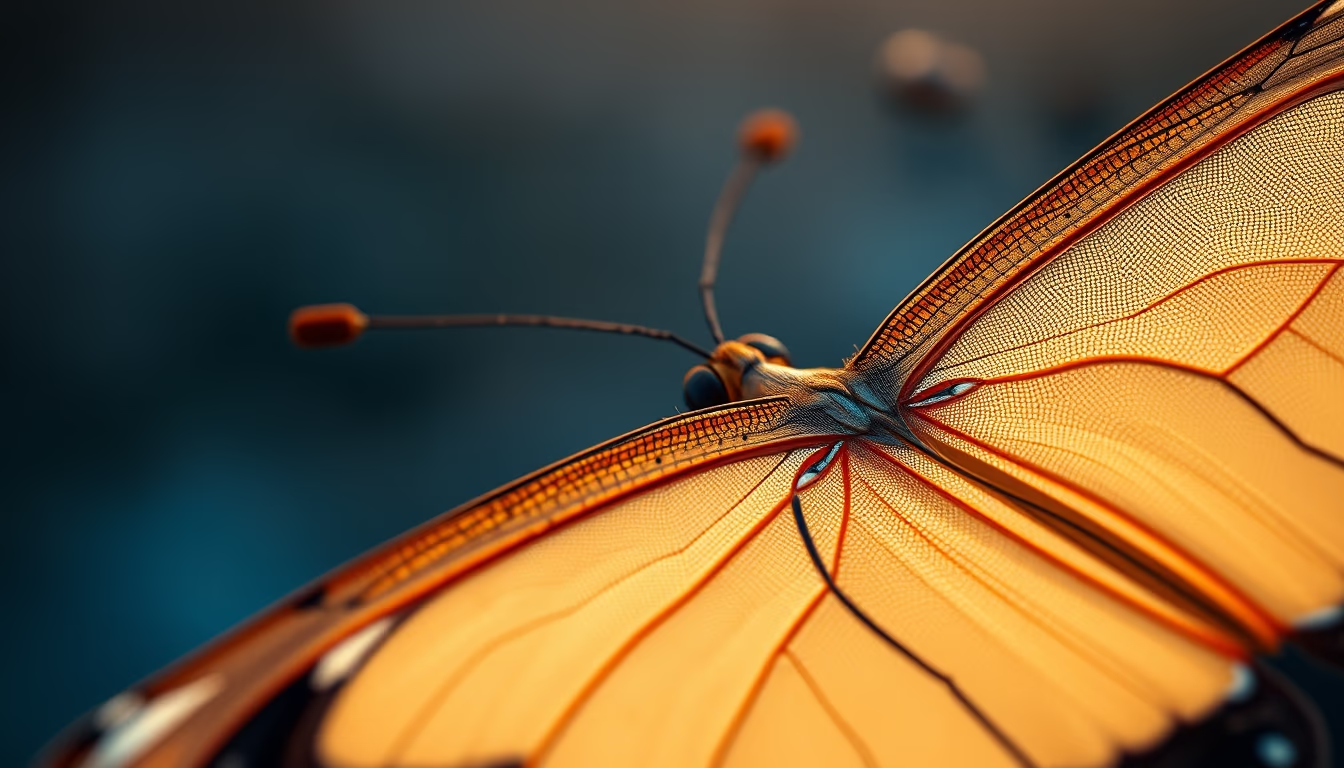
A butterfly wing reveals a universe of overlapping scales that create vibrant colors through light interference, without pigments.
About this subject
Butterfly wings are covered with thousands of tiny scales made of chitin, overlapping like roof tiles. These scales are responsible for the colors and patterns we observe. Unlike common belief, most colors come not from pigments but from optical phenomena: the microstructure of the scales reflects light at specific wavelengths, creating metallic and iridescent hues. This process is called structural coloration.
In the Amazon rainforest of Brazil, species like Morpho menelaus showcase striking blue wings through this effect. The scales have layers that interfere with light, and any change in viewing angle alters the perceived color. Beyond beauty, these colors serve vital functions: camouflage, thermoregulation, and mating communication. Some butterflies, such as the genus Doxocopa, display different colors on each side of the wing to hide from predators.
Recent studies published in 2025 show that scales also help repel water and dust, keeping the wing clean. Additionally, scales act as thermal insulators, warming the insect by absorbing solar radiation. Each scale is about 0.1 mm long and may contain internal structures as small as 100 nanometers, a feat of natural engineering that inspires synthetic materials.
Butterfly wings are a subject of biomimetic research, especially for creating optical sensors and non-toxic paints. In 2026, new discoveries about scale evolution are expected to help explain the diversity of patterns among the more than 20,000 described species worldwide. Brazil is one of the countries with the highest richness, with about 3,500 known species.
Frequently Asked Questions
Why are butterfly wings so vibrantly colored?
The vibrant colors come mainly from structural coloration: microscopic structures in the scales reflect light at specific wavelengths, creating metallic and iridescent hues without pigments.
Do butterfly scales regenerate if damaged?
No, scales do not regenerate. If a wing is damaged, the butterfly loses those scales permanently, which is why older butterflies often have worn wings.
What is the largest butterfly in Brazil?
The Morpho cisseis (giant blue morpho) has a wingspan of up to 20 cm. Another giant is the Caligo brasiliensis (owl butterfly), which mimics owl eyes to deter predators.
Direct URL
https://pub-c7d6a6ea828543ac903a74a341ccb2e1.r2.dev/imagens/butterfly-wing-macro-detail-aerial-drone-shot-p2.avifHow to credit
Include a visible link back to UtilizAí. Copy one of the snippets below:
<a href="https://xn--utiliza-eza.com/en/midia/imagens/butterfly-wing-macro-detail-aerial-drone-shot-p2">Butterfly wing macro detail</a> by <a href="https://xn--utiliza-eza.com">UtilizAí</a>, licensed under <a href="https://creativecommons.org/licenses/by/4.0/">CC BY 4.0</a>.
[Butterfly wing macro detail](https://xn--utiliza-eza.com/en/midia/imagens/butterfly-wing-macro-detail-aerial-drone-shot-p2) by [UtilizAí](https://xn--utiliza-eza.com), CC BY 4.0
License: CC-BY-4.0