Vintage typewriter detail
1344×768 · AVIF · CC BY 4.0
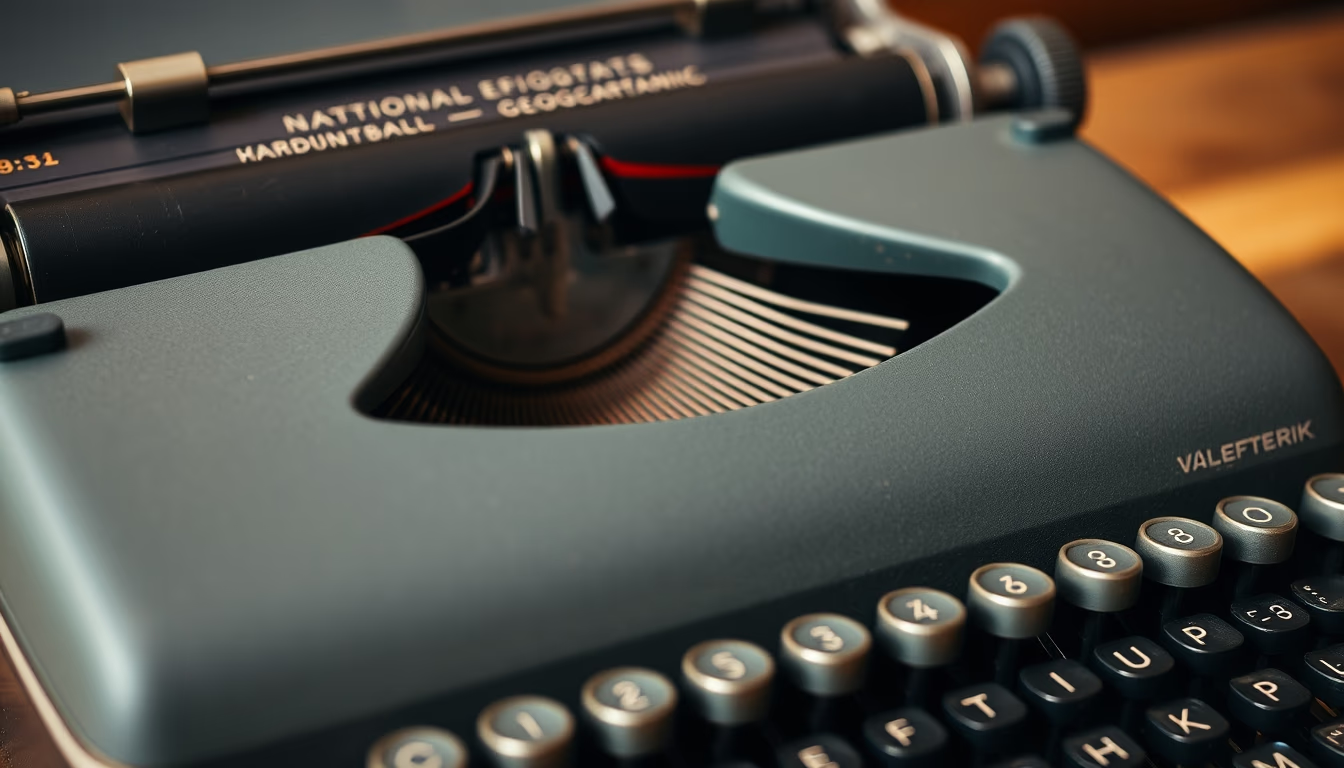
Close-up of a vintage typewriter, featuring metal keys and spools, a symbol of analog communication and the history of writing.
About this subject
Vintage typewriters, such as the one depicted in this detail, revolutionized communication in the late 19th century. Invented by Christopher Sholes in 1868 and marketed by Remington from 1873, the typewriter brought speed to office work and literary production. Its mechanical mechanism, with keys striking metal hammers to imprint letters via an ink ribbon onto paper, represents an engineering milestone predating the digital age. The QWERTY layout, standard on these models, was designed to prevent jamming and persists today on computer keyboards.
Iconic brands like Underwood, Olivetti, and Royal produced renowned models that are now collector's items. The Underwood 5, from 1900, was one of the best-sellers, while the Olivetti Lettera 22, a portable from the 1950s, is admired for its elegant design. These machines not only sped up writing but also democratized text production, enabling broader self-expression. Journalists, writers, and poets adopted them, from Ernest Hemingway to Caetano Veloso, who used one for composing.
Today, vintage typewriters are appreciated as decorative items and art pieces. Their value varies by model, condition, and rarity, sometimes fetching thousands of dollars at auctions. Moreover, the sound of the keys and the steampunk aesthetic inspire artists and filmmakers. The detail shown, with its spools and metal keys, evokes an era when writing was a physical, tactile, and noisy act.
Frequently Asked Questions
How does the mechanism of a vintage typewriter work?
When a key is pressed, a metal hammer with the corresponding character strikes an inked ribbon, transferring ink to the paper. The carriage then moves left automatically to position the next letter. The mechanism is purely mechanical, with no electricity.
Why was the QWERTY layout adopted and still used?
QWERTY was designed to prevent hammers from jamming by spacing out common letter pairs. Despite more efficient alternatives, habit and industrial standardization have kept QWERTY as the global standard.
What is the value of a vintage typewriter today?
Value depends on rarity, condition, brand, and model. Common models may sell for $20 to $100, while rare or pristine examples can exceed $1,000 at specialized auctions.
Direct URL
https://pub-c7d6a6ea828543ac903a74a341ccb2e1.r2.dev/imagens/vintage-typewriter-detail-national-geographic-style-p8.avifHow to credit
Include a visible link back to UtilizAí. Copy one of the snippets below:
<a href="https://xn--utiliza-eza.com/en/midia/imagens/vintage-typewriter-detail-national-geographic-style-p8">Vintage typewriter detail</a> by <a href="https://xn--utiliza-eza.com">UtilizAí</a>, licensed under <a href="https://creativecommons.org/licenses/by/4.0/">CC BY 4.0</a>.
[Vintage typewriter detail](https://xn--utiliza-eza.com/en/midia/imagens/vintage-typewriter-detail-national-geographic-style-p8) by [UtilizAí](https://xn--utiliza-eza.com), CC BY 4.0
License: CC-BY-4.0