Vintage typewriter detail
1344×768 · AVIF · CC BY 4.0
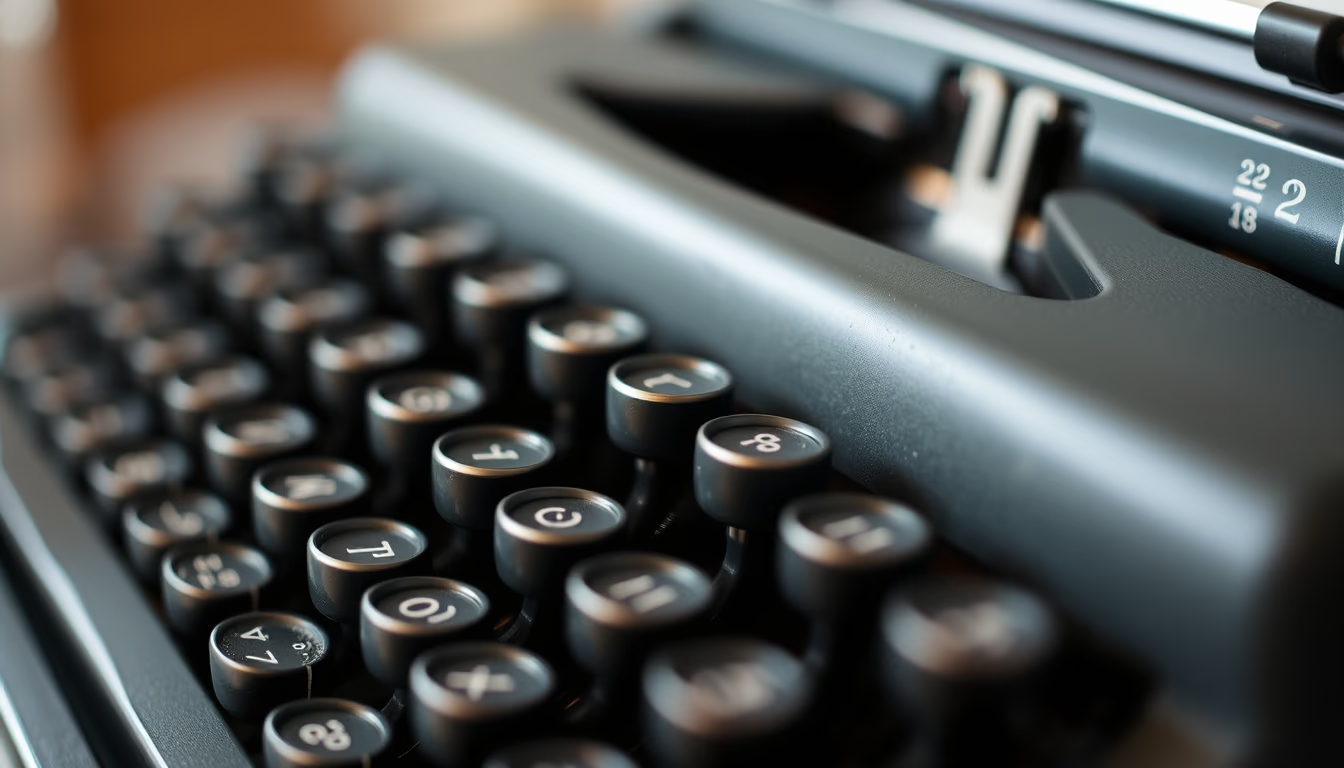
Close-up details of a vintage typewriter, showcasing the mechanical engineering that revolutionized written communication in the 20th century.
About this subject
The typewriter is one of the most iconic devices of the pre-digital era, having transformed personal, commercial, and journalistic writing. The first practical models emerged in the 1870s, with Christopher Latham Sholes' invention culminating in the famous Remington No. 1, released in 1874. The mechanism of levers, springs, and typebars is an example of industrial precision, where each key triggers a hammer that prints a character through an inked ribbon. Mechanical typewriters were widely used until the 1980s, when they were gradually replaced by computers and word processors. In Brazil, factories such as Olivetti (with a plant in São Paulo) produced iconic models like the Olivetti Lettera 32, widely used by writers and journalists. The sound of typing, the key feel, and the finger strength required shaped writing ergonomics. A curiosity: the QWERTY keyboard, designed by Sholes to prevent jamming of levers, remains the standard today, even on digital devices. The macro detail of a key or mechanism reveals the complexity of a system that, for decades, was the world's primary tool for text production.
Frequently Asked Questions
How does the mechanism of a mechanical typewriter work?
Each key is connected to a lever that triggers a hammer bearing the character. This hammer strikes an inked ribbon, transferring ink to the paper. A carriage moves the paper sideways after each character, and line advancement is done manually or via lever.
What was the importance of typewriters in Brazil?
They were essential for offices, newsrooms, and writers. Olivetti, which manufactured in Brazil, supplied popular models like the Lettera 32, used by figures such as Carlos Drummond de Andrade and Clarice Lispector.
Why is the QWERTY keyboard still used today?
The QWERTY layout was designed to prevent the jamming of levers in early typewriters. Over time, it became standard due to habit and familiarity, and was retained in computer and smartphone keyboards for compatibility.
Direct URL
https://pub-c7d6a6ea828543ac903a74a341ccb2e1.r2.dev/imagens/vintage-typewriter-detail-macro-closeup-p2.avifHow to credit
Include a visible link back to UtilizAí. Copy one of the snippets below:
<a href="https://xn--utiliza-eza.com/en/midia/imagens/vintage-typewriter-detail-macro-closeup-p2">Vintage typewriter detail</a> by <a href="https://xn--utiliza-eza.com">UtilizAí</a>, licensed under <a href="https://creativecommons.org/licenses/by/4.0/">CC BY 4.0</a>.
[Vintage typewriter detail](https://xn--utiliza-eza.com/en/midia/imagens/vintage-typewriter-detail-macro-closeup-p2) by [UtilizAí](https://xn--utiliza-eza.com), CC BY 4.0
License: CC-BY-4.0