Warehouse robot agv
1344×768 · AVIF · CC BY 4.0
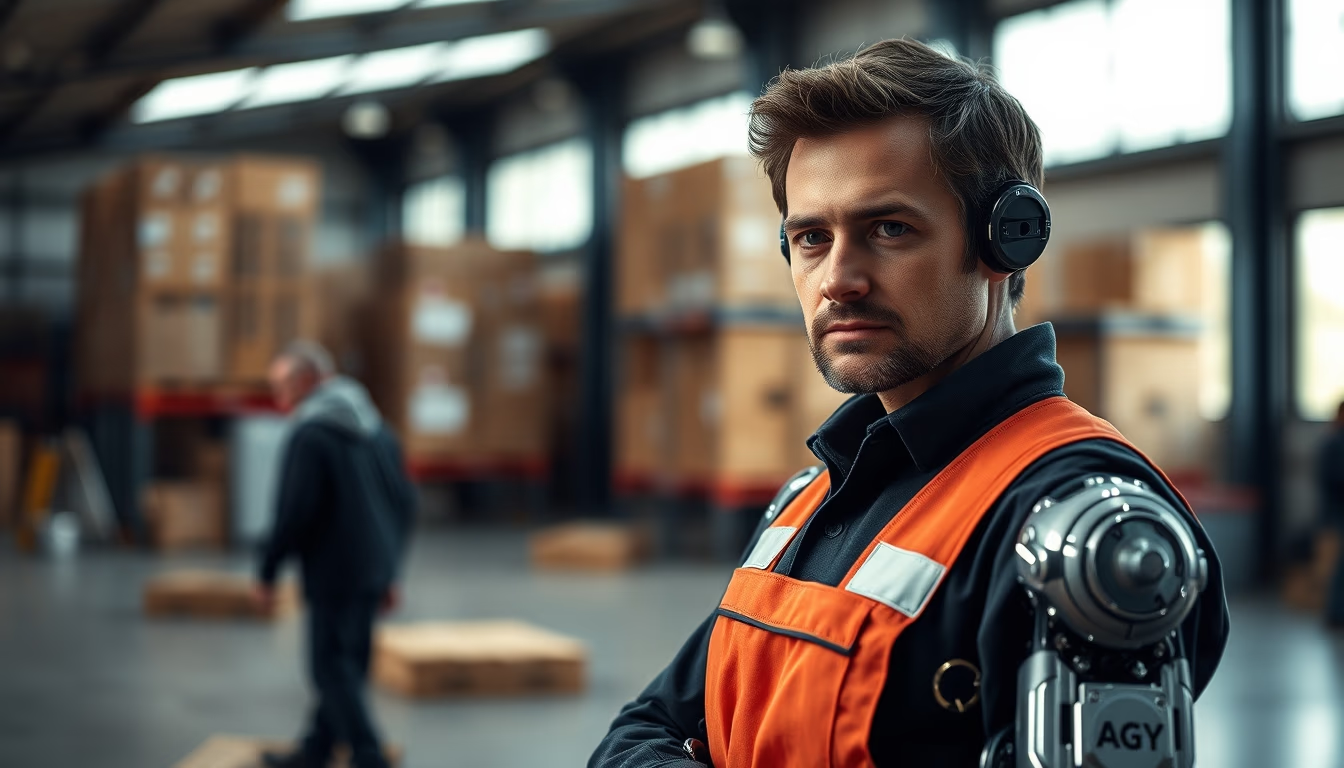
AGVs (Automated Guided Vehicles) are autonomous mobile robots revolutionizing internal logistics in warehouses and factories, transporting loads without human intervention.
About this subject
AGVs (Automated Guided Vehicles) are autonomous mobile robots designed to transport materials in industrial and logistics environments. Unlike conveyors or manual forklifts, they navigate using sensors, lasers, or magnetic guides, following fixed or dynamic routes. Their origin dates back to the 1950s, when the first AGV was developed by Barrett Electronics in the United States, initially towing loads in warehouses. Today, they are key components of Industry 4.0, integrated with warehouse management systems (WMS) and the concept of dark warehouses, fully automated facilities operating with minimal human presence.
In Brazil, AGV adoption grows mainly in e-commerce distribution centers and automotive industries. Major companies like Mercado Livre and Ambev use these robots to optimize order picking and goods movement, reducing errors and boosting productivity. A curiosity: modern AGVs can reach speeds of up to 2 m/s and carry loads over 1 ton. Some models embed artificial intelligence to avoid obstacles and recalculate routes in real time, using technologies like SLAM (Simultaneous Localization and Mapping).
Safety is critical. AGVs have proximity sensors, emergency stops, and audible/visual alarms. In environments shared with humans, they follow standards like ISO 3691-4. Despite benefits, implementation faces challenges: high initial cost (a basic AGV costs between $20,000 and $100,000) and need for adapted infrastructure (level floor, markings). However, return on investment occurs within 1 to 3 years, thanks to accident reduction, lower energy consumption compared to combustion forklifts, and 24/7 operation.
Another relevant aspect is convergence with other technologies. AGVs increasingly integrate with inventory drones, collaborative robots (cobots), and computer vision systems. Companies like the Brazilian Hikrobot (partner of Intelbras) develop national solutions. In the future, AGVs are expected to become fully autonomous, communicating via 5G and managing fleets in the cloud. This evolution promises to transform not only logistics but also warehouse design, with dynamic layouts adjusted by demand.
Frequently Asked Questions
What is the difference between an AGV and an AMR?
AGVs (Automated Guided Vehicles) follow fixed routes defined by tracks or markers. AMRs (Autonomous Mobile Robots) use sensors and AI to navigate freely without external infrastructure, adapting to environmental changes.
How much does an AGV cost?
Prices vary by capacity and technology. Basic models for light loads (up to 200 kg) cost between $20,000 and $60,000. Industrial models for heavy loads can exceed $100,000.
Do AGVs completely replace forklifts?
Not necessarily. AGVs are ideal for repetitive tasks and fixed routes. Conventional forklifts are still needed for non-standard loads, loading/unloading at docks, and complex maneuvers.
Direct URL
https://pub-c7d6a6ea828543ac903a74a341ccb2e1.r2.dev/imagens/warehouse-robot-agv-documentary-photography-p5.avifHow to credit
Include a visible link back to UtilizAí. Copy one of the snippets below:
<a href="https://xn--utiliza-eza.com/en/midia/imagens/warehouse-robot-agv-documentary-photography-p5">Warehouse robot agv</a> by <a href="https://xn--utiliza-eza.com">UtilizAí</a>, licensed under <a href="https://creativecommons.org/licenses/by/4.0/">CC BY 4.0</a>.
[Warehouse robot agv](https://xn--utiliza-eza.com/en/midia/imagens/warehouse-robot-agv-documentary-photography-p5) by [UtilizAí](https://xn--utiliza-eza.com), CC BY 4.0
License: CC-BY-4.0