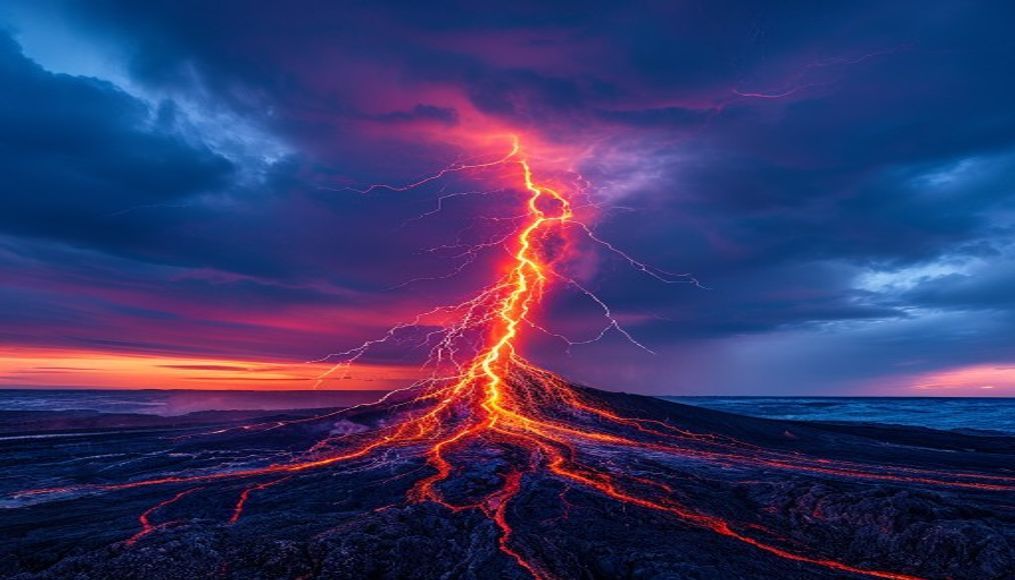
Volcanic lightning ash
1344×768 · AVIF · CC BY 4.0
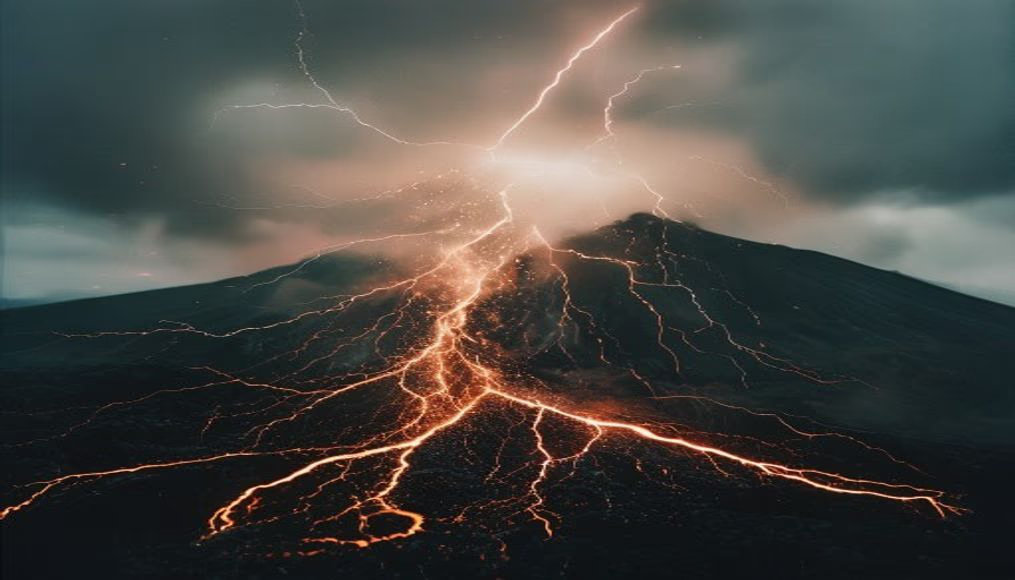
Volcanic lightning, or dirty thunderstorms, are stunning electrical discharges that occur within ash clouds of explosive volcanic eruptions.
About this subject
Volcanic lightning, also known as a dirty thunderstorm, occurs when ash, rock, and ice particles collide within a volcanic plume, generating electrical charges capable of producing lightning. Unlike common lightning in convective storms, these bolts form in extremely dry environments loaded with pyroclastic material. The charge buildup primarily results from triboelectrification, where silica and other mineral fragments rub together and transfer electrons.
Historic eruptions have recorded intense electrical activity, such as Iceland's Eyjafjallajökull in 2010, which paralyzed European air travel, and Taal in 2020 in the Philippines. Scientists use lightning detection networks to monitor eruptions in real time, as lightning often precedes the main explosion. The highest concentration of lightning ever measured in a volcanic plume occurred at Mount Sinabung, Indonesia, in 2019, with over 100,000 discharges in one hour.
Beyond the visual spectacle, volcanic lightning poses hazards to aircraft: ash can melt in jet engines, and the lightning itself can damage electrical systems. Research on this phenomenon also aids in understanding lightning formation on other planets, such as dust storms on Mars and ammonia clouds on Jupiter.
Frequently Asked Questions
What causes volcanic lightning?
Volcanic lightning is generated by the collision and friction of ash, rock, and ice particles inside the volcanic plume. This process, called triboelectrification, separates electrical charges that accumulate until they discharge.
Is volcanic lightning dangerous?
Yes, it poses a hazard to aircraft flying near plumes, as it can damage electrical systems and ash can melt in jet engines. On the ground, the greatest danger is the eruption itself.
Do all volcanoes produce lightning?
No. Only explosive eruptions with ash-rich plumes and pyroclastic material create conditions for lightning. Effusive volcanoes, like those in Hawaii, rarely produce this phenomenon.
Direct URL
https://pub-c7d6a6ea828543ac903a74a341ccb2e1.r2.dev/imagens/volcanic-lightning-ash-film-grain-authentic-p1.avifHow to credit
Include a visible link back to UtilizAí. Copy one of the snippets below:
<a href="https://xn--utiliza-eza.com/en/midia/imagens/volcanic-lightning-ash-film-grain-authentic-p1">Volcanic lightning ash</a> by <a href="https://xn--utiliza-eza.com">UtilizAí</a>, licensed under <a href="https://creativecommons.org/licenses/by/4.0/">CC BY 4.0</a>.
[Volcanic lightning ash](https://xn--utiliza-eza.com/en/midia/imagens/volcanic-lightning-ash-film-grain-authentic-p1) by [UtilizAí](https://xn--utiliza-eza.com), CC BY 4.0
License: CC-BY-4.0