Underwater robot submersible
1344×768 · AVIF · CC BY 4.0
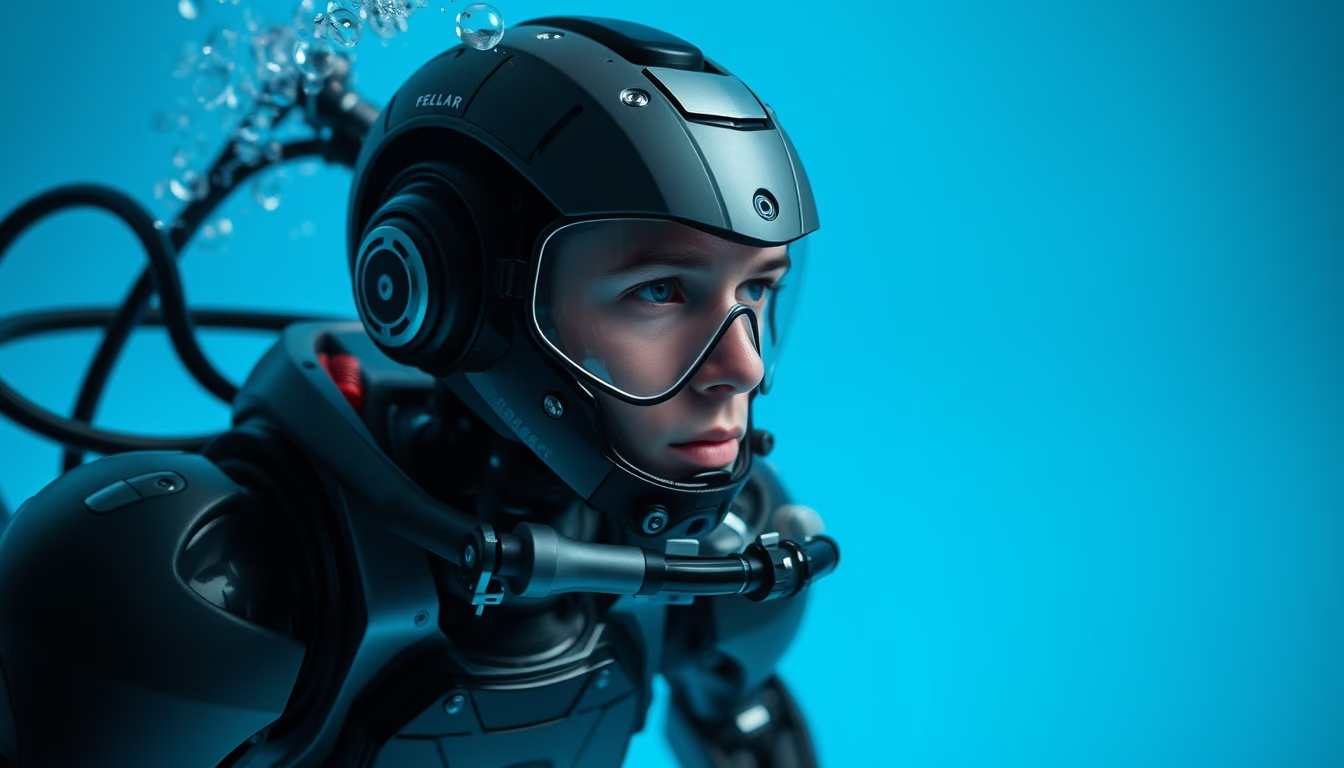
Underwater submersible robot exploring the deep sea: advanced technology for ocean research and underwater infrastructure inspection.
About this subject
Underwater submersible robots are unmanned vehicles designed to operate in aquatic environments, from shallow waters to the deepest ocean trenches. They are mainly divided into two categories: ROVs (Remotely Operated Vehicles), controlled via cables from a surface vessel, and AUVs (Autonomous Underwater Vehicles), which navigate independently following pre-programmed missions. This technology enables tasks impossible or extremely dangerous for human divers, such as exploring the Mariana Trench, which reaches nearly 11,000 meters in depth.
The application of these robots is vast and crucial for various sectors. In the oil and gas industry, they inspect pipelines, platforms, and submarine cables, ensuring safety and operational efficiency. In scientific research, they collect sediment samples, map the ocean floor, and study hydrothermal vent ecosystems, where pressure and darkness are extreme. Notable examples include the ROV Jason, operated by the Woods Hole Oceanographic Institution, and the AUV Sentry, capable of diving to 6,000 meters depth.
In Brazil, the use of underwater submersibles has grown, especially in the context of pre-salt exploration in the Santos Basin. Petrobras employs ROVs for maintenance of subsea equipment at depths exceeding 2,000 meters. Additionally, institutions like the Brazilian Navy and universities develop AUV projects for environmental monitoring and oceanographic research, contributing to knowledge of the Amazon Blue. Technical challenges include limited underwater communication, high-capacity batteries, and resistance to hydrostatic pressure, demanding advanced materials and engineering designs.
Frequently Asked Questions
How deep can an underwater submersible robot go?
The most advanced models, such as the ROV Nereus (which was lost), reached nearly 11,000 meters in the Mariana Trench. Most commercial robots operate between 1,000 and 6,000 meters depth, depending on design and pressure housing.
What is the difference between an ROV and an AUV?
An ROV is controlled via a fiber-optic cable from the surface, allowing real-time telepresence and manipulation. An AUV operates autonomously, following a pre-programmed route, ideal for mapping large areas without constant ship support.
How do underwater robots communicate with the surface?
Underwater communication uses acoustic waves (sonar) because radio waves do not propagate in water. ROVs rely on cables for direct data and power transmission. AUVs store data internally and transfer it after surfacing, via Wi-Fi or satellite.
Direct URL
https://pub-c7d6a6ea828543ac903a74a341ccb2e1.r2.dev/imagens/underwater-robot-submersible-studio-editorial-portrait-p6.avifHow to credit
Include a visible link back to UtilizAí. Copy one of the snippets below:
<a href="https://xn--utiliza-eza.com/en/midia/imagens/underwater-robot-submersible-studio-editorial-portrait-p6">Underwater robot submersible</a> by <a href="https://xn--utiliza-eza.com">UtilizAí</a>, licensed under <a href="https://creativecommons.org/licenses/by/4.0/">CC BY 4.0</a>.
[Underwater robot submersible](https://xn--utiliza-eza.com/en/midia/imagens/underwater-robot-submersible-studio-editorial-portrait-p6) by [UtilizAí](https://xn--utiliza-eza.com), CC BY 4.0
License: CC-BY-4.0