Underwater robot submersible
1344×768 · AVIF · CC BY 4.0
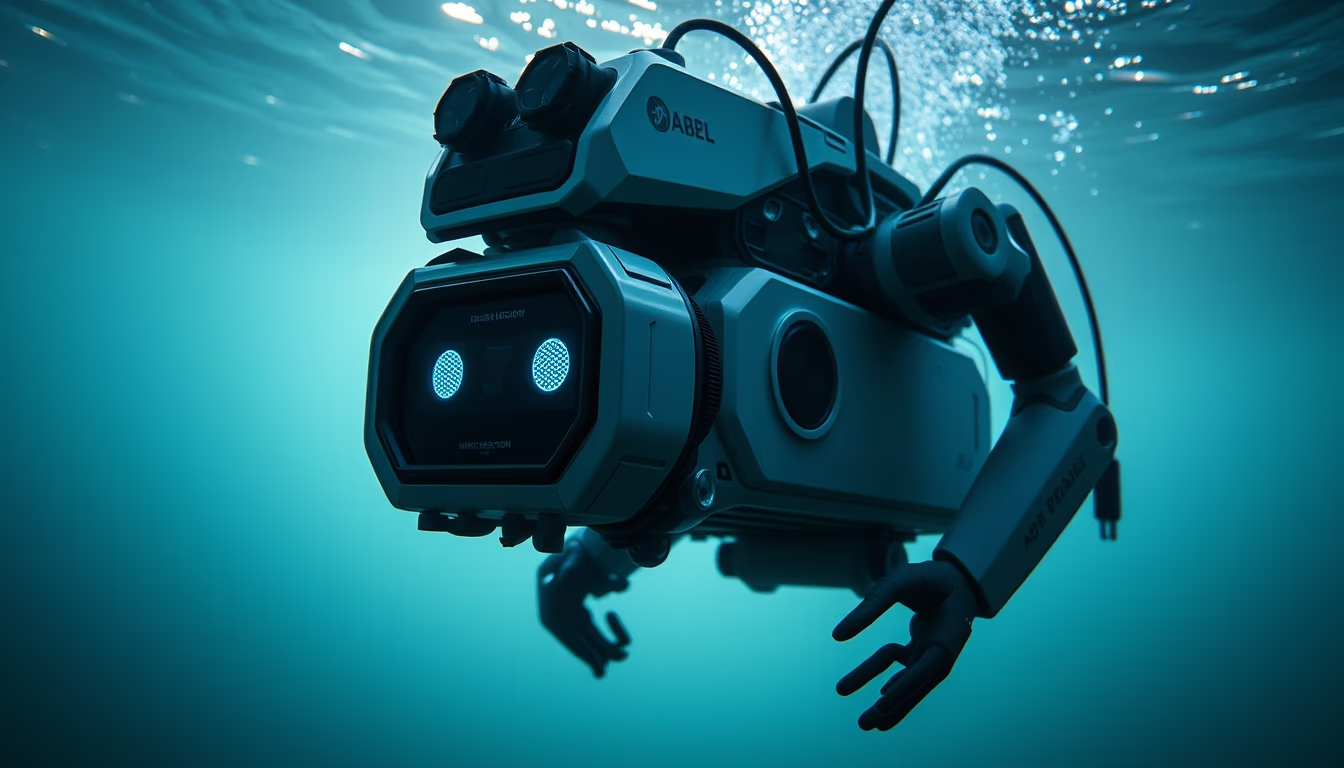
Underwater robotic submersibles operate in oceans and lakes for exploration, maintenance, and scientific research, replacing humans in dangerous missions.
About this subject
Underwater robotic submersibles, also known as remotely operated vehicles (ROVs) or autonomous underwater vehicles (AUVs), are essential for exploring and intervening in deep aquatic environments. Unlike manned submarines, these robots eliminate human risk, operating at depths exceeding 6,000 meters. The first modern ROV, the PUV-1, was developed by the US Navy in 1960 to recover lost torpedoes. Since then, technology has evolved to include manipulator arms, high-definition cameras, sonars, and chemical sensors, enabling tasks ranging from oil pipeline inspection to discovering new species in ocean trenches.
In Brazil, the use of underwater robots gained prominence with pre-salt oil exploration, where Petrobras employs ROVs for platform maintenance and equipment installation at depths up to 2,000 meters. Furthermore, institutions like the University of São Paulo and the Navy use AUVs for seafloor mapping and environmental monitoring, such as studying the Brazilian continental shelf. These robots are vital for the offshore industry but also serve in underwater archaeology, locating historic shipwrecks like the galleon Sacramento off the coast of Bahia.
A remarkable fact is that some underwater submersibles are designed for extreme conditions, such as subglacial lakes in Antarctica. In 2013, the Icefin robot explored the sea under the Thwaites Glacier, gathering data on climate change. Meanwhile, the ROV Jason, from Woods Hole Oceanographic Institution, filmed hydrothermal vents and chemosynthetic organisms on the Pacific floor. Autonomy ranges from hours to weeks, depending on power sources, lithium batteries for AUVs or tethered cables for ROVs.
The global underwater robotics market is projected to grow 12% annually until 2030, driven by demand for offshore renewable energy and deep-sea mineral exploration. Countries like Norway, Japan, and China lead in developing new technologies, including AI for autonomous navigation and object recognition. However, challenges remain, such as real-time communication limited by water signal propagation and the need for pressure-resistant materials.
Frequently Asked Questions
What is the difference between an ROV and an AUV?
ROVs (Remotely Operated Vehicles) are controlled via a tether from the surface, enabling real-time interventions but limited by cable length. AUVs (Autonomous Underwater Vehicles) are preprogrammed and operate without physical connection, conducting pre-defined mapping or data collection missions.
How deep can an underwater robot submersible operate?
Commercial ROVs and AUVs typically reach up to 3,000 meters, but specialized research vehicles like the Nereus (lost in 2014) reached 10,994 meters in the Mariana Trench. Manned submersibles have exceeded 11,000 meters, but most unmanned robots withstand pressures equivalent to over 1,000 atm.
How do underwater submersibles communicate with the surface?
Radio communication is impractical underwater, so ROVs use fiber optic cables in their tethers for real-time data transmission. AUVs internally record data and transfer it upon surfacing, or use low-bandwidth acoustic signals for basic commands.
Direct URL
https://pub-c7d6a6ea828543ac903a74a341ccb2e1.r2.dev/imagens/underwater-robot-submersible-magazine-editorial-p11.avifHow to credit
Include a visible link back to UtilizAí. Copy one of the snippets below:
<a href="https://xn--utiliza-eza.com/en/midia/imagens/underwater-robot-submersible-magazine-editorial-p11">Underwater robot submersible</a> by <a href="https://xn--utiliza-eza.com">UtilizAí</a>, licensed under <a href="https://creativecommons.org/licenses/by/4.0/">CC BY 4.0</a>.
[Underwater robot submersible](https://xn--utiliza-eza.com/en/midia/imagens/underwater-robot-submersible-magazine-editorial-p11) by [UtilizAí](https://xn--utiliza-eza.com), CC BY 4.0
License: CC-BY-4.0