Underwater robot submersible
1344×768 · AVIF · CC BY 4.0
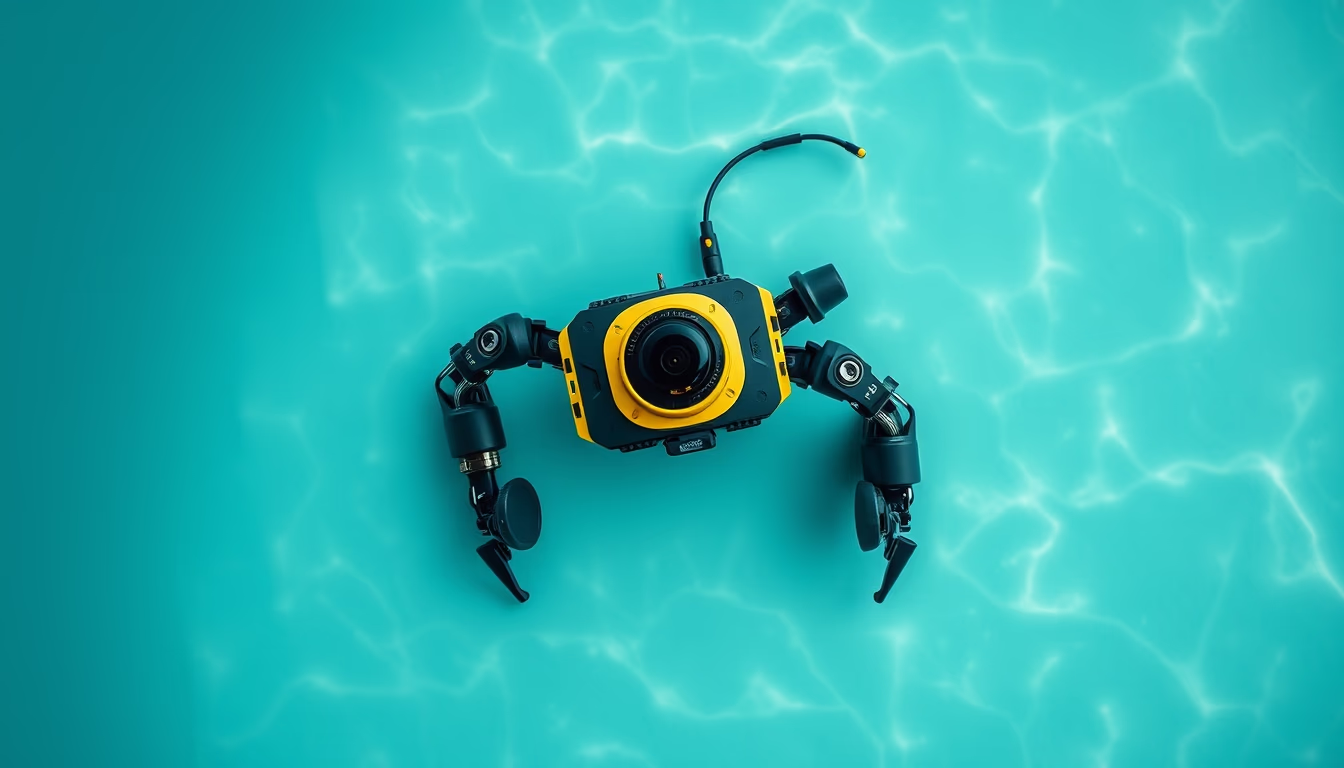
See an underwater robot submersible in isometric illustration. These vehicles operate at extreme depths for exploration and repairs.
About this subject
Underwater robotic submersibles, known as remotely operated vehicles (ROVs) or autonomous underwater vehicles (AUVs), are machines designed to perform tasks in high-pressure aquatic environments. ROVs are controlled via cables from a surface vessel, while AUVs navigate independently following pre-programmed instructions. Both types are essential for exploring seafloor mineral resources, maintaining oil and gas platforms, and studying marine biodiversity.
The history of robotic submersibles began in the 1950s with the development of the first ROV, the Poodle, by the US Navy. Technology has since advanced rapidly: vehicles like Nereus can reach the Mariana Trench at over 10,000 meters depth. Advanced sensors, high-definition cameras, and manipulator arms allow them to collect samples, inspect pipelines, and even participate in rescue operations.
In Brazil, Petrobras extensively uses ROVs for inspecting pipelines and underwater structures in the Santos Basin. The national shipbuilding industry has invested in local expertise, with companies like Oceaneering providing subsea robotic services. Beyond industrial use, these robots are vital for scientific research, such as monitoring coral reefs and underwater archaeology, where they help explore historic shipwrecks without human risk.
Interestingly, robotic submersibles are also used in search-and-rescue missions, like locating airplane black boxes. AUV autonomy allows mapping vast ocean floor areas, contributing to understanding geological phenomena such as tsunamis and underwater volcanoes. The isometric flat-lay illustration highlights the compact, functional shape of these vehicles, which combine propulsion, buoyancy, and inertial navigation systems.
Frequently Asked Questions
What is the difference between an ROV and an AUV?
An ROV (remotely operated vehicle) is controlled via cable and requires a human operator in real time. An AUV (autonomous underwater vehicle) navigates independently using pre-programmed instructions, without a tether.
How deep can an underwater robot submersible go?
Advanced models like Nereus can reach over 10,000 meters in the Mariana Trench. Most industrial ROVs operate between 500 and 3,000 meters.
Does Brazil use robotic submersibles?
Yes, Petrobras uses ROVs for pipeline and platform inspection in the Santos Basin. Companies like Oceaneering operate in Brazil, and research on AUVs is conducted at USP and UnB.
Direct URL
https://pub-c7d6a6ea828543ac903a74a341ccb2e1.r2.dev/imagens/underwater-robot-submersible-isometric-flat-lay-p1.avifHow to credit
Include a visible link back to UtilizAí. Copy one of the snippets below:
<a href="https://xn--utiliza-eza.com/en/midia/imagens/underwater-robot-submersible-isometric-flat-lay-p1">Underwater robot submersible</a> by <a href="https://xn--utiliza-eza.com">UtilizAí</a>, licensed under <a href="https://creativecommons.org/licenses/by/4.0/">CC BY 4.0</a>.
[Underwater robot submersible](https://xn--utiliza-eza.com/en/midia/imagens/underwater-robot-submersible-isometric-flat-lay-p1) by [UtilizAí](https://xn--utiliza-eza.com), CC BY 4.0
License: CC-BY-4.0