Sugar crystals macro
1344×768 · AVIF · CC BY 4.0
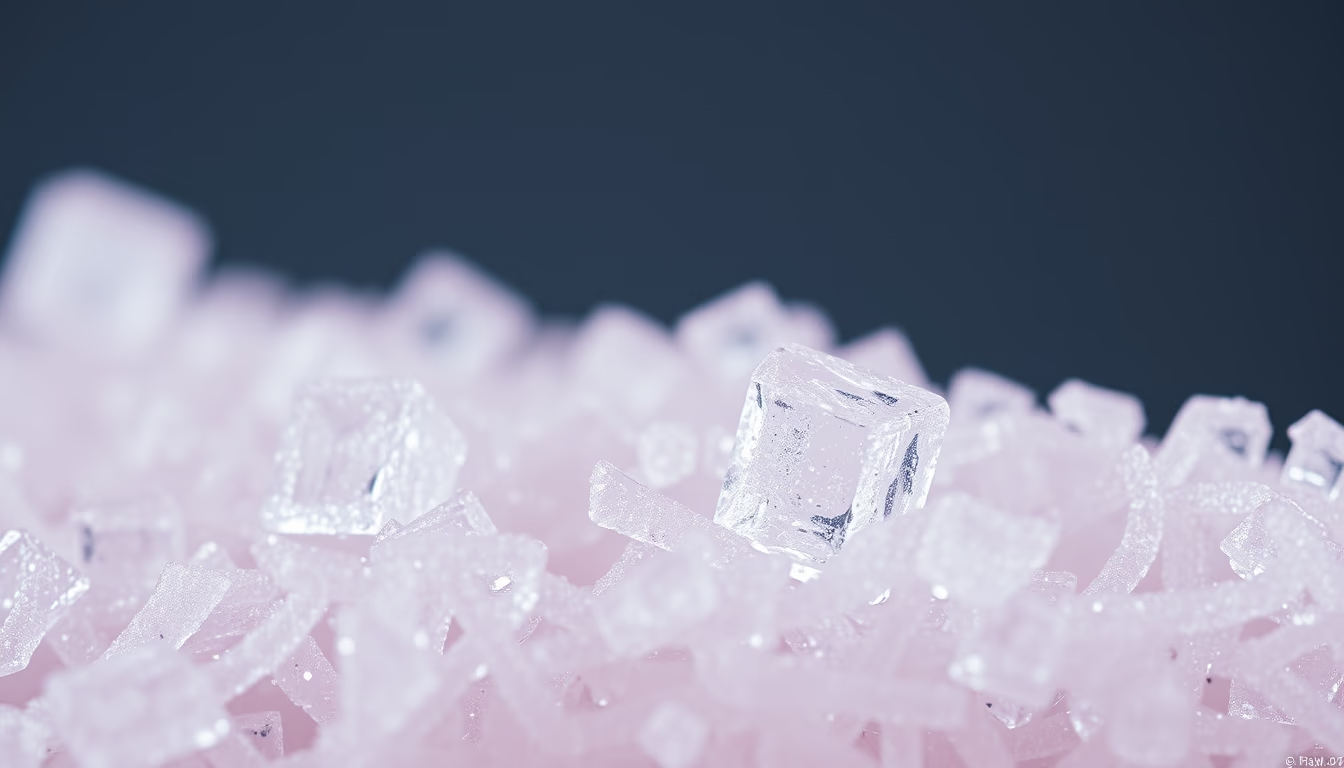
Sugar crystals are solid formations of sucrose, common in cooking and industrial production, displaying fascinating geometric structures.
About this subject
Sugar crystals are composed of sucrose, a disaccharide made of glucose and fructose. During the refining of sugarcane or sugar beet, the juice is concentrated and cooled, causing sucrose to crystallize. These crystals have a monoclinic shape, with faces that are parallelograms. The purity determines the color: white crystals undergo additional clarification, while yellowish ones retain traces of molasses.
Brazil, the world's largest producer of sugarcane, relies on sugar crystals as a key economic and culinary staple. Crystal sugar, with medium-sized translucent grains, is most common in Brazilian households. Refined sugar is ground into fine particles, while demerara and brown sugar preserve more molasses nutrients. Crystal size variation affects texture and sweetness in recipes, from cakes to syrups.
Interestingly, sugar crystals can be grown in carefully controlled lab conditions, reaching several centimeters. This is used in science experiments to demonstrate nucleation and supersaturation. In industry, crystal size and uniformity are critical for solubility and appearance in products like chocolates and candies. In humid conditions, crystals tend to clump into lumps.
The crystalline structure of sucrose is stable at room temperature but decomposes above 160°C, forming caramel. Macro photography of these crystals reveals sharp edges and brittle surfaces, highlighting their mechanical fragility. Although chemically identical, crystals from different sources may have trace impurities that slightly alter color and flavor.
Frequently Asked Questions
How are sugar crystals formed?
Sugar crystals form when a supersaturated sucrose solution is cooled. Sucrose molecules arrange into a monoclinic crystal structure, initiating nucleation and crystal growth.
What is the difference between white and brown sugar crystals?
White sugar undergoes refining and clarification, removing molasses and impurities. Brown sugar retains some molasses, giving it darker color, stronger flavor, and higher mineral content.
Why do sugar crystals dissolve in water?
Sucrose is polar, forming hydrogen bonds with water. Water molecules separate the ions and break the crystal bonds, resulting in the dissolution of the crystals.
Direct URL
https://pub-c7d6a6ea828543ac903a74a341ccb2e1.r2.dev/imagens/sugar-crystals-macro-studio-editorial-portrait-p3.avifHow to credit
Include a visible link back to UtilizAí. Copy one of the snippets below:
<a href="https://xn--utiliza-eza.com/en/midia/imagens/sugar-crystals-macro-studio-editorial-portrait-p3">Sugar crystals macro</a> by <a href="https://xn--utiliza-eza.com">UtilizAí</a>, licensed under <a href="https://creativecommons.org/licenses/by/4.0/">CC BY 4.0</a>.
[Sugar crystals macro](https://xn--utiliza-eza.com/en/midia/imagens/sugar-crystals-macro-studio-editorial-portrait-p3) by [UtilizAí](https://xn--utiliza-eza.com), CC BY 4.0
License: CC-BY-4.0