Sugar crystals macro
1344×768 · AVIF · CC BY 4.0
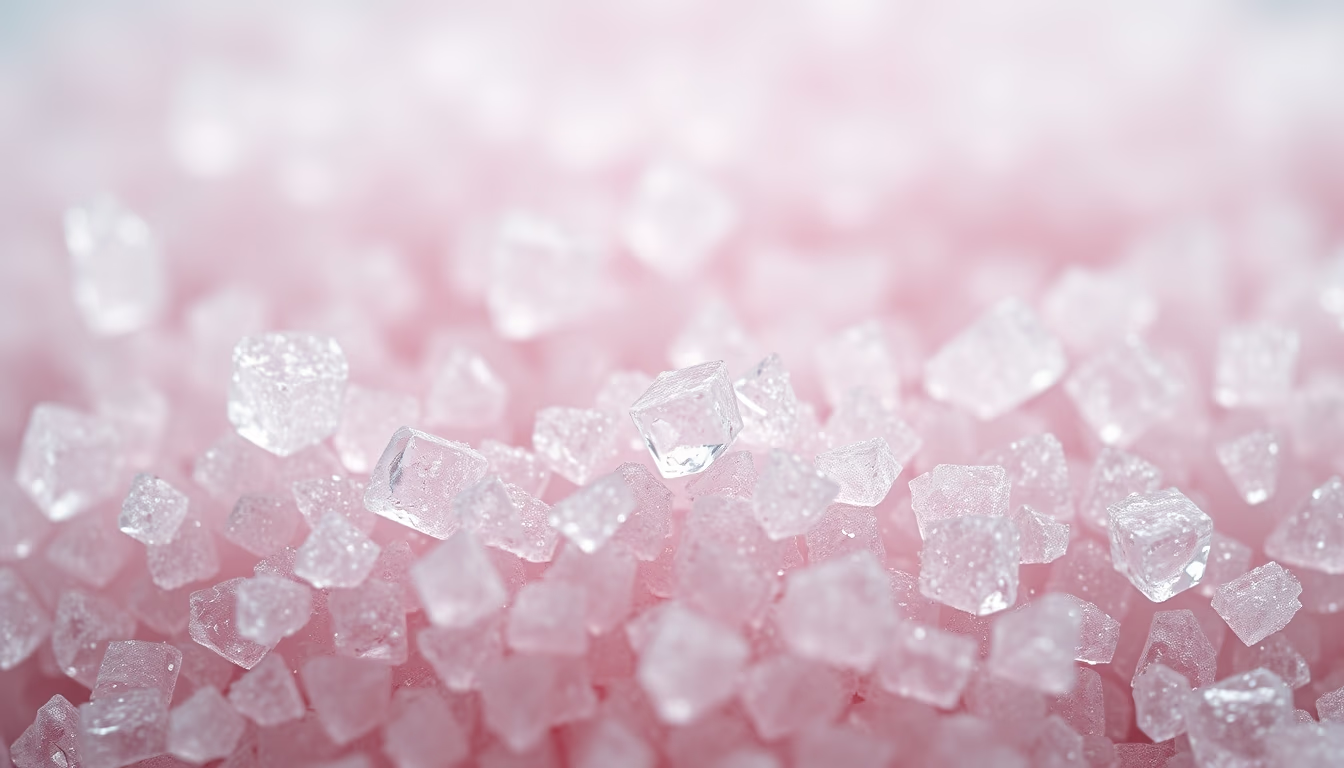
Sugar crystals, composed of pure sucrose, display perfect geometric structures that reveal the beauty of organic chemistry at a microscopic scale.
About this subject
Sugar crystals are formed from sucrose, a disaccharide composed of glucose and fructose. During crystallization, sucrose molecules arrange into a monoclinic crystal lattice, resulting in prismatic or tabular shapes. The purity and cooling rate of the syrup directly influence the size and transparency of the crystals, which can range from fine grains to large sugar rocks.
Historically, the production of crystallized sugar dates back to ancient India around 500 BCE, from where the technique spread to Persia and the Mediterranean. In Brazil, sugarcane was introduced during the colonial period and soon became the backbone of the economy, with mills producing brown sugar and later refined sugar. Today, Brazil is the world's largest sugar producer, accounting for about 23% of global production, with São Paulo state leading.
Beyond culinary use as a sweetener, sugar crystals have applications in the pharmaceutical industry as an excipient, in candy manufacturing, and in food preservation. Large crystals, or granulated sugar, undergo washing and drying to remove molasses, resulting in white, free-flowing grains. Refined sugar is ground into finer particles. The way crystals refract light also makes them a popular subject in macro photography, where angles and lighting highlight facets and inclusions.
Interestingly, the crystal structure can be altered by adding impurities like glucose, which inhibits crystallization and is used in making candies such as caramel. Under controlled conditions, sugar crystals can be grown to several centimeters, known as rock candy, forming over days or weeks in a supersaturated solution.
Frequently Asked Questions
Why do sugar crystals have geometric shapes?
Sugar crystals form geometric shapes because sucrose molecules arrange in a repeating monoclinic crystal lattice, producing flat faces and specific angles due to orderly packing.
What is the difference between granulated and powdered sugar?
Granulated sugar has larger crystals and is washed to remove molasses, staying free-flowing. Powdered sugar is ground into a fine powder, dissolving faster, but both are chemically pure sucrose.
Can I grow sugar crystals at home?
Yes, you can grow sugar crystals at home using a supersaturated solution of water and sugar, with a string or stick as a seed. Dissolve sugar in hot water until saturated and let it sit for days.
Direct URL
https://pub-c7d6a6ea828543ac903a74a341ccb2e1.r2.dev/imagens/sugar-crystals-macro-documentary-photography-p1.avifHow to credit
Include a visible link back to UtilizAí. Copy one of the snippets below:
<a href="https://xn--utiliza-eza.com/en/midia/imagens/sugar-crystals-macro-documentary-photography-p1">Sugar crystals macro</a> by <a href="https://xn--utiliza-eza.com">UtilizAí</a>, licensed under <a href="https://creativecommons.org/licenses/by/4.0/">CC BY 4.0</a>.
[Sugar crystals macro](https://xn--utiliza-eza.com/en/midia/imagens/sugar-crystals-macro-documentary-photography-p1) by [UtilizAí](https://xn--utiliza-eza.com), CC BY 4.0
License: CC-BY-4.0