Sugar crystals macro
1344×768 · AVIF · CC BY 4.0
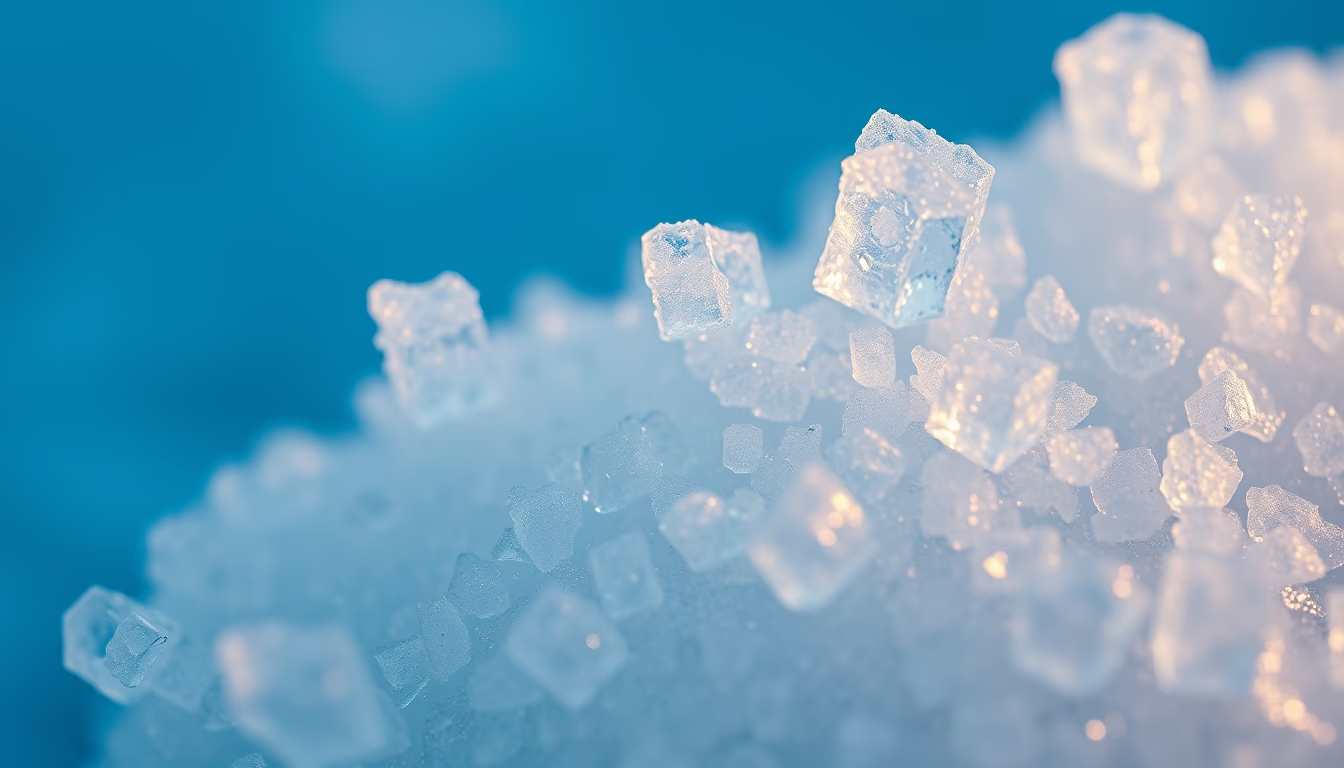
Macro shot of sugar crystals reveals the natural geometry of sucrose chloride, formed by controlled evaporation.
About this subject
Sugar crystals are the solid form of sucrose, the most consumed sweetener worldwide. They form by crystallization from a supersaturated solution of sugarcane or sugar beet juice. The industrial process involves controlled evaporation and cooling, which allows ordered growth of molecules into monoclinic structures. Each crystal has flat faces and defined angles, typical of the sucrose crystal system. Purity influences transparency, with impurities like molasses giving amber tones to brown sugars.
Historically, crystallized sugar was the first affordable sweetener on a large scale, revolutionizing cuisine and the food industry from the 18th century onward. Brazil is the world's largest producer of sugarcane, accounting for about 40% of global sugar output. Brazilian refineries use crystallization techniques that ensure standardized size and uniformity, ranging from white refined sugar to organic and demerara varieties.
At the microscopic level, sucrose crystals show imperfections and inclusions that tell their processing history. Crystal analysis is used in industry for quality control and determining parameters such as average size and distribution. Besides food use, sugar crystals are employed in labs for nucleation and crystal growth experiments, serving as a classic didactic model.
Fun fact: the rhombic shape of sugar crystals is the same as that of table salt (halite), though salt crystals are cubic, the difference lies in molecular geometry. Sucrose crystallizes in the monoclinic system, while sodium chloride is face-centered cubic.
Frequently Asked Questions
How are sugar crystals formed industrially?
They are formed by controlled evaporation of sugarcane or beet juice, followed by cooling to supersaturate the solution, allowing sucrose molecules to arrange into crystals. The process can take hours and involves adding seed crystals to standardize size.
What is the difference between crystal sugar and refined sugar?
Crystal sugar has larger, more visible crystals and is generally less processed, while refined sugar undergoes additional milling resulting in fine particles. Both are pure sucrose, but refined sugar may contain additives like starch to prevent clumping.
Why are some sugar crystals amber-colored?
The amber color comes from residual molasses and other non-crystallized compounds, typical of less refined sugars such as brown and demerara. Pure sucrose is colorless; the coloring is due to impurities trapped on the crystal surface.
Direct URL
https://pub-c7d6a6ea828543ac903a74a341ccb2e1.r2.dev/imagens/sugar-crystals-macro-aerial-drone-shot-p4.avifHow to credit
Include a visible link back to UtilizAí. Copy one of the snippets below:
<a href="https://xn--utiliza-eza.com/en/midia/imagens/sugar-crystals-macro-aerial-drone-shot-p4">Sugar crystals macro</a> by <a href="https://xn--utiliza-eza.com">UtilizAí</a>, licensed under <a href="https://creativecommons.org/licenses/by/4.0/">CC BY 4.0</a>.
[Sugar crystals macro](https://xn--utiliza-eza.com/en/midia/imagens/sugar-crystals-macro-aerial-drone-shot-p4) by [UtilizAí](https://xn--utiliza-eza.com), CC BY 4.0
License: CC-BY-4.0