Solar panel farm in dry Brazilian landscape
1344×768 · AVIF · CC BY 4.0
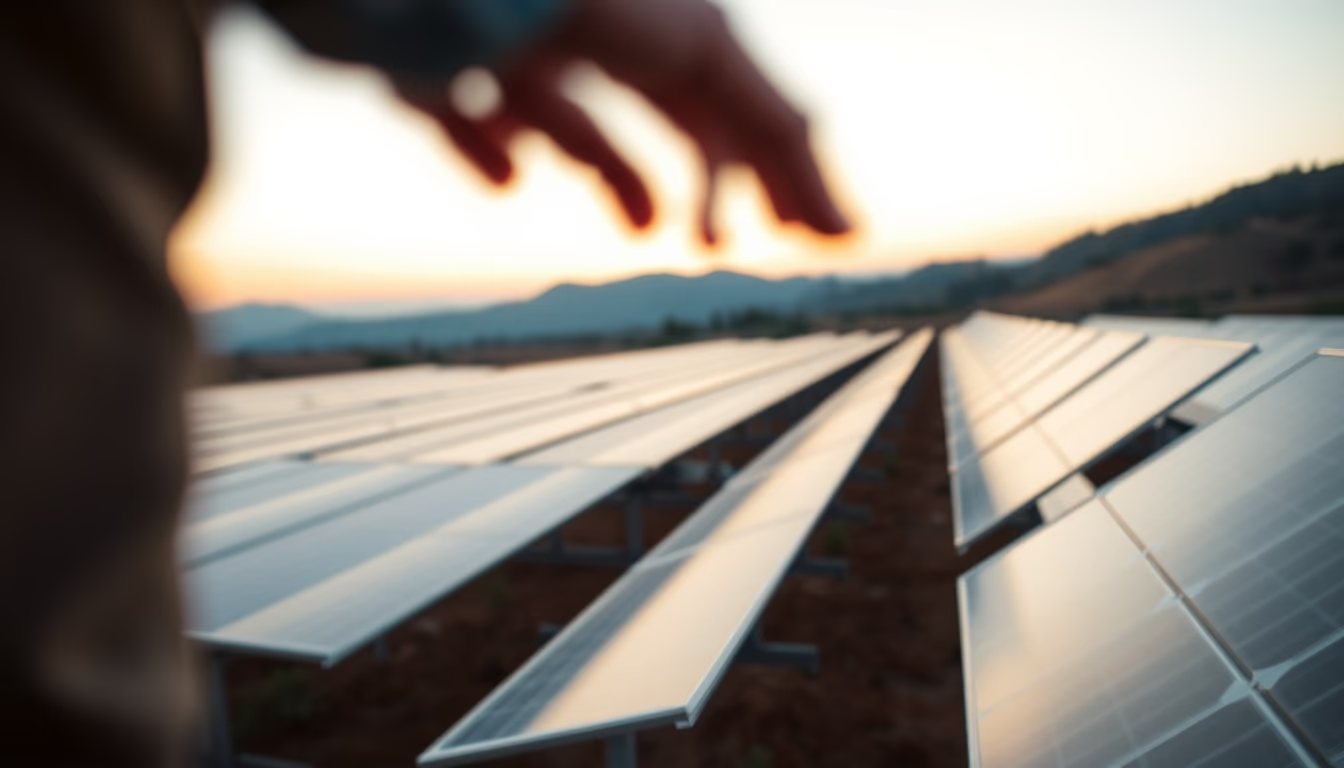
Solar farm in the Brazilian sertão harnesses high irradiation for clean energy, transforming the semi-arid landscape.
About this subject
The Brazilian sertão, a semi-arid region covering much of the Northeast, has one of the highest solar irradiation potentials in the country, with annual averages above 5.5 kWh/m²/day. This characteristic has attracted investments in large-scale solar parks, such as those installed in the states of Bahia, Pernambuco, and Piauí. The image depicts a solar farm at twilight, when generation ceases but the landscape gains orange hues contrasting with the blue photovoltaic panels.
Installing solar farms in the sertão is not trivial. The dry climate and high temperatures require frequent panel cleaning, as dust reduces efficiency. Additionally, the native Caatinga vegetation, adapted to water scarcity, must be preserved in surrounding areas, and many projects adopt environmental compensation measures. The generated energy is injected into the National Interconnected System (SIN), helping to supply distant urban centers like São Paulo and Rio de Janeiro.
Interestingly, the sertão also hosts the largest solar complex in Latin America, the Lapa Solar Complex in Bahia, with an installed capacity of 400 MW. These projects generate local jobs during construction and operation, contributing to the regional economy. However, challenges such as energy transmission and seasonal variability (cloudy and rainy periods) still require storage and grid management solutions.
The expansion of solar energy in Brazil is driven by energy auctions and falling photovoltaic module costs. In 2023, solar power surpassed 30 GW of installed capacity in the country, with distributed generation (rooftops) accounting for about half of that total. Large-scale plants, like the one in the image, represent the other half and are essential for decarbonizing the Brazilian electricity matrix.
Frequently Asked Questions
Why is the Brazilian sertão ideal for solar farms?
The sertão has high average annual solar irradiation, above 5.5 kWh/m²/day, and low cloud cover, maximizing photovoltaic energy generation.
What are the main challenges of operating solar panels in a semi-arid region?
Dust and sand require frequent panel cleaning to maintain efficiency. Additionally, high temperatures can reduce module performance.
What is the largest solar complex in Latin America and where is it located?
The Lapa Solar Complex in Bahia, with 400 MW of installed capacity, is the largest in Latin America.
Direct URL
https://pub-c7d6a6ea828543ac903a74a341ccb2e1.r2.dev/imagens/solar-panel-farm-in-brazilian-sertao-landscape-closeup-twilight-7.avifHow to credit
Include a visible link back to UtilizAí. Copy one of the snippets below:
<a href="https://xn--utiliza-eza.com/en/midia/imagens/solar-panel-farm-in-brazilian-sertao-landscape-closeup-twilight-7">Solar panel farm in dry Brazilian landscape</a> by <a href="https://xn--utiliza-eza.com">UtilizAí</a>, licensed under <a href="https://creativecommons.org/licenses/by/4.0/">CC BY 4.0</a>.
[Solar panel farm in dry Brazilian landscape](https://xn--utiliza-eza.com/en/midia/imagens/solar-panel-farm-in-brazilian-sertao-landscape-closeup-twilight-7) by [UtilizAí](https://xn--utiliza-eza.com), CC BY 4.0
License: CC-BY-4.0