Solar panel array desert
1344×768 · AVIF · CC BY 4.0
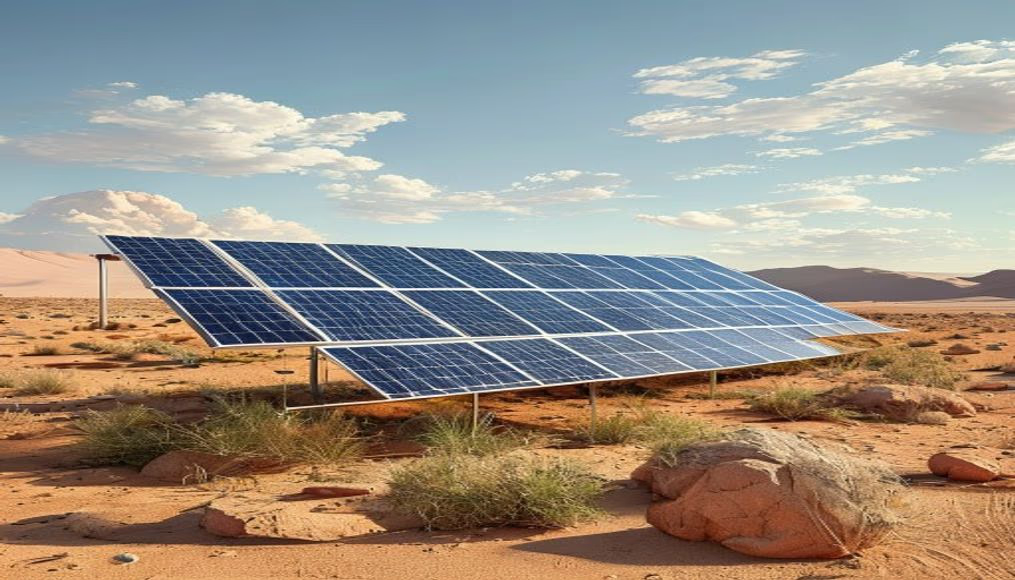
Solar farms in deserts harness high irradiance to generate clean energy on a large scale, turning arid landscapes into renewable power hubs.
About this subject
Solar panel arrays installed in desert regions represent one of the most efficient strategies for photovoltaic power generation. Deserts such as the Sahara, Atacama, and Mojave receive intense solar radiation for most of the year, with irradiation levels exceeding 2,500 kWh/m² annually, compared to an average of 1,200 kWh/m² in temperate areas. This abundance allows solar farms to achieve capacity factors above 25%, comparable to hydropower plants in favorable regions.
Large projects like the Noor solar complex in Morocco (580 MW) and Ivanpah in California use either concentrating solar power (CSP) or conventional photovoltaics. CSP employs mirrors to focus sunlight onto towers or troughs, generating heat that drives steam turbines. Photovoltaic panels convert light directly into electricity. Both systems require solutions for dust, which reduces efficiency, and high temperatures that affect solar cells. Robotic cleaning and anti-reflective coatings help mitigate these losses.
Desert locations offer vast, low-cost land with little competition from agriculture or housing. However, logistical challenges include long-distance power transmission to urban centers, cooling system requirements, and ecological impacts on local flora and fauna. Studies show that solar farms can alter microclimates but may also serve as refuges for adapted species. Initiatives combine panels with agriculture (agrivoltaics) at desert edges, providing shade for crops and reducing evaporation.
The theoretical potential of desert solar energy is immense: covering just 1% of the world's deserts with average-efficiency panels would supply more than 20 times the global electricity demand. Projects like DESERTEC, which envisioned submarine power cables from the Sahara to Europe, illustrate the scale possible. Today, countries such as Saudi Arabia, Chile, and Australia are investing in mega desert solar plants, notably the Al Dhafra plant in the UAE (2 GW), which uses bifacial panels to capture light reflected from the ground.
Frequently Asked Questions
Why is installing solar panels in deserts more efficient?
Desert regions receive high solar irradiation year-round with little cloud cover, resulting in higher energy generation per installed panel. Capacity factors can exceed 25%, compared to averages of 10-15% in cloudy areas.
What are the main challenges of operating solar farms in deserts?
Dust and sand accumulation on panels reduces efficiency, requiring frequent cleaning. High temperatures also decrease photovoltaic cell performance. Additionally, transmitting power to distant urban centers requires high-voltage lines and infrastructure investments.
Do desert solar farms harm the local environment?
They can alter microclimates and affect local flora and fauna, but many desert-adapted species can coexist. Modern projects include environmental impact studies and mitigation measures such as ecological corridors and shared land use with grazing or agriculture.
Direct URL
https://pub-c7d6a6ea828543ac903a74a341ccb2e1.r2.dev/imagens/solar-panel-array-desert-commercial-product-photography-v9.avifHow to credit
Include a visible link back to UtilizAí. Copy one of the snippets below:
<a href="https://xn--utiliza-eza.com/en/midia/imagens/solar-panel-array-desert-commercial-product-photography-v9">Solar panel array desert</a> by <a href="https://xn--utiliza-eza.com">UtilizAí</a>, licensed under <a href="https://creativecommons.org/licenses/by/4.0/">CC BY 4.0</a>.
[Solar panel array desert](https://xn--utiliza-eza.com/en/midia/imagens/solar-panel-array-desert-commercial-product-photography-v9) by [UtilizAí](https://xn--utiliza-eza.com), CC BY 4.0
License: CC-BY-4.0