Sextant navigation tool
1344×768 · AVIF · CC BY 4.0
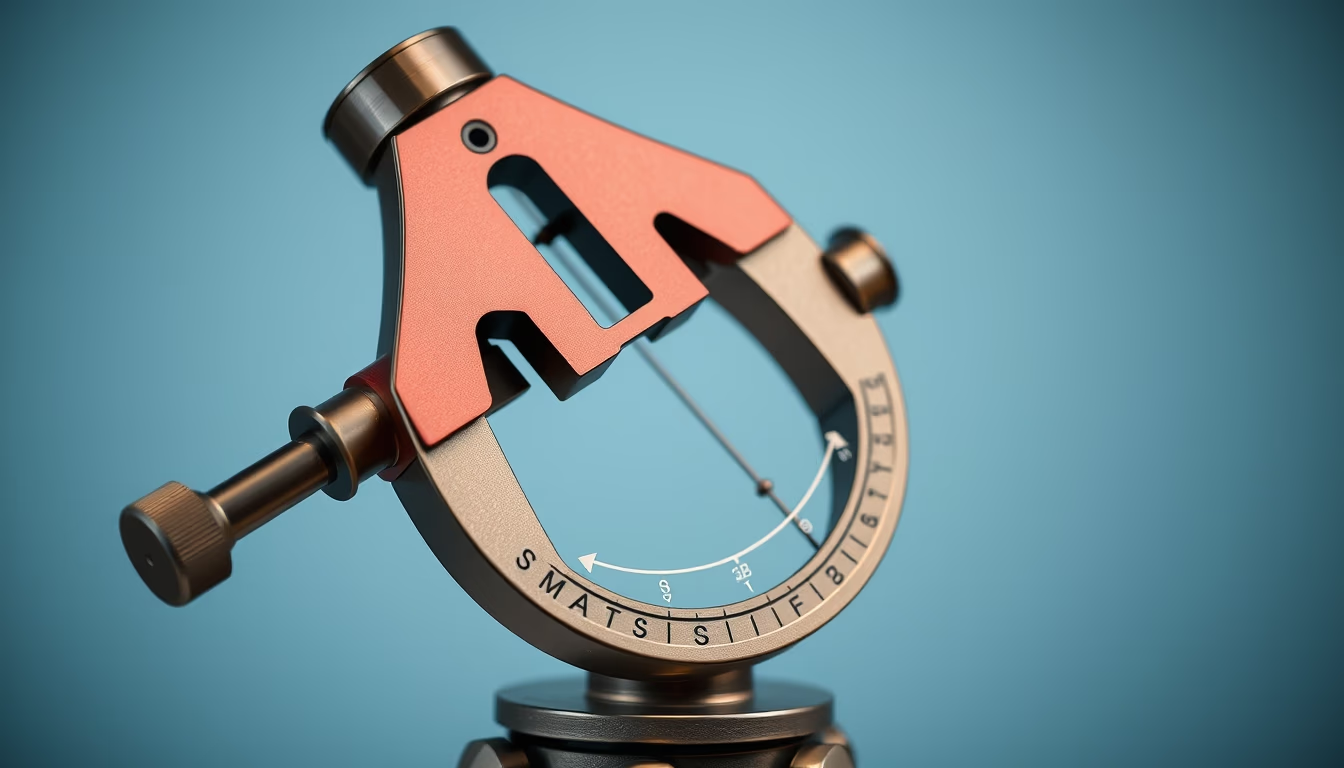
The sextant is an astronomical navigation instrument that measures angles between celestial bodies and the horizon, essential for historical maritime navigation.
About this subject
The sextant is a navigation instrument that played a crucial role in the Age of Discovery and maritime trade during the 18th and 19th centuries. It allows measuring the altitude of celestial bodies (such as the Sun, Moon, or stars) above the horizon, information used to determine the observer's latitude. Its invention is attributed to English mathematician and astronomer John Hadley (1682, 1744) and, independently, to American Thomas Godfrey around 1730. The name "sextant" derives from the Latin "sextans," referring to the 60-degree arc (one-sixth of a circle) that the instrument uses.
The operation is based on the principle of double reflection: a fixed mirror and a movable one allow aligning the image of a celestial body with the horizon line, providing the angular reading on a graduated scale. Unlike the astrolabe, the sextant is more accurate and can be used even with the ship's motion, thanks to the artificial horizon or the natural sea horizon. For centuries, it was mandatory equipment on exploration and trade vessels, being essential for navigators like James Cook and Portuguese and Spanish explorers.
Interestingly, the sextant was also used in aircraft until the advent of inertial navigation systems and GPS. Today, its use is more restricted to long-distance sailors, traditional mariners, and enthusiasts of historical navigation. The instrument is a symbol of human ingenuity to master the oceans, representing the transition from dead reckoning to precise astronomical navigation. Its elegant and functional design makes it a collector's item and an object of study in maritime history museums.
Frequently Asked Questions
How does a sextant work?
The sextant measures the angle between a celestial body and the horizon using two mirrors. The user aligns the reflected image of the body with the horizon and reads the angle on the graduated scale.
What is the difference between a sextant and an astrolabe?
The astrolabe is older and measures angles with a disc and alidade, being less accurate in rough seas. The sextant uses double reflection, allowing stable measurements even with the ship's motion.
Is the sextant still used today?
Yes, by long-distance sailors, traditional mariners, and in navigation training. It is also used as a backup in case of electronic system failure.
Direct URL
https://pub-c7d6a6ea828543ac903a74a341ccb2e1.r2.dev/imagens/sextant-navigation-tool-studio-still-life-p9.avifHow to credit
Include a visible link back to UtilizAí. Copy one of the snippets below:
<a href="https://xn--utiliza-eza.com/en/midia/imagens/sextant-navigation-tool-studio-still-life-p9">Sextant navigation tool</a> by <a href="https://xn--utiliza-eza.com">UtilizAí</a>, licensed under <a href="https://creativecommons.org/licenses/by/4.0/">CC BY 4.0</a>.
[Sextant navigation tool](https://xn--utiliza-eza.com/en/midia/imagens/sextant-navigation-tool-studio-still-life-p9) by [UtilizAí](https://xn--utiliza-eza.com), CC BY 4.0
License: CC-BY-4.0