São Paulo metro train arriving at illuminated station platform
1344×768 · AVIF · CC BY 4.0
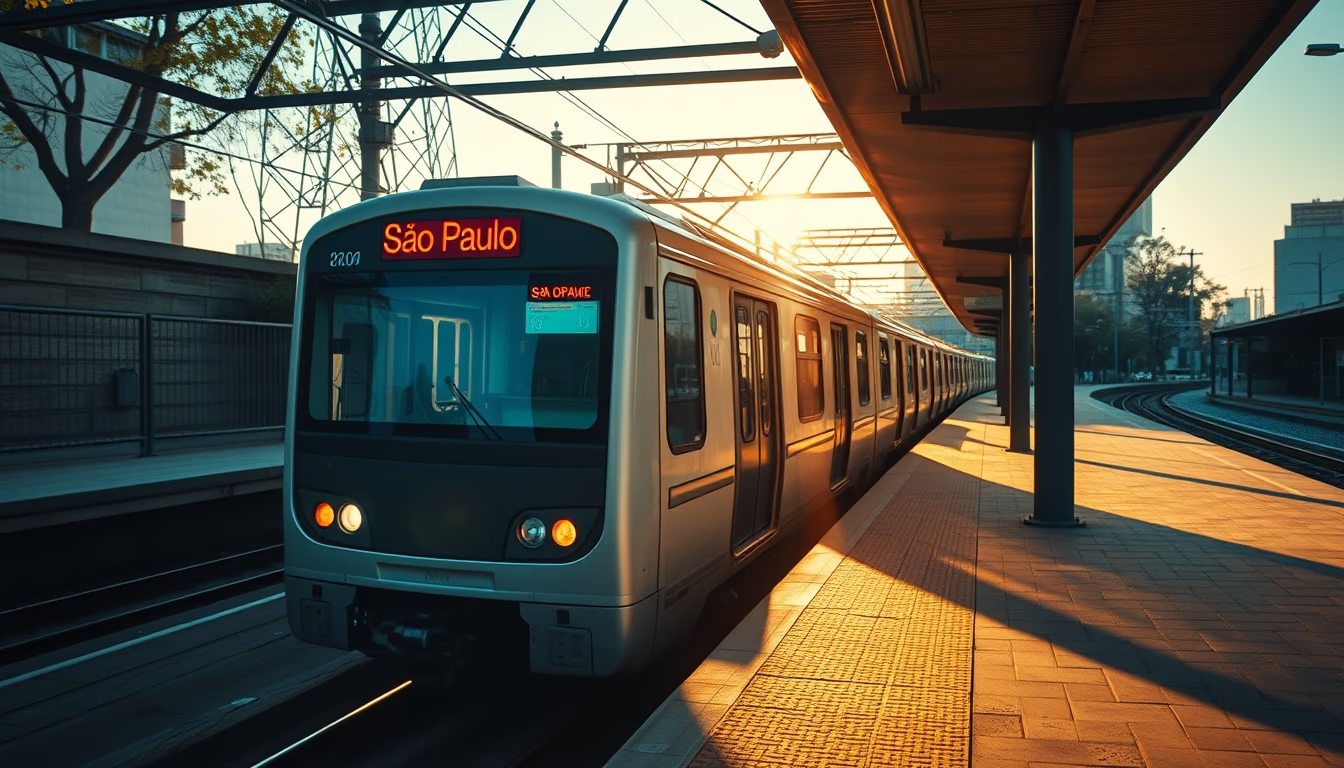
A São Paulo metro train arrives at an illuminated platform during peak hours, highlighting the efficiency of the city's public transportation.
About this subject
The São Paulo Metro, inaugurated in 1974, is one of the largest rail transit systems in Brazil, spanning 104 km with 91 stations across six lines. The image captures a train, likely from the modern fleet such as the 3000 or 4000 series, approaching a brightly lit platform. The intense illumination is a hallmark of newer stations, like those on Line 4-Yellow and Line 5-Lilac, which use LED lights to ensure safety and visual comfort. The late afternoon time, indicated by natural light entering the station, coincides with peak hours when the system carries about 4 million passengers on weekdays. Punctuality and frequency, with trains arriving every 2 to 3 minutes during rush hours, are crucial to alleviating the city's chaotic traffic. Platforms are equipped with glass doors that open only when the train stops, preventing accidents and improving boarding flow. Stations like Sé and Paulista offer integration with other lines and bus terminals, forming a network that serves from the central area to peripheral neighborhoods. The São Paulo Metro is a benchmark in energy efficiency: since 2019, all stations use renewable energy, contributing to carbon footprint reduction. Preventive maintenance and constant modernization, such as the implementation of CBTC (Communication-Based Train Control) signaling on Line 2-Green and Line 3-Red, ensure shorter intervals and greater transport capacity.
Frequently Asked Questions
What is the passenger capacity of the São Paulo Metro?
The São Paulo Metro carries about 4 million passengers on weekdays, with a maximum capacity of 5 million during peak hours.
How many lines and stations does the São Paulo Metro have?
Currently, the system has 6 lines (1-Blue, 2-Green, 3-Red, 4-Yellow, 5-Lilac, and 15-Silver) and 91 stations, totaling 104 km in length.
How does the São Paulo Metro contribute to sustainability?
Since 2019, all stations use renewable energy, and the modern fleet features regenerative braking systems that save energy.
Direct URL
https://pub-c7d6a6ea828543ac903a74a341ccb2e1.r2.dev/imagens/sao-paulo-metro-train-arriving-at-illuminated-station-platform-wide-late-afternoon-2.avifHow to credit
Include a visible link back to UtilizAí. Copy one of the snippets below:
<a href="https://xn--utiliza-eza.com/en/midia/imagens/sao-paulo-metro-train-arriving-at-illuminated-station-platform-wide-late-afternoon-2">São Paulo metro train arriving at illuminated station platform</a> by <a href="https://xn--utiliza-eza.com">UtilizAí</a>, licensed under <a href="https://creativecommons.org/licenses/by/4.0/">CC BY 4.0</a>.
[São Paulo metro train arriving at illuminated station platform](https://xn--utiliza-eza.com/en/midia/imagens/sao-paulo-metro-train-arriving-at-illuminated-station-platform-wide-late-afternoon-2) by [UtilizAí](https://xn--utiliza-eza.com), CC BY 4.0
License: CC-BY-4.0