Recycling symbols colorful
1344×768 · AVIF · CC BY 4.0
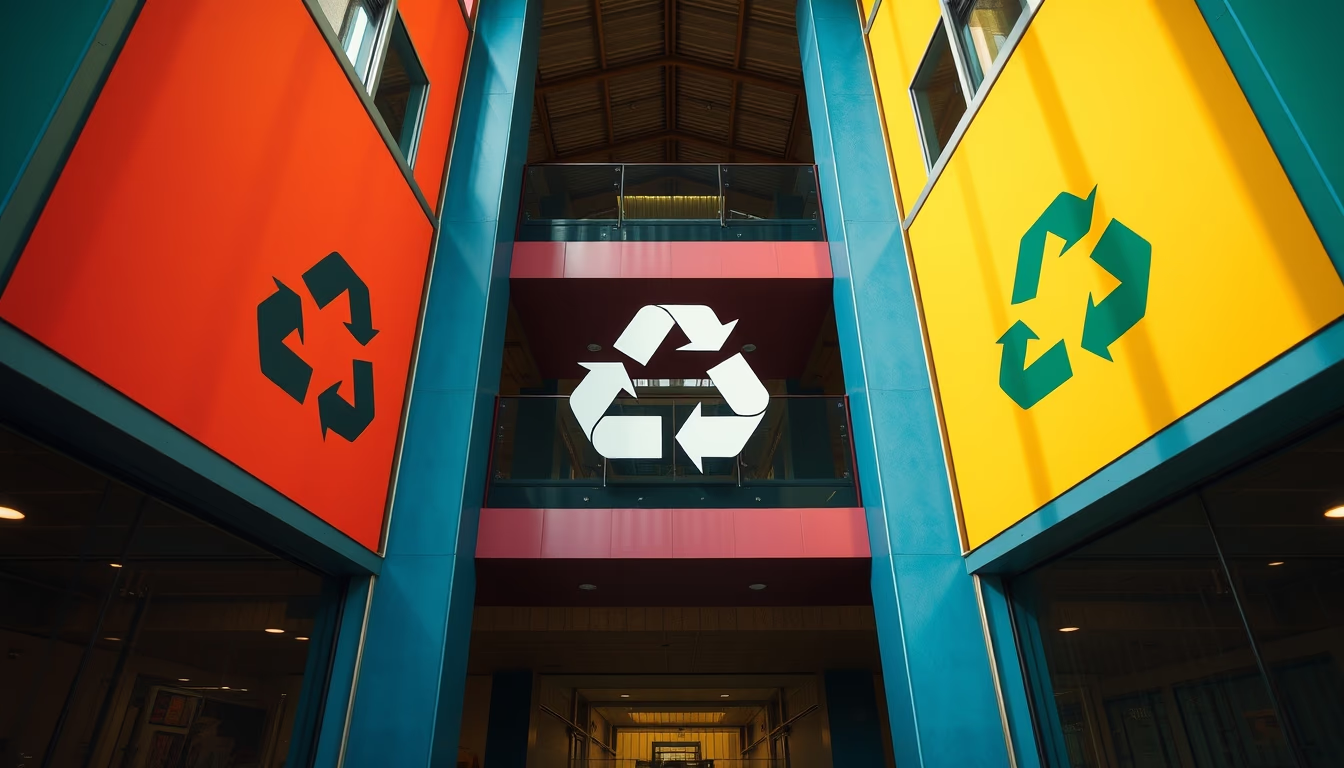
Colorful recycling symbols represent different types of recyclable materials, with internationally standardized colors to facilitate proper sorting and disposal.
About this subject
Recycling symbols vary in colors and shapes to quickly identify the type of material: paper (blue), plastic (red), glass (green), metal (yellow), and organic (brown). This color coding is adopted in many countries, including Brazil, where CONAMA Resolution 275/2001 establishes a standard color scheme for selective collection. Each symbol carries information about the recyclability of the item, such as the Möbius triangle with a number in the center (resin code for plastics) or specific arrows for glass and metal. Understanding these symbols is essential for recycling efficiency, as incorrect disposal can contaminate entire batches of recyclable materials, increasing costs and reducing reuse. In Brazil, the National Solid Waste Policy (Law 12,305/2010) reinforces the importance of reverse logistics and environmental education, making symbols a daily tool for consumers and waste pickers. For instance, aluminum recycling saves 95% of the energy needed to produce primary aluminum, and glass can be recycled infinitely without quality loss. Colorful recycling symbols are thus not mere drawings: they are part of a global system aimed at reducing the environmental impact of solid waste.
Frequently Asked Questions
What do the colors of recycling symbols mean?
The colors follow an international standard: blue for paper, red for plastic, green for glass, yellow for metal, and brown for organics. In Brazil, CONAMA Resolution 275/2001 formalized this color code for selective collection.
How can I tell if a plastic is recyclable by its symbol?
Look for the Möbius triangle with a number from 1 to 7 in the center. Each number indicates a resin type: 1 (PET), 2 (HDPE), 3 (PVC), 4 (LDPE), 5 (PP), 6 (PS), and 7 (other). Plastics with numbers 1, 2, and 5 are more easily recyclable.
Why are recycling symbols important for the environment?
They facilitate proper waste sorting, preventing contamination and increasing recycling rates. This reduces resource extraction, saves energy, and decreases the amount of waste sent to landfills.
Direct URL
https://pub-c7d6a6ea828543ac903a74a341ccb2e1.r2.dev/imagens/recycling-symbols-colorful-architectural-photography.avifHow to credit
Include a visible link back to UtilizAí. Copy one of the snippets below:
<a href="https://xn--utiliza-eza.com/en/midia/imagens/recycling-symbols-colorful-architectural-photography">Recycling symbols colorful</a> by <a href="https://xn--utiliza-eza.com">UtilizAí</a>, licensed under <a href="https://creativecommons.org/licenses/by/4.0/">CC BY 4.0</a>.
[Recycling symbols colorful](https://xn--utiliza-eza.com/en/midia/imagens/recycling-symbols-colorful-architectural-photography) by [UtilizAí](https://xn--utiliza-eza.com), CC BY 4.0
License: CC-BY-4.0