Quadruped robot dog
1344×768 · AVIF · CC BY 4.0
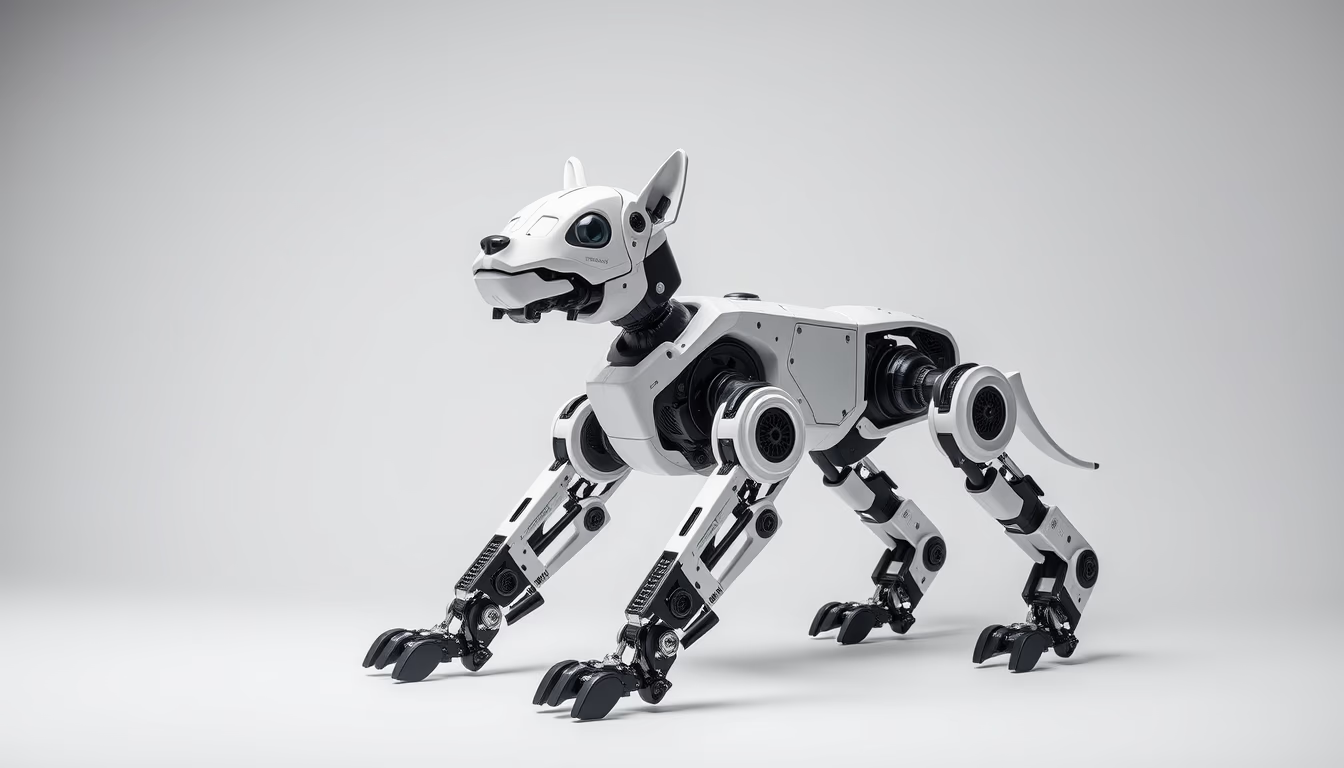
Quadruped robots like robot dogs are advanced mobile platforms used in industrial inspection, rescue, and research.
About this subject
Quadruped robots, commonly known as robot dogs, are machines designed to locomote on four legs, inspired by the biomechanics of quadruped animals. This configuration provides stability and agility on rough terrain, surpassing wheeled or tracked robots in uneven environments. Sensors such as LIDAR, cameras, and inertial measurement units enable these robots to navigate autonomously, map surroundings, and avoid obstacles.
Applications of quadruped robots are vast and growing. In industry, they are used for inspection of pipelines, oil platforms, and underground mines, places hazardous to humans. In search and rescue operations, they can access debris after earthquakes or landslides. Military forces employ versions for reconnaissance and logistics in the field. In research, universities and institutes like MIT and ETH Zurich study locomotion control, human-robot interaction, and artificial intelligence.
The development of quadruped robots gained prominence with Boston Dynamics' BigDog in 2005, a combustion-engine prototype. Later, the company launched Spot, a compact electric robot commercialized since 2019. Other notable examples include ETH Zurich's ANYmal, used in industrial inspection, and China's Unitree Go1 and Aliengo, offering more affordable options for research and development.
Quadruped locomotion involves complex control algorithms, such as inverse dynamics and footstep planning. Robots can walk, trot, run, and even climb stairs. Energy autonomy remains a challenge, with batteries lasting 1 to 3 hours depending on activity. Onboard sensors and computers process data in real time, allowing execution of pre-programmed missions or teleoperation. The trend is for these robots to become more autonomous and integrated into collaborative robotics systems in Industry 4.0.
Frequently Asked Questions
How do robot dogs maintain balance?
They use sensors such as gyroscopes and accelerometers to detect tilt, and control algorithms adjust leg positions and weight distribution in real time to maintain stability.
What are the differences between quadruped robots and other types?
Quadruped robots offer better mobility on uneven terrain compared to wheeled robots. Biped robots (like humans) are more challenging to balance. Aerial robots (drones) have limitations in payload and flight time, while quadrupeds can carry sensors longer on the ground.
Can quadruped robots be used at home?
Currently, models like Boston Dynamics' Spot or Unitree Go1 are mainly used in research and industry, but more affordable and safe versions are being developed for domestic use, such as assistance and entertainment.
Direct URL
https://pub-c7d6a6ea828543ac903a74a341ccb2e1.r2.dev/imagens/quadruped-robot-dog-studio-editorial-portrait-p9.avifHow to credit
Include a visible link back to UtilizAí. Copy one of the snippets below:
<a href="https://xn--utiliza-eza.com/en/midia/imagens/quadruped-robot-dog-studio-editorial-portrait-p9">Quadruped robot dog</a> by <a href="https://xn--utiliza-eza.com">UtilizAí</a>, licensed under <a href="https://creativecommons.org/licenses/by/4.0/">CC BY 4.0</a>.
[Quadruped robot dog](https://xn--utiliza-eza.com/en/midia/imagens/quadruped-robot-dog-studio-editorial-portrait-p9) by [UtilizAí](https://xn--utiliza-eza.com), CC BY 4.0
License: CC-BY-4.0