Mechanical clock gears
1344×768 · AVIF · CC BY 4.0
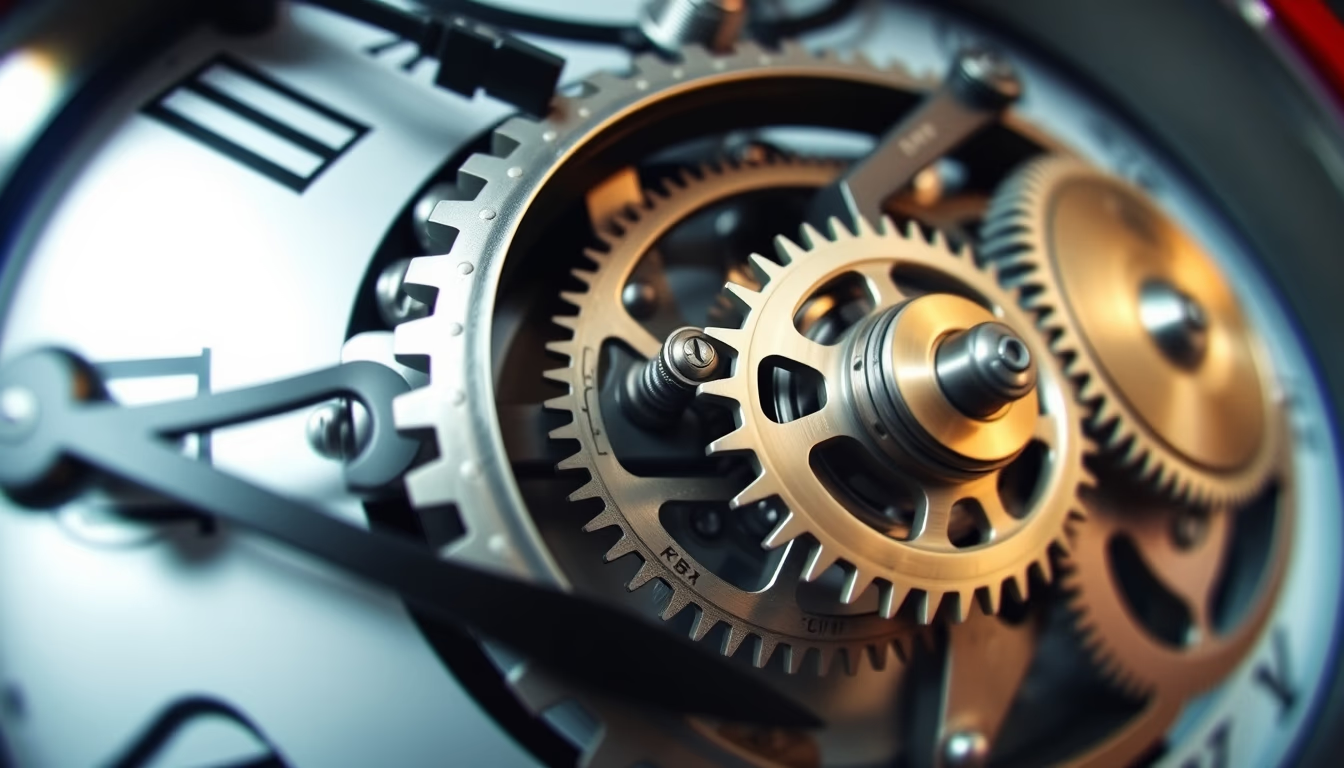
Mechanical clock gears, a symbol of precision in horological engineering, have transformed timekeeping since the Middle Ages.
About this subject
Mechanical clock gears are essential components that transmit motion and torque, allowing hands to indicate time accurately. The basic principle involves toothed wheels of different sizes, where the ratio of teeth determines rotational speed. This technology dates back to the 13th century, when the first mechanical clocks appeared in European monasteries, such as the Salisbury clock (1386) and the Wells clock (1392). These early devices used verge escapements and hand-forged gears, with precision limitations of about 15 minutes per day.
Precision gear development advanced with the Industrial Revolution. In the 18th century, horologists like John Harrison created gear mechanisms for marine chronometers, solving the longitude problem. Harrison used brass and steel gears with machine-cut teeth, reducing errors to seconds per day. Today, high-end mechanical watches use gears made of special alloys like nickel silver, with heat treatments to reduce wear. Lubrication with synthetic oils and mounting on synthetic rubies minimize friction.
Culturally, clock gears symbolize the connection between art and technique. The design of gear wheels has influenced industrial aesthetics, appearing in logos and jewelry. In Brazil, mechanical horology has a tradition in cities like Curitiba and São Paulo, with restoration shops that keep alive the practice of manually adjusting gears. The complexity of gear systems, such as perpetual calendars and minute repeaters, demonstrates human ingenuity in mastering time.
Frequently Asked Questions
How do mechanical clock gears work?
Gears transmit power from the mainspring or weight to the hands. The escape wheel controls energy release, while intermediate wheels reduce speed to seconds, minutes, and hours.
What is the difference between a mechanical and a quartz watch?
Mechanical watches use gears and springs, no battery, requiring manual winding. Quartz watches use an oscillating quartz crystal and are more accurate and cheaper, but less prized as art.
Why do old clock gears have triangular teeth?
Triangular or sawtooth shapes were common in early clocks because they could be hand-cut with files. Later, the involute profile was adopted for better efficiency and durability.
Direct URL
https://pub-c7d6a6ea828543ac903a74a341ccb2e1.r2.dev/imagens/mechanical-clock-gears-fish-eye-wide-angle-p7.avifHow to credit
Include a visible link back to UtilizAí. Copy one of the snippets below:
<a href="https://xn--utiliza-eza.com/en/midia/imagens/mechanical-clock-gears-fish-eye-wide-angle-p7">Mechanical clock gears</a> by <a href="https://xn--utiliza-eza.com">UtilizAí</a>, licensed under <a href="https://creativecommons.org/licenses/by/4.0/">CC BY 4.0</a>.
[Mechanical clock gears](https://xn--utiliza-eza.com/en/midia/imagens/mechanical-clock-gears-fish-eye-wide-angle-p7) by [UtilizAí](https://xn--utiliza-eza.com), CC BY 4.0
License: CC-BY-4.0