Insect compound eye macro
1344×768 · AVIF · CC BY 4.0
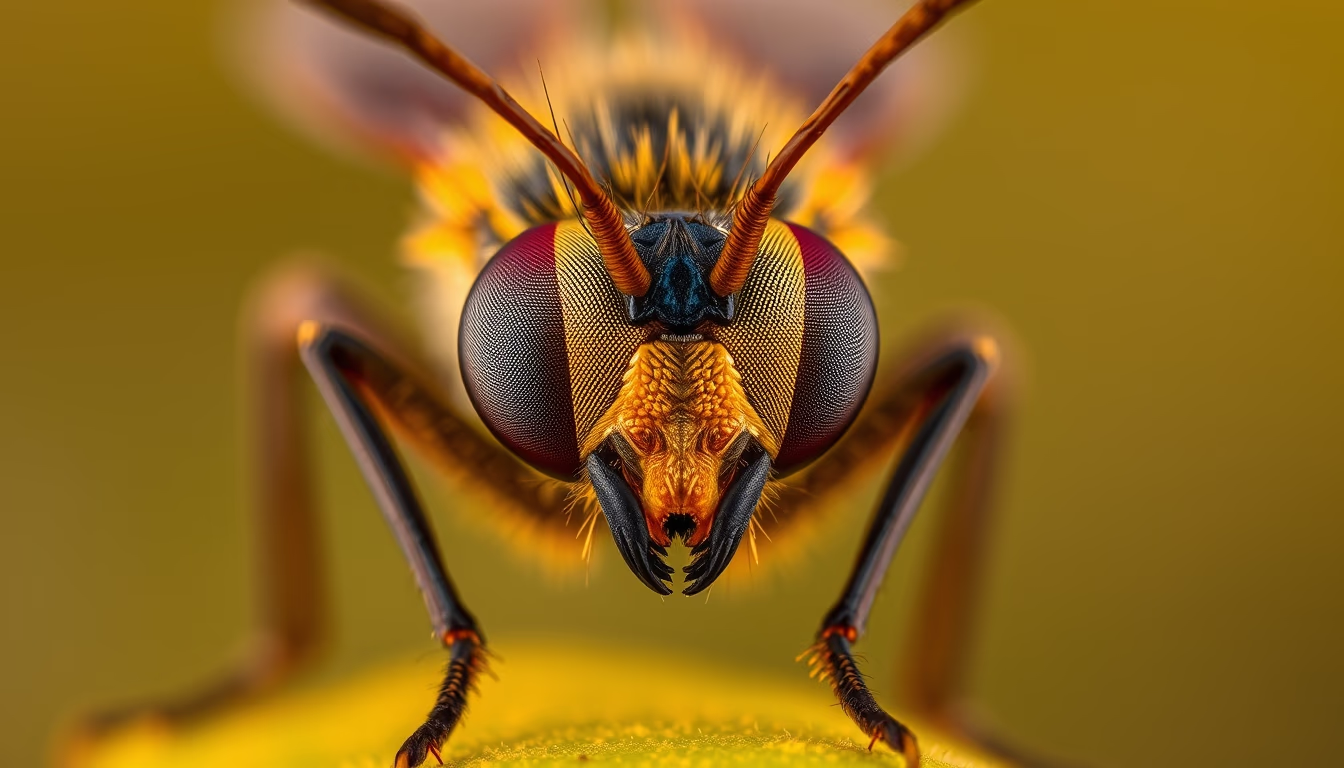
Insect compound eyes consist of thousands of individual units called ommatidia, providing a mosaic vision highly sensitive to motion.
About this subject
Compound eyes are the predominant visual structure in insects and other arthropods. Unlike human eyes with a single lens, each compound eye consists of hundreds or thousands of ommatidia. Each ommatidium contains a set of photoreceptor cells, a lens, and a crystalline cone, functioning as an independent miniature eye. The final image is formed by integrating signals from all ommatidia, resulting in a mosaic image with low spatial resolution but excellent ability to detect rapid movements and light changes.
There are two main types of compound eyes: apposition eyes, typical of diurnal insects like bees and dragonflies, and superposition eyes, found in nocturnal or crepuscular insects such as moths and beetles. In apposition eyes, each ommatidium is optically isolated, while in superposition eyes, light can cross multiple ommatidia before reaching photoreceptors, enhancing sensitivity in low light. This adaptation allows nocturnal insects to see in dim conditions, albeit with less sharpness.
The diversity of compound eyes is remarkable. Dragonflies have eyes covering almost their entire head, with up to 30,000 ommatidia each, providing nearly 360-degree vision and the ability to detect tiny movements. Fruit flies have about 700 ommatidia but process images very quickly, enabling them to escape predators. Bees and other hymenopterans see ultraviolet light, revealing patterns on flowers invisible to humans. Additionally, many insects can perceive polarized light, using it as a compass for navigation.
The study of compound eyes has inspired technological advances, such as wide-field cameras and motion sensors in robotics. Biomimetics seeks to replicate ommatidial structures to create more efficient optical devices. Understanding insect vision is also crucial for developing pest control methods and conserving pollinators, as visual perception influences foraging and mating behavior.
Frequently Asked Questions
How do insects see with compound eyes?
Each ommatidium captures a small part of the visual field. The insect's brain combines these parts to form a mosaic image, which has low resolution but high sensitivity to motion and light.
Why do compound eyes have a faceted appearance?
The facets are the outer lenses of each ommatidium. They form a hexagonal or rounded surface, maximizing light capture area and protecting internal structures.
Do all insects have compound eyes?
Most adult insects have compound eyes, but larvae and some immature stages may only have ocelli (simple eyes). Some insects, such as certain parasites, may have reduced or absent compound eyes.
Direct URL
https://pub-c7d6a6ea828543ac903a74a341ccb2e1.r2.dev/imagens/insect-compound-eye-macro-travel-photography-p1.avifHow to credit
Include a visible link back to UtilizAí. Copy one of the snippets below:
<a href="https://xn--utiliza-eza.com/en/midia/imagens/insect-compound-eye-macro-travel-photography-p1">Insect compound eye macro</a> by <a href="https://xn--utiliza-eza.com">UtilizAí</a>, licensed under <a href="https://creativecommons.org/licenses/by/4.0/">CC BY 4.0</a>.
[Insect compound eye macro](https://xn--utiliza-eza.com/en/midia/imagens/insect-compound-eye-macro-travel-photography-p1) by [UtilizAí](https://xn--utiliza-eza.com), CC BY 4.0
License: CC-BY-4.0