Insect compound eye macro
1344×768 · AVIF · CC BY 4.0
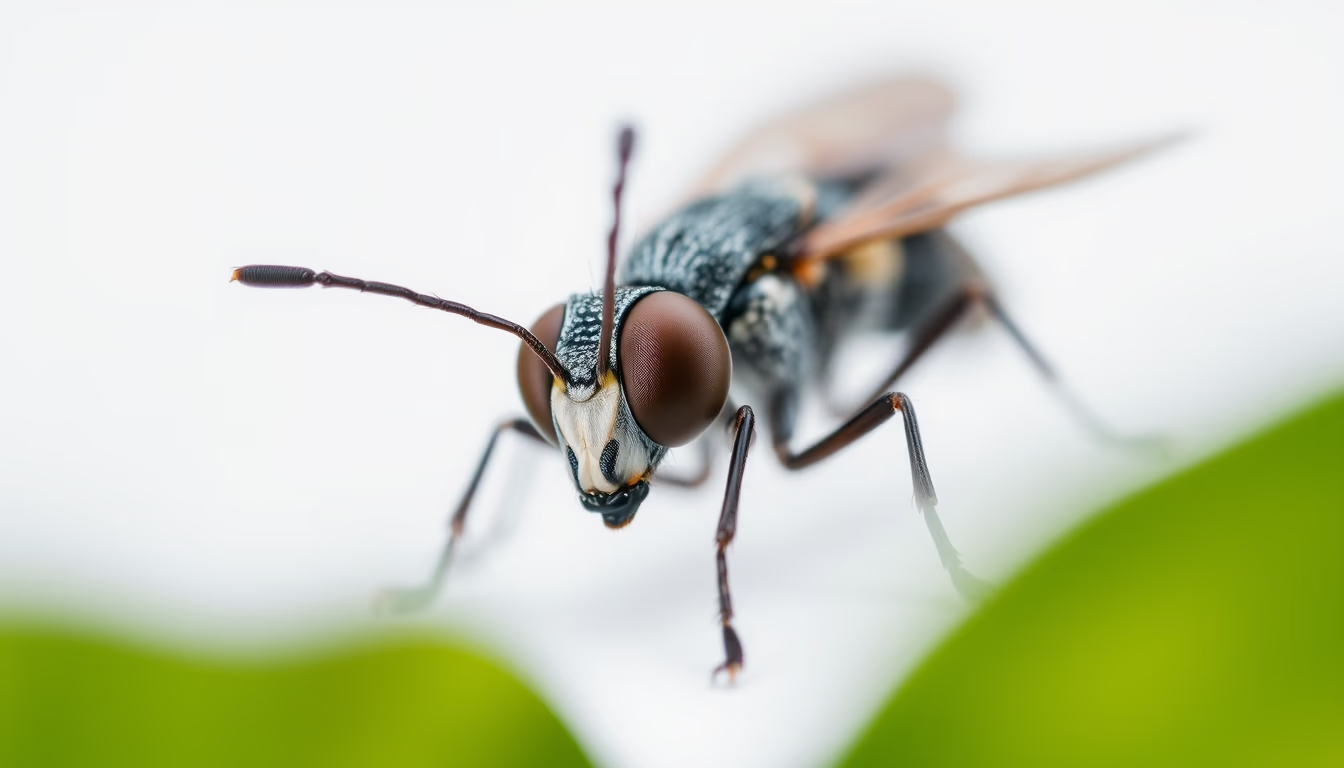
The compound eye of insects is a visual structure composed of thousands of ommatidia, each acting as an independent sensory unit.
About this subject
The compound eye is the primary visual organ of insects, found in groups such as Diptera (flies), Hymenoptera (bees), and Odonata (dragonflies). Unlike the human eye with a single lens, the compound eye consists of repeating units called ommatidia. Each ommatidium contains a lens (cornea) and a crystalline cone that focuses light onto photoreceptor cells. The number of ommatidia varies widely: ants may have as few as a hundred, while dragonflies can have up to 30,000 per eye, providing an almost spherical field of view.
There are two main types of compound eyes: apposition and superposition. The apposition eye, common in diurnal insects like bees, forms a mosaic image with low resolution but high motion sensitivity. The superposition eye, typical of nocturnal insects like moths, uses movable pigments to enhance light capture. This adaptation allows moths to see in light levels 1,000 times dimmer than required for apposition eyes.
Spatial resolution in compound eyes is limited by the angle between adjacent ommatidia. Generally, insects see much less detail than humans; a housefly has resolution equivalent to about 1/100 of human visual acuity. However, they excel at motion detection, capable of perceiving changes up to 300 frames per second (compared to 60 for humans). This explains why flies are so hard to swat.
Interestingly, some insects, like dragonflies, have specialized eye regions: the dorsal zone contains ommatidia pointing skyward, optimized for spotting prey against a bright background. In bees, compound eyes are sensitive to ultraviolet light, enabling them to see patterns on flowers invisible to humans. Studies indicate that compound eyes evolved during the Devonian period, over 400 million years ago, making them one of the oldest and most successful visual systems on Earth.
Frequently Asked Questions
How does the compound eye of insects work?
Each ommatidium captures a tiny point of light, and the insect's brain combines signals from thousands of ommatidia to form a mosaic image. This results in low spatial resolution but high motion sensitivity.
How many ommatidia does a fly have?
A housefly (Musca domestica) has about 4,000 ommatidia per eye. Dragonflies can have up to 30,000 ommatidia per eye.
Why are compound eyes more sensitive to light?
Nocturnal insects have superposition eyes that pool light from multiple ommatidia to amplify the signal. Additionally, many insects have a tapetum lucidum, a reflective layer that enhances photon capture.
Direct URL
https://pub-c7d6a6ea828543ac903a74a341ccb2e1.r2.dev/imagens/insect-compound-eye-macro-commercial-product-photography-p0.avifHow to credit
Include a visible link back to UtilizAí. Copy one of the snippets below:
<a href="https://xn--utiliza-eza.com/en/midia/imagens/insect-compound-eye-macro-commercial-product-photography-p0">Insect compound eye macro</a> by <a href="https://xn--utiliza-eza.com">UtilizAí</a>, licensed under <a href="https://creativecommons.org/licenses/by/4.0/">CC BY 4.0</a>.
[Insect compound eye macro](https://xn--utiliza-eza.com/en/midia/imagens/insect-compound-eye-macro-commercial-product-photography-p0) by [UtilizAí](https://xn--utiliza-eza.com), CC BY 4.0
License: CC-BY-4.0