Globe vintage spinning
1344×768 · AVIF · CC BY 4.0
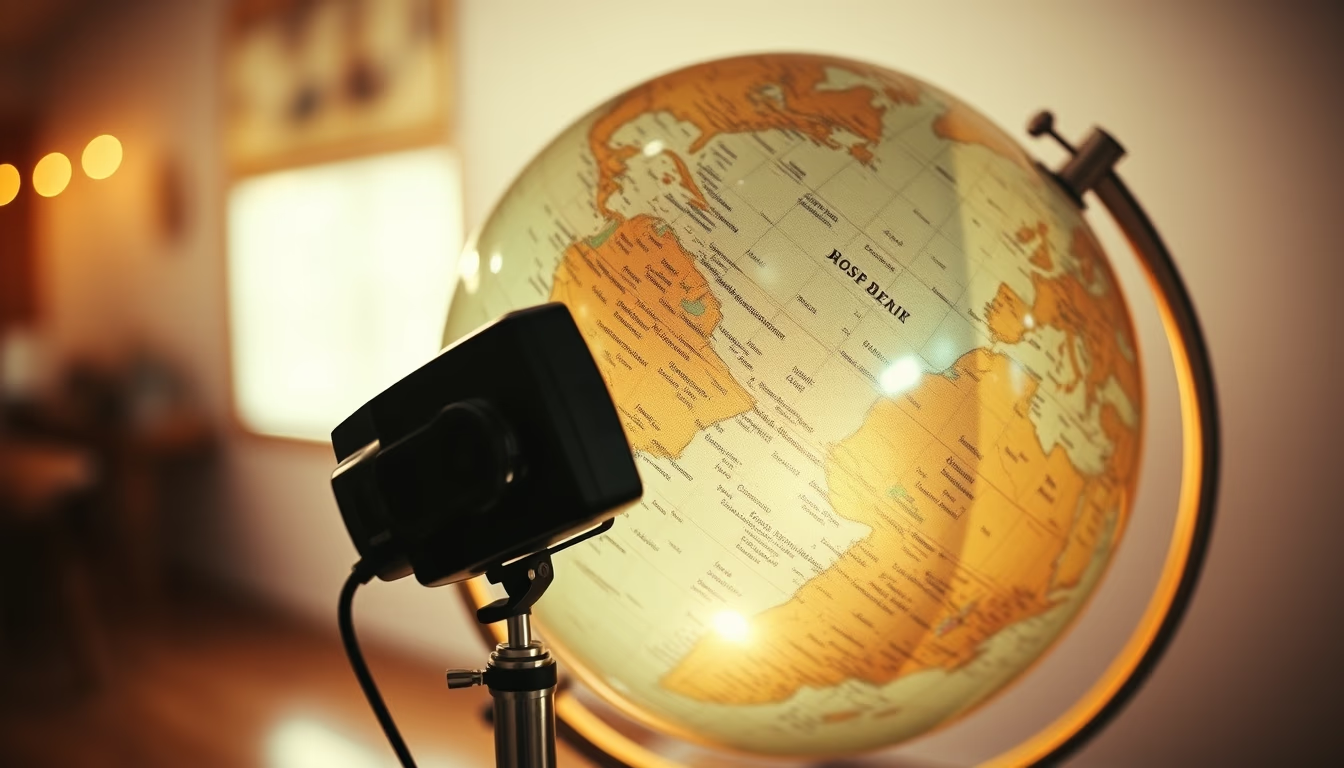
Vintage spinning globe, a classic educational and decorative instrument dating back to the 15th and 16th centuries.
About this subject
The vintage terrestrial globe is an object that combines science, history, and aesthetics. Unlike flat maps, the globe represents the Earth with three-dimensional fidelity, free from projection distortions. The earliest known globes were built in Europe during the Renaissance, such as Martin Behaim's Erdapfel (1492), which still did not include the Americas. By the 16th century, celestial and terrestrial globes were produced in pairs by makers like Gerhard Mercator and Willem Blaeu, often mounted on wooden stands with brass meridian rings. These instruments were used for navigation, astronomy, and education, but also as symbols of status and knowledge.
Vintage globes are typically made with papier-mâché or plaster spheres covered by lithographed or hand-printed paper gores. The finish includes a protective varnish. Many examples date from the 18th and 19th centuries, when cartography became more accurate. The typical stand has a brass or iron meridian ring, and the globe can spin freely. In Brazil, antique globes were imported from Europe and used in schools and private libraries.
Curiosity: one of the world's largest terrestrial globes, the Columbia Globe (1912), is 4.6 meters in diameter and displayed in New York. Small vintage globes, like the one in the image, were common on desks and in reading rooms. The patina of time, with stains and wear, increases collector value. The spinning motion, whether manual or motorized, evokes geographic exploration and the desire to understand the world.
Beyond historical value, the vintage globe is a sought-after decorative piece. Its aesthetics combine nostalgia and erudition, appearing in themed films, cafes, and retro environments. For collectors, the condition of the paper, the accuracy of the maps, and the authenticity of the stand are crucial factors. Modern replicas exist, but the original offers a tangible piece of cartographic history.
Frequently Asked Questions
What is the difference between a terrestrial globe and a celestial globe?
A terrestrial globe represents the Earth's surface, with countries and oceans. A celestial globe shows the stars and constellations as seen from Earth, used in astronomy.
How were antique globes manufactured?
They were made with plaster or papier-mâché spheres, covered with lithographed paper gores. The gores were glued and then varnished. The stand typically had turned wood and brass rings.
Why are some vintage globes valuable to collectors?
Value depends on rarity, condition, cartographic accuracy, maker, and date. Globes by makers like Blaeu or Coronelli are especially valuable. Patina and history also add worth.
Direct URL
https://pub-c7d6a6ea828543ac903a74a341ccb2e1.r2.dev/imagens/globe-vintage-spinning-lo-fi-disposable-camera-p7.avifHow to credit
Include a visible link back to UtilizAí. Copy one of the snippets below:
<a href="https://xn--utiliza-eza.com/en/midia/imagens/globe-vintage-spinning-lo-fi-disposable-camera-p7">Globe vintage spinning</a> by <a href="https://xn--utiliza-eza.com">UtilizAí</a>, licensed under <a href="https://creativecommons.org/licenses/by/4.0/">CC BY 4.0</a>.
[Globe vintage spinning](https://xn--utiliza-eza.com/en/midia/imagens/globe-vintage-spinning-lo-fi-disposable-camera-p7) by [UtilizAí](https://xn--utiliza-eza.com), CC BY 4.0
License: CC-BY-4.0