Broken glass pattern
1344×768 · AVIF · CC BY 4.0
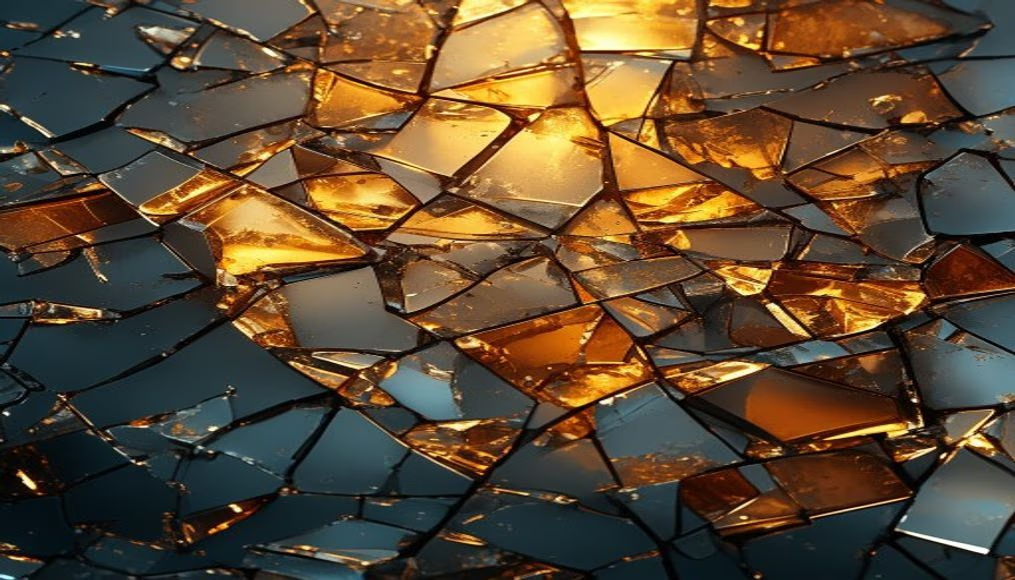
Exploration of patterns formed by broken glass, focusing on aesthetics and light refraction through fragments.
About this subject
Broken glass, despite its often accidental or violent context, reveals a unique aesthetic when observed closely. Fragments of ordinary or tempered glass create random geometric patterns with sharp edges and surfaces that reflect and refract light in unpredictable ways. In urban environments, these shards are commonly found on sidewalks near bus stops or in construction areas, where human or natural impact has generated them.
The science behind fracture patterns is fascinating. Tempered glass, for example, undergoes a tempering process that creates internal stresses, causing it to shatter into small cubes or granules when broken, less sharp than fragments of ordinary glass. Laminated glass, used in windshields, remains held together by a PVB layer, preventing complete dispersion. The randomness of fragments depends on the glass type, applied force, and impact point.
For photographers and artists, broken glass is a rich subject. Sunlight or artificial light passing through fragments can produce prismatic effects, generating small rainbows and color splashes. Macro photography allows capturing details such as internal air bubbles, manufacturing marks, and the textures of fractured surfaces. This approach transforms a dangerous object into an abstract work of art, exploring concepts of fragility, impermanence, and beauty in chaos.
Frequently Asked Questions
Why does tempered glass break into small pieces?
Tempered glass undergoes a tempering process that creates internal compressive and tensile stresses. When broken, these stresses release explosively, producing small cubes or granules that are less sharp and safer.
How to photograph broken glass patterns?
Use a macro lens for close-ups. Take advantage of side light or backlight to emphasize edges and refractions. A tripod helps prevent camera shake. Look for dark backgrounds to make the fragments stand out.
What causes the rainbow effect in glass fragments?
The rainbow effect is caused by the dispersion of white light as it passes through the glass, a phenomenon called refraction. The glass acts like a prism, separating light into colors due to its refractive index and the angle of incidence.
Direct URL
https://pub-c7d6a6ea828543ac903a74a341ccb2e1.r2.dev/imagens/broken-glass-pattern-travel-photography-v10.avifHow to credit
Include a visible link back to UtilizAí. Copy one of the snippets below:
<a href="https://xn--utiliza-eza.com/en/midia/imagens/broken-glass-pattern-travel-photography-v10">Broken glass pattern</a> by <a href="https://xn--utiliza-eza.com">UtilizAí</a>, licensed under <a href="https://creativecommons.org/licenses/by/4.0/">CC BY 4.0</a>.
[Broken glass pattern](https://xn--utiliza-eza.com/en/midia/imagens/broken-glass-pattern-travel-photography-v10) by [UtilizAí](https://xn--utiliza-eza.com), CC BY 4.0
License: CC-BY-4.0