Autonomous drone military
1344×768 · AVIF · CC BY 4.0
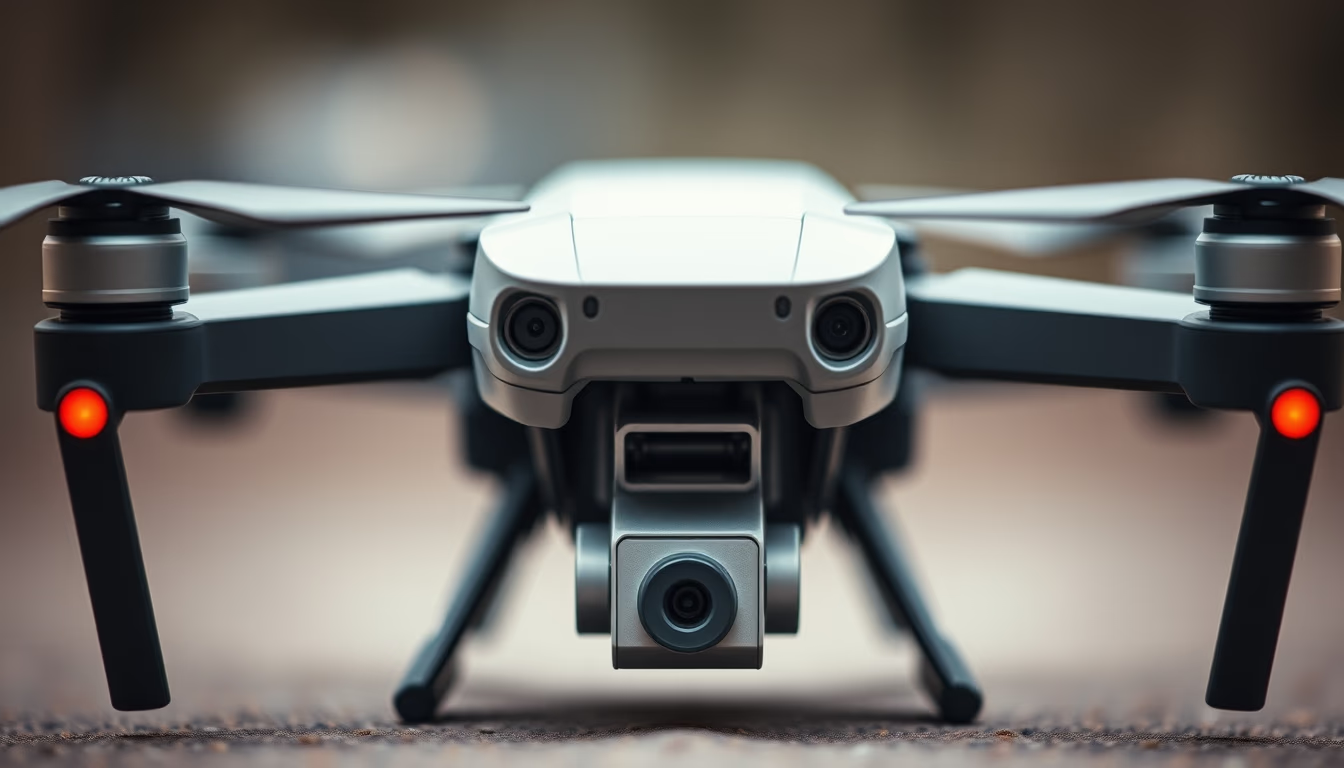
Autonomous military drones are transforming battlefields with artificial intelligence and mission capability without direct human piloting.
About this subject
Autonomous military drones represent one of the most significant evolutions in the history of modern warfare. Unlike conventional unmanned aerial vehicles that rely on remote human control, these systems use artificial intelligence to make real-time decisions such as navigation, target identification, and evasive maneuvers. Development began with programs like the American MQ-9 Reaper, which already operated semi-autonomously, but true autonomy advanced with projects like the X-47B, capable of landing on aircraft carriers without human intervention.
Operational use of autonomous drones is already a reality in recent conflicts. During the 2020 Nagorno-Karabakh war, Turkish Bayraktar TB2 drones, though remotely piloted, demonstrated the effectiveness of unmanned aerial systems. In 2024, Ukrainian forces employed FPV drones with autonomous flight capability against Russian targets, using computer vision to engage without GPS signals. The technology also raises ethical and legal questions: the lack of direct human oversight in attack decisions sparks debates about accountability and compliance with international humanitarian law.
Technical curiosities include the use of reinforcement learning algorithms to train drones in combat simulations, where they learn complex maneuvers. Additionally, swarm systems allow dozens of drones to coordinate simultaneous attacks, as demonstrated by the US Golden Horde program. Miniaturization of sensors and processors has made it possible to embed artificial intelligence in small drones like the Switchblade 300, used by special forces. Despite advances, full autonomy still faces reliability and unpredictability challenges, keeping humans in the loop for critical decisions.
The future points to greater integration with other platforms, such as autonomous tanks and ships, creating interconnected battlefields. Countries like China, Russia, and Israel invest heavily in this area, aiming to overcome human limitations in reaction time and fatigue. However, international agreements, such as discussions in the Convention on Certain Conventional Weapons, seek to establish limits on the use of lethal autonomous systems.
Frequently Asked Questions
What distinguishes an autonomous drone from a remotely controlled drone?
An autonomous drone makes flight and mission decisions without direct human input, using AI and sensors. A remotely controlled drone depends on a distant pilot for every maneuver.
Can autonomous military drones attack without human authorization?
Currently, most autonomous systems require human approval for lethal attacks, following 'human-in-the-loop' policies. However, fully autonomous systems are under development and raise ethical concerns.
Which countries lead in military autonomous drone development?
The United States, China, Russia, and Israel are at the forefront. The US has programs like Loyal Wingman, while China tests the CH-7 and swarm drones.
Direct URL
https://pub-c7d6a6ea828543ac903a74a341ccb2e1.r2.dev/imagens/autonomous-drone-military-macro-closeup-p5.avifHow to credit
Include a visible link back to UtilizAí. Copy one of the snippets below:
<a href="https://xn--utiliza-eza.com/en/midia/imagens/autonomous-drone-military-macro-closeup-p5">Autonomous drone military</a> by <a href="https://xn--utiliza-eza.com">UtilizAí</a>, licensed under <a href="https://creativecommons.org/licenses/by/4.0/">CC BY 4.0</a>.
[Autonomous drone military](https://xn--utiliza-eza.com/en/midia/imagens/autonomous-drone-military-macro-closeup-p5) by [UtilizAí](https://xn--utiliza-eza.com), CC BY 4.0
License: CC-BY-4.0