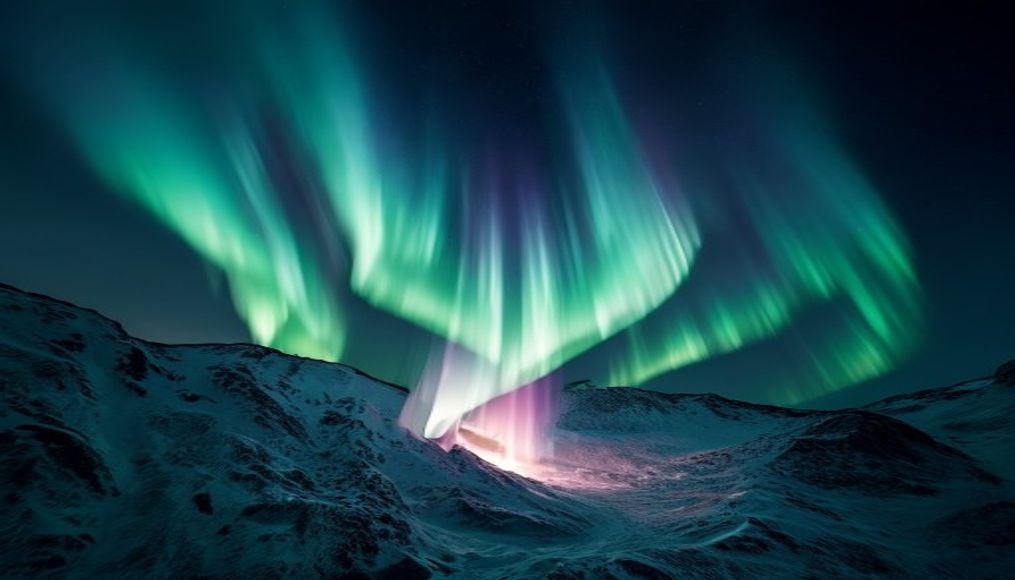
Aurora pillar dance
1344×768 · AVIF · CC BY 4.0
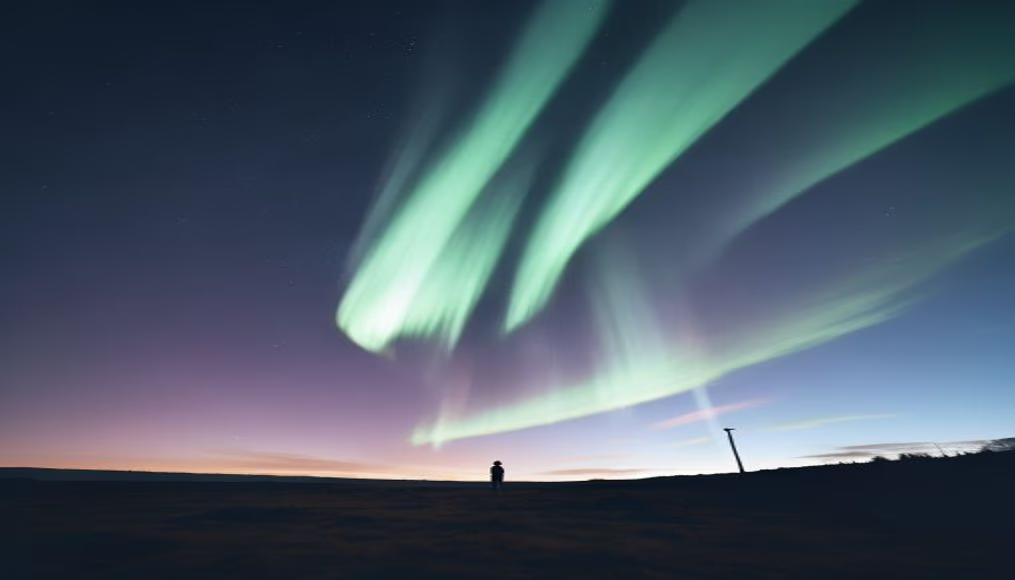
Aurora pillars, also known as light columns, are atmospheric phenomena occurring in polar regions when charged solar particles interact with the upper atmosphere, creating colorful vertical bands in the night sky.
About this subject
Aurora borealis, or northern lights, appears in various forms, including curtains, arcs, and the striking vertical pillars. These light columns occur when Earth's magnetic fields channel solar particles along field lines, creating elongated beams that seem to rise directly from the horizon. The phenomenon is most common during periods of high solar activity, which follows an approximately 11-year cycle with peaks of intensity. Colors range from green to red, depending on altitude and the gas excited: oxygen produces green at low altitudes (100-300 km) and red at high altitudes (above 300 km), while nitrogen generates blue and violet tones.
The best regions to observe aurora pillars are the Arctic Circle, notably northern Norway, Sweden, Finland, Canada, Alaska, and Siberia. In Norway, the Svalbard archipelago offers frequent sightings due to its extreme location. The phenomenon also occurs in the Southern Hemisphere as the aurora australis, visible in Antarctica and sub-Antarctic islands. The optimal viewing season is between September and March in the Arctic, during dark nights with clear skies, away from city light pollution.
Culturally, aurora borealis has inspired mythologies among Nordic and indigenous peoples. Ancient Scandinavians believed they were reflections from the shields of Valkyries, while Alaskan Inuit saw them as the dance of animal spirits. Today, aurora photography has become a popular tourist activity, with dedicated expeditions to capture their beauty. Advanced camera techniques allow recording of the undulating motion of pillars, which can last from seconds to hours. The use of filters and wide-angle lenses helps highlight the colors and dynamics of the celestial curtains.
Science behind aurora pillars relates to the interaction between solar wind and Earth's magnetosphere. When charged particles (electrons and protons) penetrate the atmosphere and collide with molecules, light is emitted. Events such as coronal mass ejections from the Sun can intensify the phenomenon, bringing auroras to lower latitudes, such as southern Canada or northern continental Europe. Though rare, auroras have been recorded in places like Scotland and the northern United States during extreme solar storms.
Frequently Asked Questions
What causes pillars in the northern lights?
Pillars are formed when charged solar particles are channeled along Earth's magnetic field lines, exciting oxygen and nitrogen molecules in the atmosphere and producing light emissions in vertical columns.
What's the difference between aurora borealis and aurora australis?
Aurora borealis occurs in the Northern Hemisphere (near the North Pole), while aurora australis occurs in the Southern Hemisphere (near the South Pole). Both are caused by the same physical process, but visibility depends on geographic location.
Can aurora pillars be predicted?
Yes, through solar activity indices like the Kp-index and forecasts of geomagnetic storms. Specialized websites and apps provide real-time alerts; clear, moonless nights are ideal for observation.
Direct URL
https://pub-c7d6a6ea828543ac903a74a341ccb2e1.r2.dev/imagens/aurora-pillar-dance-lo-fi-disposable-camera-p1.avifHow to credit
Include a visible link back to UtilizAí. Copy one of the snippets below:
<a href="https://xn--utiliza-eza.com/en/midia/imagens/aurora-pillar-dance-lo-fi-disposable-camera-p1">Aurora pillar dance</a> by <a href="https://xn--utiliza-eza.com">UtilizAí</a>, licensed under <a href="https://creativecommons.org/licenses/by/4.0/">CC BY 4.0</a>.
[Aurora pillar dance](https://xn--utiliza-eza.com/en/midia/imagens/aurora-pillar-dance-lo-fi-disposable-camera-p1) by [UtilizAí](https://xn--utiliza-eza.com), CC BY 4.0
License: CC-BY-4.0