Astrolabe ancient
1344×768 · AVIF · CC BY 4.0
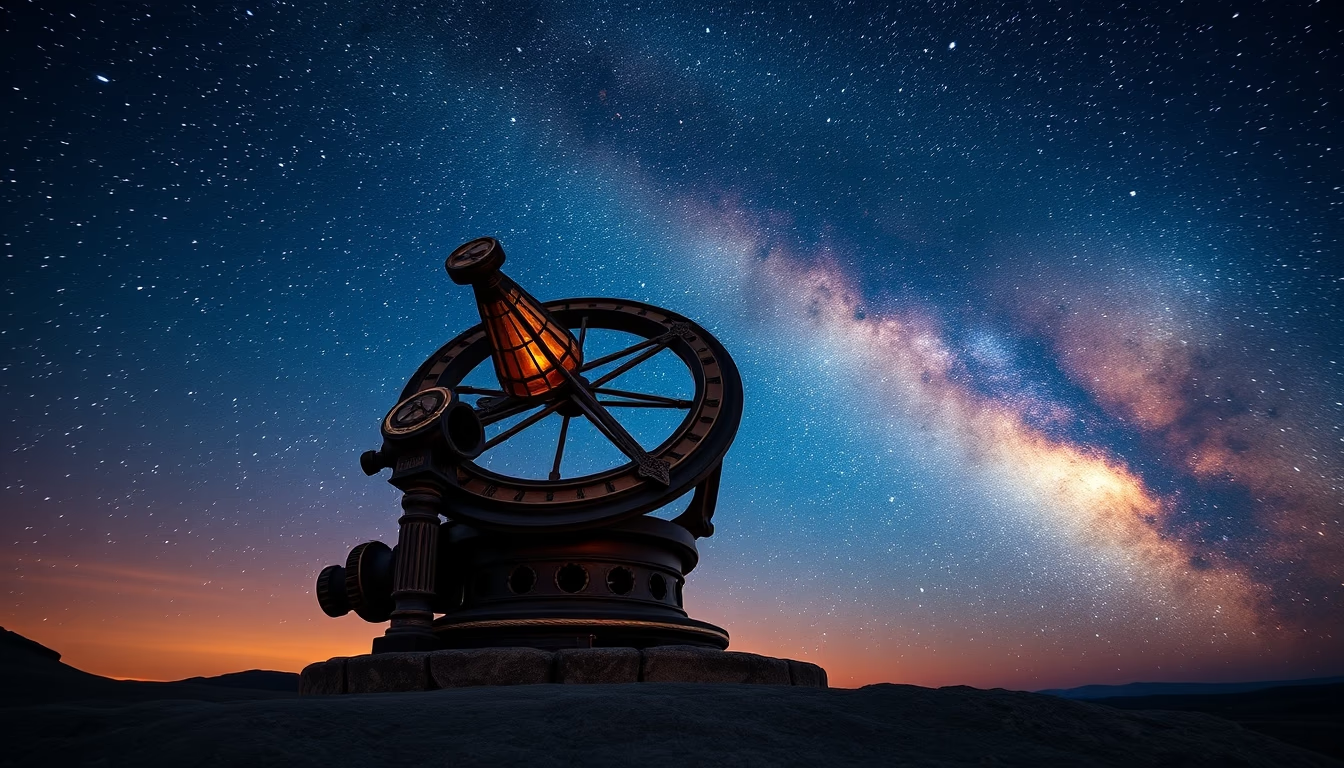
The astrolabe, an astronomical instrument used since antiquity, allowed measuring the height of celestial bodies and solving navigation and time problems.
About this subject
The astrolabe is one of the oldest known scientific instruments, used to measure the position of stars and planets in the sky. Its origins date back to ancient Greece, around the 2nd century BCE, with the astronomer Hipparchus often credited for its early development. The instrument consists of a circular disk (mater) with a coordinate grid (tympan) and a rotating alidade that points to celestial bodies. It works based on stereographic projection, converting celestial coordinates into measurable angles.
During the Middle Ages, the astrolabe was refined by Islamic astronomers, who made it more precise and used it to determine prayer times and the direction of Mecca. It reached Europe in the 10th century and became essential for navigators during the Age of Discovery, enabling latitude calculation from the height of the Sun or the North Star. The instrument was also used in schools to teach astronomy and mathematics, often adorned with engravings and inscriptions.
With the advent of the sextant in the 18th century, the astrolabe lost prominence in navigation, but continued to be used for educational and historical purposes. Today, original pieces are extremely rare and highly valued in museums and collections. The astrolabe represents a milestone in the history of science, demonstrating how ancient civilizations understood the cosmos and integrated technical knowledge into daily life.
Frequently Asked Questions
How does an astrolabe work?
The astrolabe measures the altitude of celestial bodies above the horizon by rotating an alidade until it aligns with the Sun or a star. The angle is read on the limb, and with tables or scales, it is converted into local time or latitude.
Who invented the astrolabe?
There is no single inventor. The principle was developed in ancient Greece, possibly by Hipparchus (2nd century BCE). Islamic astronomers like Al-Farghani and Al-Zarqali refined it between the 9th and 11th centuries.
What is the difference between an astrolabe and a sextant?
The sextant is more precise and modern, using a mirror to measure angles directly, while the astrolabe uses projections and requires more calculations. The sextant replaced the astrolabe in navigation from the 18th century onward.
Direct URL
https://pub-c7d6a6ea828543ac903a74a341ccb2e1.r2.dev/imagens/astrolabe-ancient-long-exposure-p4.avifHow to credit
Include a visible link back to UtilizAí. Copy one of the snippets below:
<a href="https://xn--utiliza-eza.com/en/midia/imagens/astrolabe-ancient-long-exposure-p4">Astrolabe ancient</a> by <a href="https://xn--utiliza-eza.com">UtilizAí</a>, licensed under <a href="https://creativecommons.org/licenses/by/4.0/">CC BY 4.0</a>.
[Astrolabe ancient](https://xn--utiliza-eza.com/en/midia/imagens/astrolabe-ancient-long-exposure-p4) by [UtilizAí](https://xn--utiliza-eza.com), CC BY 4.0
License: CC-BY-4.0