Astrolabe ancient
1344×768 · AVIF · CC BY 4.0
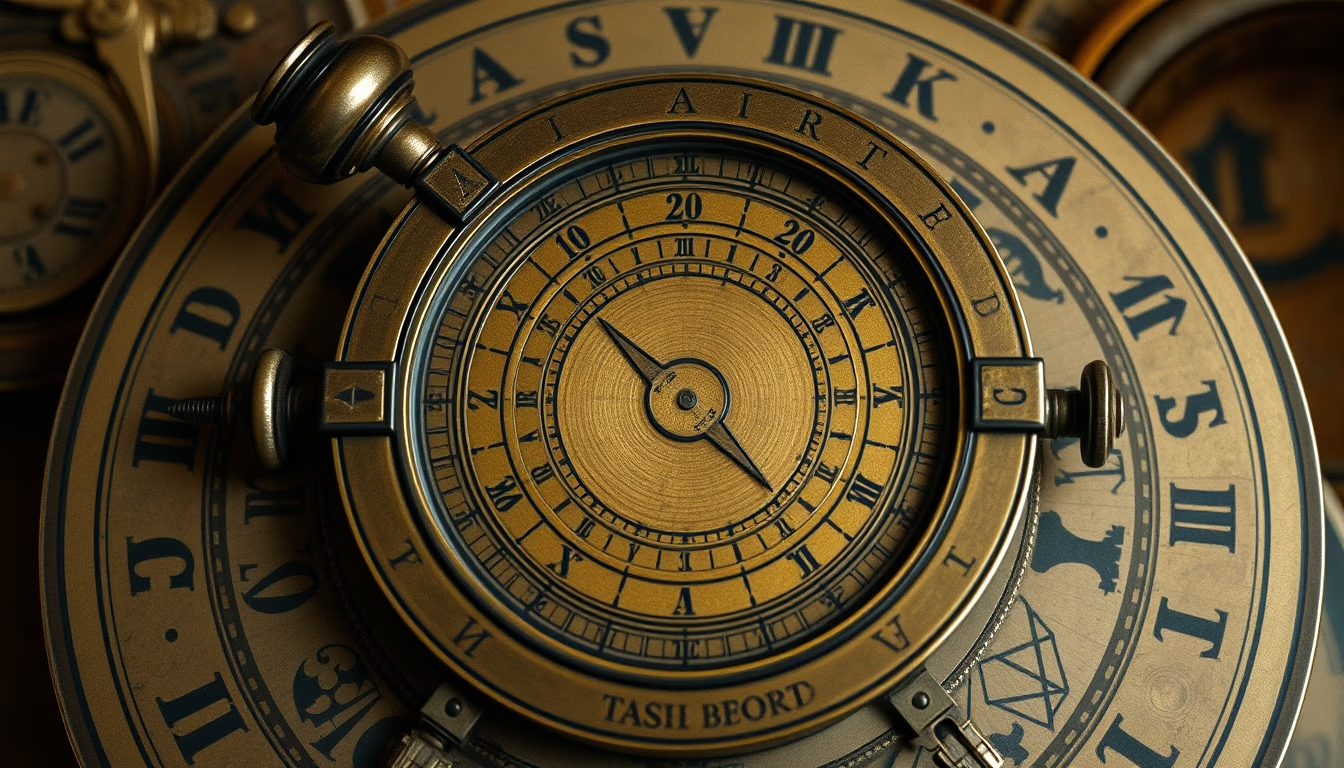
The astrolabe, an ancient astronomical instrument, was used to measure celestial positions and aid navigation.
About this subject
The astrolabe is one of the oldest astronomical instruments, originating in ancient Greece around the 2nd century BC. It was refined by Islamic scholars during the Middle Ages, who turned it into a portable and accurate tool for navigation, astrology, and timekeeping. The instrument consists of a metal disk (mater) with a degree scale, a perforated plate (rete) representing fixed stars and the ecliptic, and a movable alidade to align with celestial bodies. With it, one could calculate the altitude of the Sun or stars above the horizon, determine local latitude, and even predict eclipses.
Its spread to Europe began in the 10th century via the Iberian Peninsula, where translations of Islamic treatises spurred medieval astronomy. Famous astrolabes, such as those of Persian astronomer Abū Rayḥān al-Bīrūnī (11th century) or Ibn al-Shatir (14th century), demonstrate the technical sophistication of the era. The instrument was essential for the Age of Discovery until gradually replaced by the sextant and marine chronometer in the 18th century.
Interestingly, the astrolabe also had religious applications, such as determining the direction of Mecca (qibla) for Islamic prayers. The most elaborate models, carved in brass, are now museum pieces, but their stereographic projection principle is still used in maps and gnomonics. Its accuracy, though limited by modern standards, was remarkable for its time: errors of only a few degrees in altitude measurements.
Frequently Asked Questions
How did the astrolabe work?
The astrolabe used stereographic projection to map the sky on a flat disk. The user aligned the alidade with the Sun or a star and read the angle on the scale, allowing calculation of time or latitude.
When was the astrolabe invented?
The astrolabe was invented in ancient Greece, likely by Hipparchus in the 2nd century BC, but decisive developments occurred in the Islamic world between the 8th and 15th centuries.
Is the astrolabe still used today?
Not as a practical instrument, but it is studied as a historical artifact. Its projection principle is used in some analog devices, such as educational astrolabe maps.
Direct URL
https://pub-c7d6a6ea828543ac903a74a341ccb2e1.r2.dev/imagens/astrolabe-ancient-film-grain-authentic-p1.avifHow to credit
Include a visible link back to UtilizAí. Copy one of the snippets below:
<a href="https://xn--utiliza-eza.com/en/midia/imagens/astrolabe-ancient-film-grain-authentic-p1">Astrolabe ancient</a> by <a href="https://xn--utiliza-eza.com">UtilizAí</a>, licensed under <a href="https://creativecommons.org/licenses/by/4.0/">CC BY 4.0</a>.
[Astrolabe ancient](https://xn--utiliza-eza.com/en/midia/imagens/astrolabe-ancient-film-grain-authentic-p1) by [UtilizAí](https://xn--utiliza-eza.com), CC BY 4.0
License: CC-BY-4.0