Astrolabe ancient
1344×768 · AVIF · CC BY 4.0
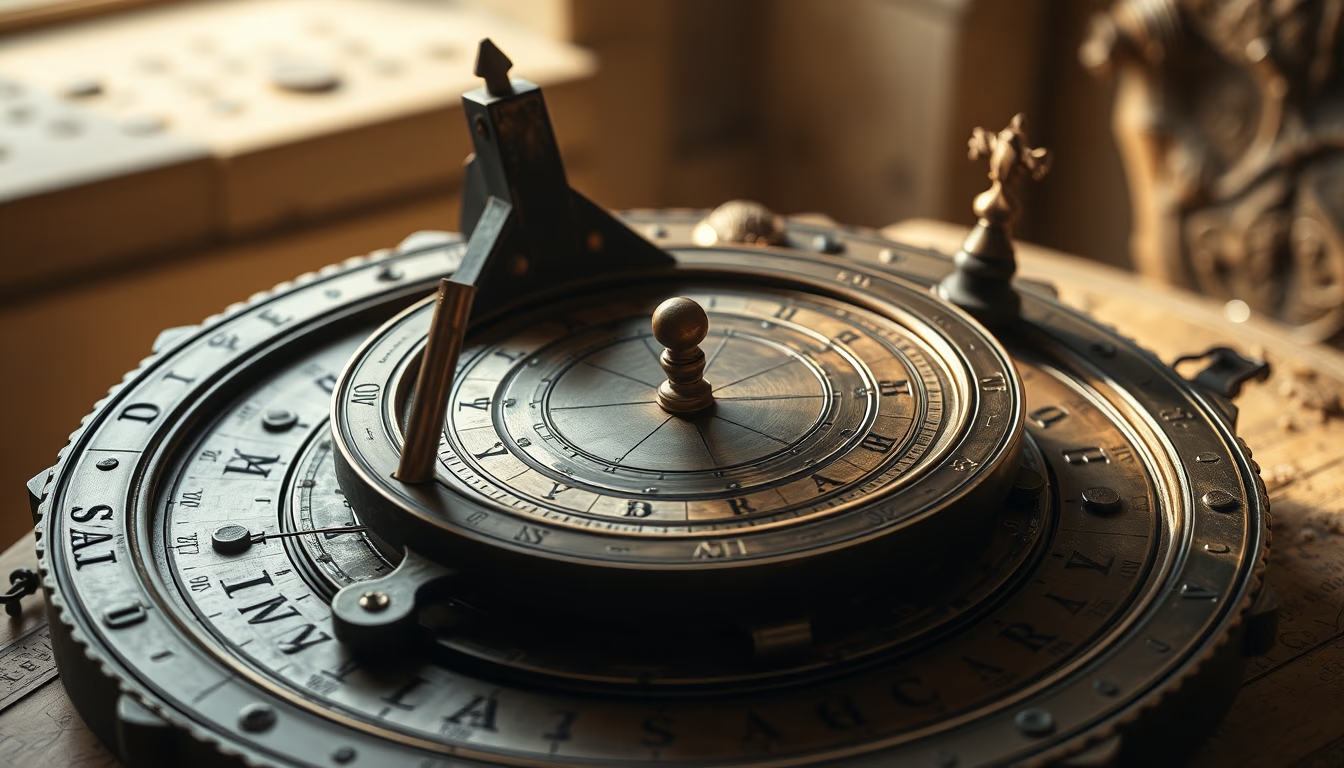
The astrolabe, a medieval astronomical instrument, enabled calculation of celestial positions and local time, crucial for navigation and astrology.
About this subject
The astrolabe is one of the oldest known astronomical instruments, with origins tracing back to ancient Greece around the 2nd century BC. Refined by Islamic scholars during the Middle Ages, it became a versatile tool for determining the positions of the Sun, Moon, stars, and planets. Its operation relies on a rotating disc called the rete, which represents the night sky, over a base plate with celestial coordinates. By aligning the instrument with the altitude of a celestial body, the user could calculate local time, latitude, and even make astrological measurements.
During the European Age of Discovery in the 15th and 16th centuries, the astrolabe was crucial for open-sea navigation, allowing explorers like Vasco da Gama and Pedro Álvares Cabral to determine their position by observing the Sun and stars. However, its use required technical skill and complex calculations, leading to simpler versions like the mariner's astrolabe. With the advent of the sextant in the 18th century, the astrolabe gradually fell out of use, but its legacy endures in museums and as a symbol of ancient science.
Interestingly, astrolabes were also luxury objects, often adorned with gold and silver, commissioned by kings and nobles. Many surviving examples are true works of art, featuring engravings and inscriptions in Arabic, Latin, or Hebrew, reflecting the cultural exchange among Islamic, Christian, and Jewish worlds during the Middle Ages. The Al-Sahili astrolabe from the 11th century is one of the oldest preserved, while Chaucer's astrolabe from the 14th century is famous for its explanatory treatise.
Frequently Asked Questions
What is the origin of the astrolabe?
The astrolabe originated in ancient Greece around the 2nd century BC, but was significantly developed by Islamic scholars during the Middle Ages, becoming a sophisticated instrument for astronomy and navigation.
How was the astrolabe used in navigation?
Navigators measured the altitude of the Sun or a star above the horizon using the astrolabe. With this measurement and astronomical tables, they could calculate the ship's latitude, essential for ocean navigation.
What are the main types of astrolabe?
Main types include the planispheric astrolabe (most common), the mariner's astrolabe (simplified for sea use), and the universal astrolabe (usable at different latitudes). All operate on similar principles.
Direct URL
https://pub-c7d6a6ea828543ac903a74a341ccb2e1.r2.dev/imagens/astrolabe-ancient-documentary-photography-p8.avifHow to credit
Include a visible link back to UtilizAí. Copy one of the snippets below:
<a href="https://xn--utiliza-eza.com/en/midia/imagens/astrolabe-ancient-documentary-photography-p8">Astrolabe ancient</a> by <a href="https://xn--utiliza-eza.com">UtilizAí</a>, licensed under <a href="https://creativecommons.org/licenses/by/4.0/">CC BY 4.0</a>.
[Astrolabe ancient](https://xn--utiliza-eza.com/en/midia/imagens/astrolabe-ancient-documentary-photography-p8) by [UtilizAí](https://xn--utiliza-eza.com), CC BY 4.0
License: CC-BY-4.0