Water droplet on leaf
1344×768 · AVIF · CC BY 4.0
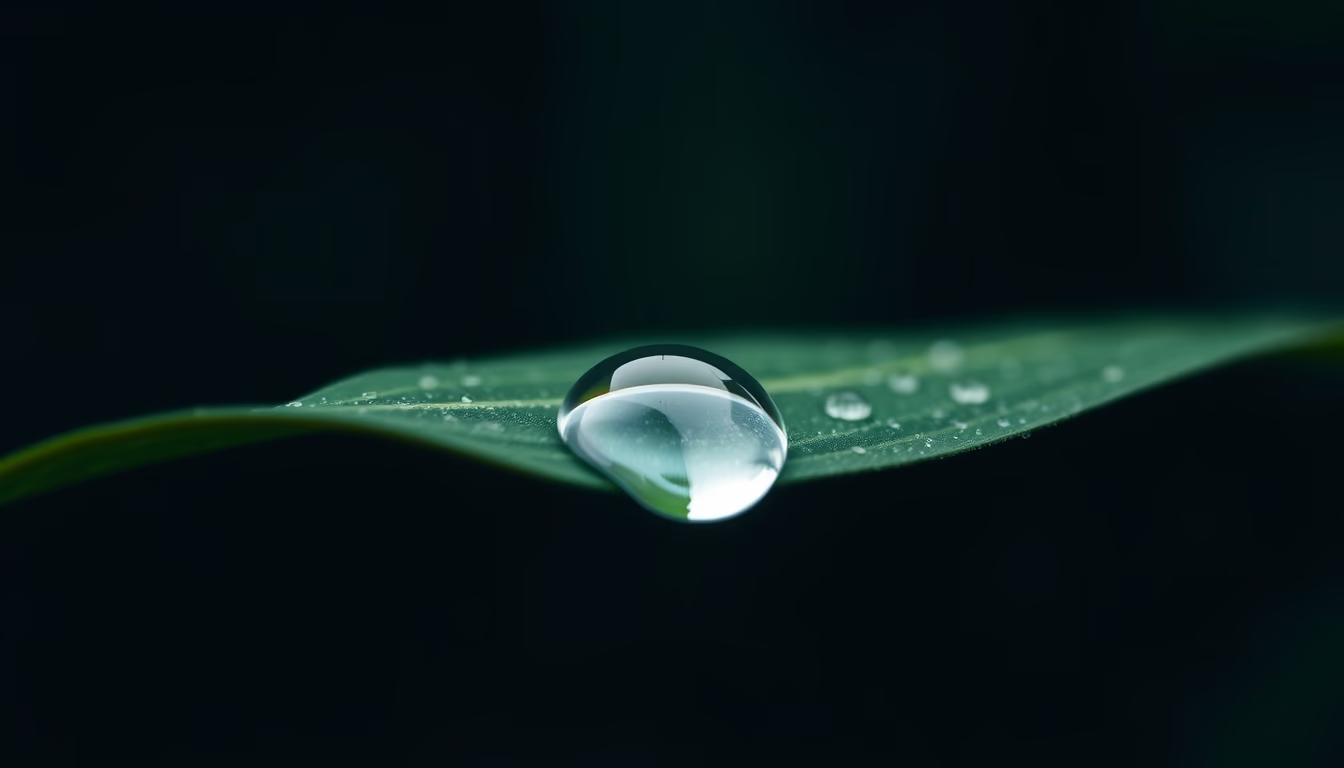
Water droplets on leaves are natural phenomena that combine physics, biology and aesthetics, revealing principles of surface tension and light refraction.
About this subject
Droplets resting on leaves owe their characteristic shape to water's surface tension, a property that makes surface molecules attract each other, forming an elastic film. This force, combined with adhesion between water and the leaf cuticle wax, produces rounded droplets that minimize contact area. The spherical shape is energetically stable and occurs when the contact angle between droplet and leaf exceeds 90 degrees, creating a near-perfect sphere.
There are two main origins for water on leaves: dew and guttation. Dew is condensation of atmospheric moisture during clear, cold nights. Guttation is a physiological process where the plant exudes liquid through hydathodes, structures at leaf margins. It happens when root pressure is high and transpiration is low, typical of moist soil and high humidity. Guttation is common in grasses, strawberries, and many tropical species, releasing not only water but also dissolved minerals.
Optically, each droplet acts as a spherical lens that focuses sunlight onto a focal point. This effect can raise local temperature enough to cause thermal damage or even burn leaf tissue, known as the "lens effect." Studies show droplets 2, 5 mm in diameter can cause burns on sensitive leaves. Some plants have evolved hydrophobic surfaces or trichomes that prevent large droplets from forming, thereby reducing risk.
In fine‑art macro photography, the image of a droplet on a leaf is a classic theme. Photographers exploit refraction, which inverts and magnifies the background, and specular reflections on the droplet's surface. Popularity has grown with social media and the affordability of macro lenses. For 2026, the trend points toward abstract, minimalist compositions that highlight natural textures and patterns, using controlled lighting to enhance reflections and transparency.
Frequently Asked Questions
Why are water droplets on leaves spherical?
The spherical shape is due to water's surface tension, which acts like an elastic film trying to minimize surface area. On hydrophobic surfaces like many leaves, the droplet forms a high contact angle, preserving sphericity.
What is guttation and how does it differ from dew?
Guttation is the exudation of liquid water from leaf margins due to root pressure, occurring mainly at night. Dew is condensation of water vapor from the air onto the leaf surface. Guttation is a plant process; dew is meteorological.
Can water droplets burn leaves?
Yes, spherical droplets act as converging lenses, focusing sunlight into a point. If the sun is strong and the droplet is large (2, 5 mm), the local temperature can rise enough to cause leaf tissue burns.
Direct URL
https://pub-c7d6a6ea828543ac903a74a341ccb2e1.r2.dev/imagens/water-droplet-on-leaf-fine-art-photography-p2.avifHow to credit
Include a visible link back to UtilizAí. Copy one of the snippets below:
<a href="https://xn--utiliza-eza.com/en/midia/imagens/water-droplet-on-leaf-fine-art-photography-p2">Water droplet on leaf</a> by <a href="https://xn--utiliza-eza.com">UtilizAí</a>, licensed under <a href="https://creativecommons.org/licenses/by/4.0/">CC BY 4.0</a>.
[Water droplet on leaf](https://xn--utiliza-eza.com/en/midia/imagens/water-droplet-on-leaf-fine-art-photography-p2) by [UtilizAí](https://xn--utiliza-eza.com), CC BY 4.0
License: CC-BY-4.0