Underwater robot submersible
1344×768 · AVIF · CC BY 4.0
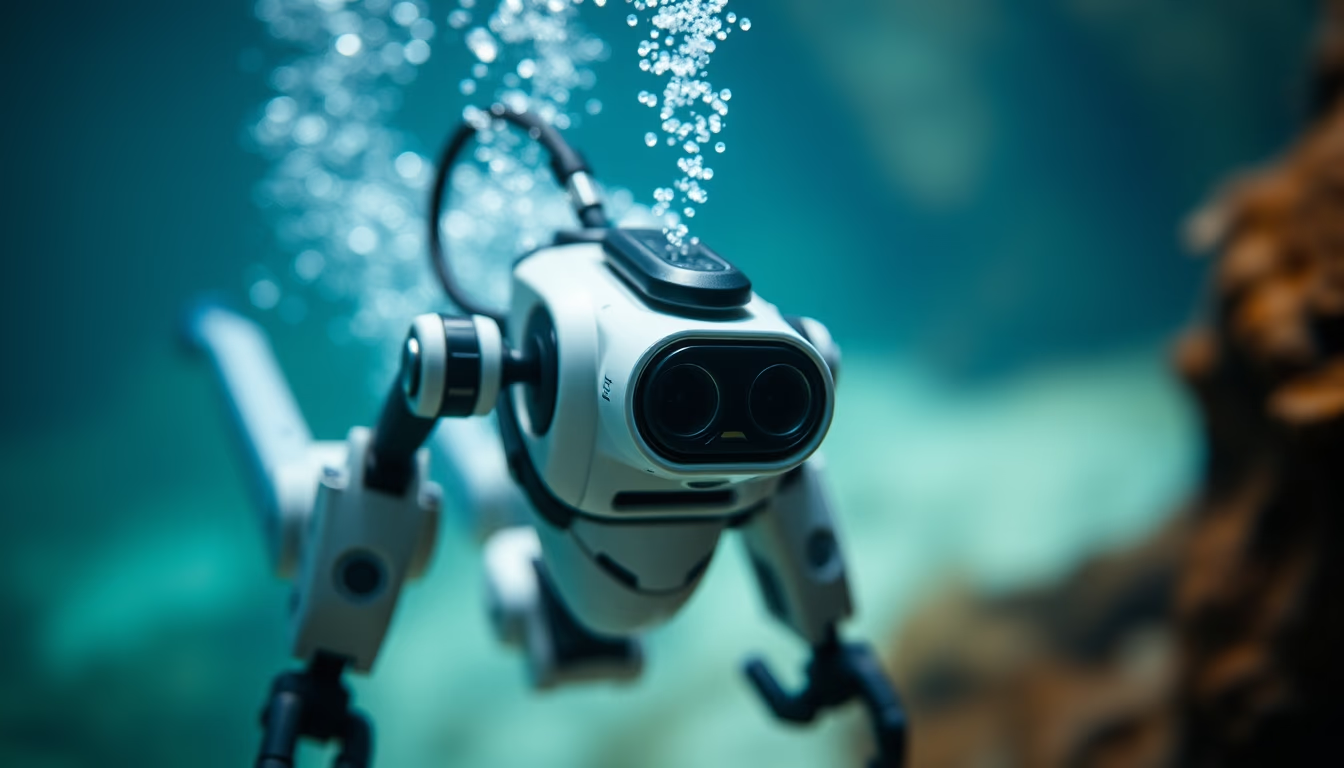
Autonomous underwater submersible robots revolutionize ocean exploration with advanced technology for data collection at extreme depths.
About this subject
Submersible robots are unmanned vehicles designed to operate underwater, performing tasks ranging from scientific research to industrial inspection. They fall into two main categories: AUVs, which navigate autonomously following pre-programmed instructions, and ROVs, remotely controlled by an operator on the surface via a cable. This technology enables exploration of ocean regions inaccessible to humans, such as abyssal trenches and areas under polar ice.
Their applications are vast and critical. In science, they map the seafloor, collect sediment samples, and monitor marine ecosystems. In industry, they inspect pipelines, oil platforms, and submarine cables, reducing risks and costs. They are also used in search and recovery missions, such as locating aircraft wreckage. A notable example is the Nereus vehicle, which reached the Mariana Trench at nearly 11 km depth.
Technically, these machines require materials resistant to extreme pressure, like titanium and ceramics. They use lithium-ion batteries or fuel cells for long missions. Communication is a challenge: while ROVs rely on fiber-optic cables, AUVs store data internally or transmit via acoustic modem. Sensors such as side-scan sonar and high-definition cameras provide detailed images of the ocean floor.
Interestingly, the term "submersible" often causes confusion with manned submarines. The key difference is that submersible robots have no crew, making them safer for hazardous missions. Ongoing development aims for greater energy autonomy and artificial intelligence for real-time decision-making, opening new frontiers for ocean exploration.
Frequently Asked Questions
What is an underwater submersible robot?
It is an unmanned vehicle designed to operate underwater for exploration, scientific research, industrial inspection, and other tasks in aquatic environments.
What is the difference between an AUV and an ROV?
AUVs are autonomous and navigate without a cable, following pre-programmed instructions. ROVs are remotely controlled by an operator on the surface via an umbilical cable.
What are the applications of these robots?
They are used for seafloor mapping, environmental monitoring, oil platform inspection, search for shipwrecks, submarine cable maintenance, and biological sample collection.
Direct URL
https://pub-c7d6a6ea828543ac903a74a341ccb2e1.r2.dev/imagens/underwater-robot-submersible-tilt-shift-miniature-p3.avifHow to credit
Include a visible link back to UtilizAí. Copy one of the snippets below:
<a href="https://xn--utiliza-eza.com/en/midia/imagens/underwater-robot-submersible-tilt-shift-miniature-p3">Underwater robot submersible</a> by <a href="https://xn--utiliza-eza.com">UtilizAí</a>, licensed under <a href="https://creativecommons.org/licenses/by/4.0/">CC BY 4.0</a>.
[Underwater robot submersible](https://xn--utiliza-eza.com/en/midia/imagens/underwater-robot-submersible-tilt-shift-miniature-p3) by [UtilizAí](https://xn--utiliza-eza.com), CC BY 4.0
License: CC-BY-4.0