Underwater robot submersible
1344×768 · AVIF · CC BY 4.0
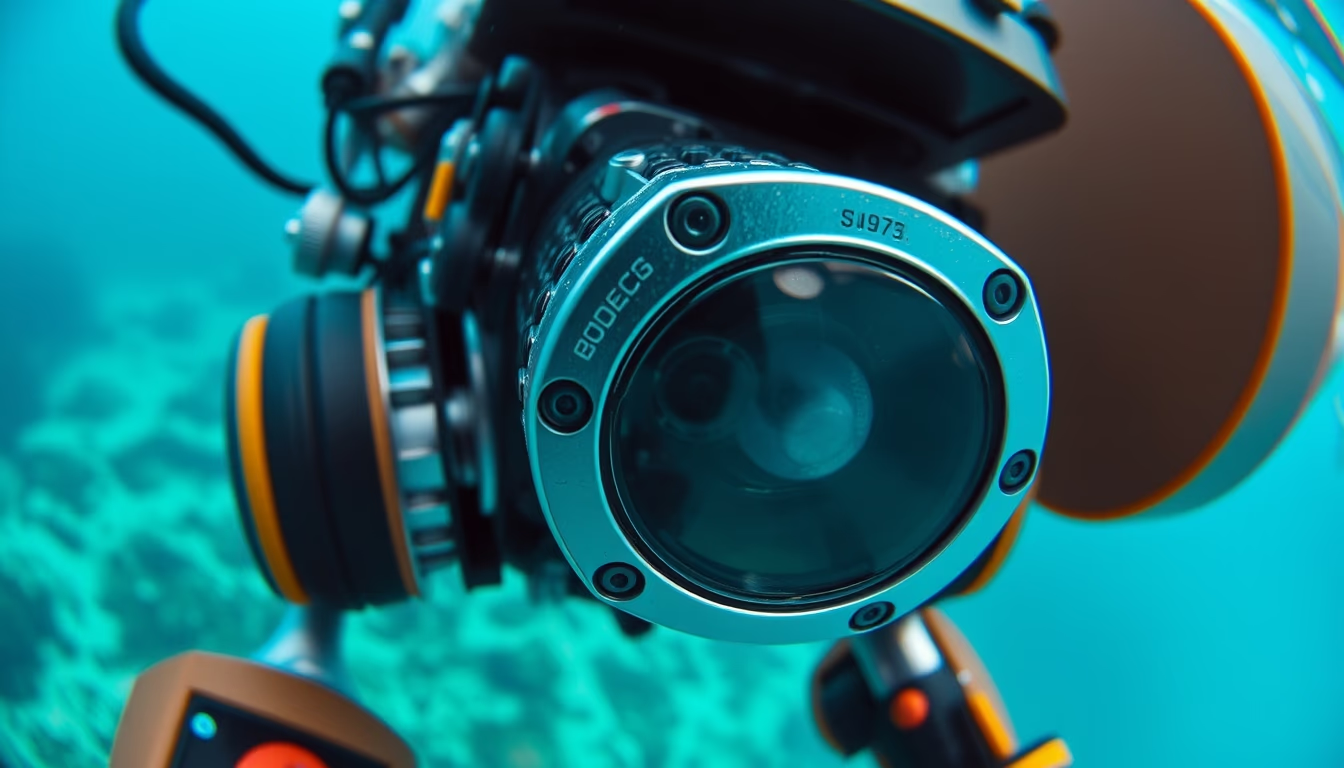
Submersible robots such as ROVs and AUVs are essential for deep ocean exploration, data collection, and underwater infrastructure inspection.
About this subject
Submersible robots are remotely operated vehicles (ROVs) or autonomous underwater vehicles (AUVs) designed to perform tasks in underwater environments. They differ in the degree of human control: ROVs are piloted by an operator on the surface via an umbilical cable, while AUVs follow a pre-programmed mission without constant intervention. This technology enables access to depths that would be lethal for human divers, exceeding 6,000 meters in some models.
Applications are vast. In the oil and gas industry, ROVs inspect pipelines, platforms, and perform maintenance. In marine sciences, AUVs map the seafloor, collect water samples, and monitor ecosystems. Underwater archaeology also benefits, with robots exploring shipwrecks at great depths. Commercial fisheries use vehicles to locate schools of fish and monitor nets.
Technologically, these robots carry high-definition cameras, sonars, temperature and salinity sensors, as well as manipulator arms. The fisheye lens is common in cameras on these vehicles to provide a wide field of view, crucial for navigation and inspection in confined spaces. Lithium batteries and electric thrusters provide up to 30 hours of autonomy in AUVs.
Historically, the first functional ROV was the CURV (Controlled Underwater Recovery Vehicle), developed by the U.S. Navy in the 1960s. Since then, advances in electronics and materials have allowed miniaturization and greater payload capacity. Today, companies like Ocean Infinity operate fleets of AUVs for large-scale mapping, while universities develop low-cost models for coastal research.
Frequently Asked Questions
What is the maximum depth a submersible robot can reach?
Commercial models like the ROV Jason can reach 6,500 meters. The AUV Nereus reached 10,994 meters in the Mariana Trench but was lost in 2014.
How are ROVs controlled over long distances?
Via an umbilical cable that transmits electrical power and video/command signals. Latency is nearly zero because the cable is physically connected.
What typical sensors does an AUV carry?
It includes side-scan sonar, video camera, conductivity-temperature-depth (CTD) sensor, and sometimes a fluorometer to detect chlorophyll.
Direct URL
https://pub-c7d6a6ea828543ac903a74a341ccb2e1.r2.dev/imagens/underwater-robot-submersible-fish-eye-wide-angle-p2.avifHow to credit
Include a visible link back to UtilizAí. Copy one of the snippets below:
<a href="https://xn--utiliza-eza.com/en/midia/imagens/underwater-robot-submersible-fish-eye-wide-angle-p2">Underwater robot submersible</a> by <a href="https://xn--utiliza-eza.com">UtilizAí</a>, licensed under <a href="https://creativecommons.org/licenses/by/4.0/">CC BY 4.0</a>.
[Underwater robot submersible](https://xn--utiliza-eza.com/en/midia/imagens/underwater-robot-submersible-fish-eye-wide-angle-p2) by [UtilizAí](https://xn--utiliza-eza.com), CC BY 4.0
License: CC-BY-4.0