Sugar crystals macro
1344×768 · AVIF · CC BY 4.0
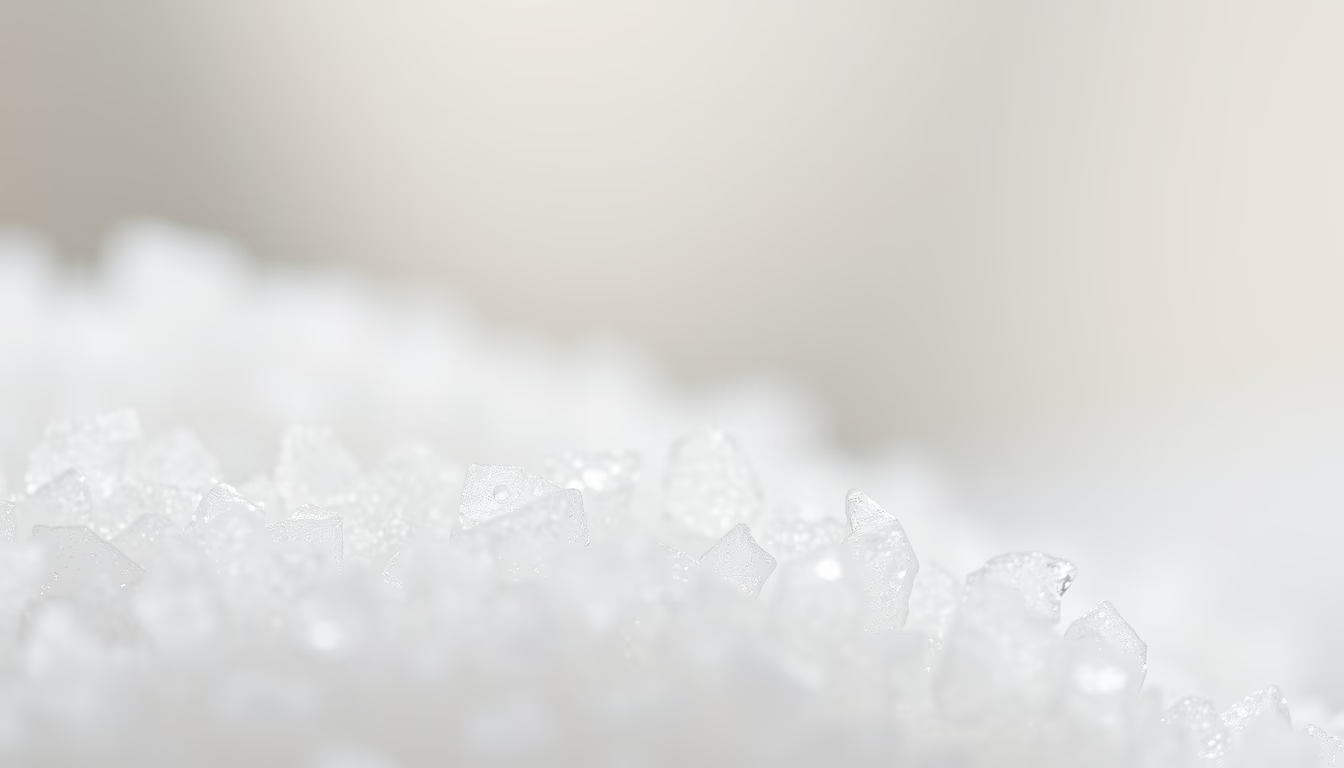
Macro sugar crystals reveal a complex, mesmerizing geometry with facets reminiscent of precious gems.
About this subject
Common sugar, or sucrose, is a disaccharide composed of glucose and fructose, primarily extracted from sugarcane (Saccharum officinarum) and sugar beet. During refining, the juice is concentrated until supersaturation, triggering crystal formation. These crystals belong to the monoclinic crystal system, showing an elongated prismatic habit that, under macro photography, reveals sharp edges and flat faces with a characteristic luster. The purity of sugar directly affects the crystal's transparency and shape: the purer the sugar, the more defined the facets.
Industrial crystallization is carefully controlled to achieve uniform sizes, ranging from refined sugar (fine crystals) to brown sugar (larger, less processed crystals). In nature, sucrose is also found in fruits and vegetables but in much lower concentrations. Interestingly, sugar can form giant crystals when the solution evaporates slowly, a phenomenon used in scientific experiments and artisan confectionery.
Culturally, Brazil is the world's largest producer of sugarcane, with a history dating back to the colonial period. Sugar was a major economic driver, shaping cycles of wealth and inequality. Today, beyond food consumption, sucrose serves as feedstock for ethanol and bioplastics. Macro photography of sugar crystals has become a popular subject for photographers seeking abstract patterns and textures, highlighting the hidden beauty in everyday objects.
Frequently Asked Questions
How are sugar crystals formed?
Sugar crystals form when a sucrose solution reaches supersaturation, i.e., a concentration above the saturation point. Sucrose molecules arrange into regular patterns, nucleating and growing into crystals in a process called crystallization.
What is the crystal structure of sugar?
Sucrose crystallizes in the monoclinic system, with specific cell parameters and a prismatic habit. The crystals are often elongated and have well-defined faces, varying in size depending on refining conditions.
Why does sugar crystallize in different forms?
Crystallization conditions such as temperature, impurity content, and cooling rate determine crystal size and morphology. Refined sugar has small, uniform crystals, while brown or demerara sugar exhibits larger crystals due to less intensive processing.
Direct URL
https://pub-c7d6a6ea828543ac903a74a341ccb2e1.r2.dev/imagens/sugar-crystals-macro-minimalist-composition-p6.avifHow to credit
Include a visible link back to UtilizAí. Copy one of the snippets below:
<a href="https://xn--utiliza-eza.com/en/midia/imagens/sugar-crystals-macro-minimalist-composition-p6">Sugar crystals macro</a> by <a href="https://xn--utiliza-eza.com">UtilizAí</a>, licensed under <a href="https://creativecommons.org/licenses/by/4.0/">CC BY 4.0</a>.
[Sugar crystals macro](https://xn--utiliza-eza.com/en/midia/imagens/sugar-crystals-macro-minimalist-composition-p6) by [UtilizAí](https://xn--utiliza-eza.com), CC BY 4.0
License: CC-BY-4.0