Spectrophotometer cuvettes
1344×768 · AVIF · CC BY 4.0

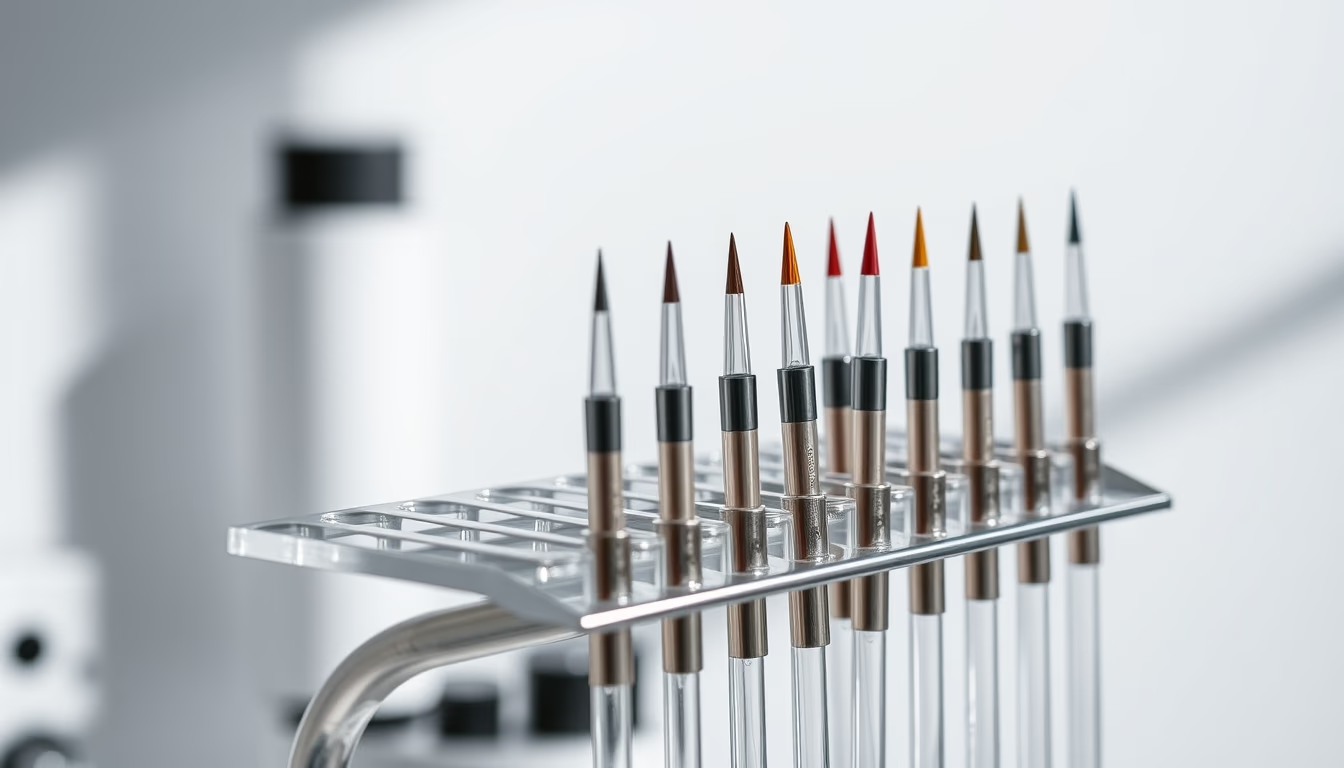
Spectrophotometer cuvettes are precise containers used in optical analysis, varying in material (glass, quartz, plastic) and volume, essential for UV-Vis spectrophotometry. They have standardized optical paths, typically 1 cm, ensuring reproducibility.
About this subject
Spectrophotometer cuvettes are laboratory accessories designed to hold liquid samples during measurements of light absorption or transmittance. The term “cuvette” comes from French, meaning “small container.” These items are integral parts of spectrophotometers, instruments that quantify substance concentration through interaction with electromagnetic radiation, predominantly in the ultraviolet and visible (UV-Vis) range.
Manufacturing materials define the useful spectral range: optical glass cuvettes work between 340 and 2500 nm, while high-purity quartz extends the lower limit to 190 nm, enabling deep UV readings. Plastic cuvettes (polystyrene or PMMA) are disposable and suitable for wavelengths above 340 nm. Choosing the wrong material can distort results, as each substrate absorbs some incident light.
Standardized geometry is crucial: most cuvettes have an optical path length of 1 cm (10 mm) and an external width of 12.5 mm to fit universal sample holders. Typical volumes range from 0.5 to 3.5 mL, though micro (50 µL) and macro (10 mL) versions exist. Flow-through cuvettes are used in automated systems. Additionally, there are quartz models with welded windows for aggressive solvents.
In lab practice, cleanliness is decisive: fingerprints or solvent residues can absorb light and falsify readings. Therefore, handling with gloves and washing with neutral detergent or dilute nitric acid is recommended. Periodic verification of the cuvette pair (reference vs. sample) with distilled water ensures no transmittance differences greater than 0.5%.
Frequently Asked Questions
What is the difference between glass, quartz, and plastic cuvettes?
Optical glass cuvettes are suitable for the visible range (340-2500 nm). Quartz cuvettes allow deep UV measurements (190-2500 nm). Plastic cuvettes are disposable and used only above 340 nm. The choice depends on the wavelength of the analysis.
How to properly clean spectrophotometer cuvettes?
Wash with neutral detergent and deionized water, rinse thoroughly, and dry in air or with compressed air. For stubborn residues, use 10% nitric acid for 24 hours. Never touch the optical faces with fingers.
What does the 1 cm optical path mean?
The optical path is the distance light travels through the sample. The 1 cm standard facilitates the Beer-Lambert Law, as absorbance is directly proportional to concentration and path length.
Direct URL
https://pub-c7d6a6ea828543ac903a74a341ccb2e1.r2.dev/imagens/spectrophotometer-cuvettes-high-fashion-editorial-fresh18.avifHow to credit
Include a visible link back to UtilizAí. Copy one of the snippets below:
<a href="https://xn--utiliza-eza.com/en/midia/imagens/spectrophotometer-cuvettes-high-fashion-editorial-fresh18">Spectrophotometer cuvettes</a> by <a href="https://xn--utiliza-eza.com">UtilizAí</a>, licensed under <a href="https://creativecommons.org/licenses/by/4.0/">CC BY 4.0</a>.
[Spectrophotometer cuvettes](https://xn--utiliza-eza.com/en/midia/imagens/spectrophotometer-cuvettes-high-fashion-editorial-fresh18) by [UtilizAí](https://xn--utiliza-eza.com), CC BY 4.0
License: CC-BY-4.0