Pick and place robot
1344×768 · AVIF · CC BY 4.0

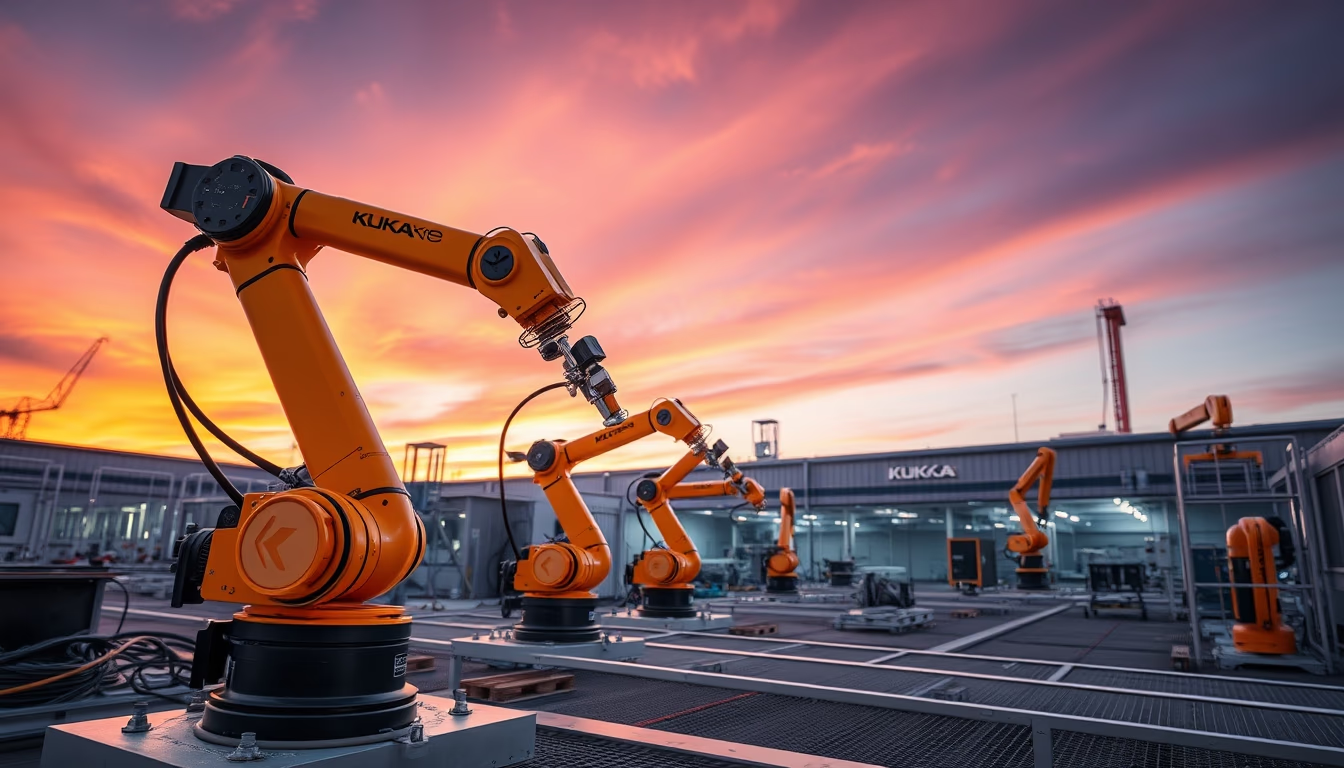
A pick and place robot is an industrial device used to move objects with precision and speed along automated production lines.
About this subject
A pick and place robot is a type of industrial manipulator designed to grasp objects from one location and place them in another with high repeatability. It consists of a robotic arm, an end effector (gripper, suction cup, or magnet), and position sensors, performing rapid pick-and-place cycles. Its origin dates back to the 1960s with the Unimate, the first industrial robot installed by General Motors. Since then, it has evolved to meet demands for speed and precision, especially in the electronics, food, and pharmaceutical industries.
In Industry 4.0, pick and place robots are integrated with computer vision and artificial intelligence systems to identify and handle varied parts. They operate at speeds that can reach 200 moves per minute, far surpassing human capability. This automation reduces costs and errors, enabling continuous 24-hour production. Positional accuracy reaches tenths of a millimeter, essential for assembling tiny components on circuit boards.
There are several types of pick and place robots. Cartesian or gantry robots move along linear axes and are common on assembly lines. SCARA robots, with articulated horizontal arms, are popular in electronics for their rigidity and speed. Delta robots, with a pyramid-shaped suspension structure, are extremely fast and lightweight, capable of accelerations up to 10g, ideal for packaging and sorting products. The choice depends on part weight, reach, speed, and working environment.
Interestingly, pick and place robots are not limited to factories. Smaller versions are used in biology labs to manipulate samples and in hospitals to prepare medications. They are also found in automated warehouses, moving boxes and packages. Although their function seems simple, the system design involves complex control engineering and trajectory optimization to minimize vibrations and cycle time.
Frequently Asked Questions
What is the difference between a pick and place robot and a common industrial robot?
A pick and place robot is specialized for pick-and-place operations with high speed and repeatability, whereas common industrial robots can perform varied tasks like welding, painting, or assembly. Pick and place robots typically have shorter reach and lower payload but higher speed.
In which industrial sectors are pick and place robots most used?
They are widely used in the electronics industry for circuit board assembly, in the food industry for packaging and sorting, in pharmaceuticals for handling medications, and in logistics for moving items in warehouses.
What are the most common types of pick and place robots?
The most common types are: Cartesian (gantry) robots, SCARA robots (horizontal articulation), and delta robots (parallel structure). Each is suited for different applications based on speed, precision, and load capacity.
Direct URL
https://pub-c7d6a6ea828543ac903a74a341ccb2e1.r2.dev/imagens/pick-and-place-robot-travel-photography-p1.avifHow to credit
Include a visible link back to UtilizAí. Copy one of the snippets below:
<a href="https://xn--utiliza-eza.com/en/midia/imagens/pick-and-place-robot-travel-photography-p1">Pick and place robot</a> by <a href="https://xn--utiliza-eza.com">UtilizAí</a>, licensed under <a href="https://creativecommons.org/licenses/by/4.0/">CC BY 4.0</a>.
[Pick and place robot](https://xn--utiliza-eza.com/en/midia/imagens/pick-and-place-robot-travel-photography-p1) by [UtilizAí](https://xn--utiliza-eza.com), CC BY 4.0
License: CC-BY-4.0