Paper texture fiber macro
1344×768 · AVIF · CC BY 4.0
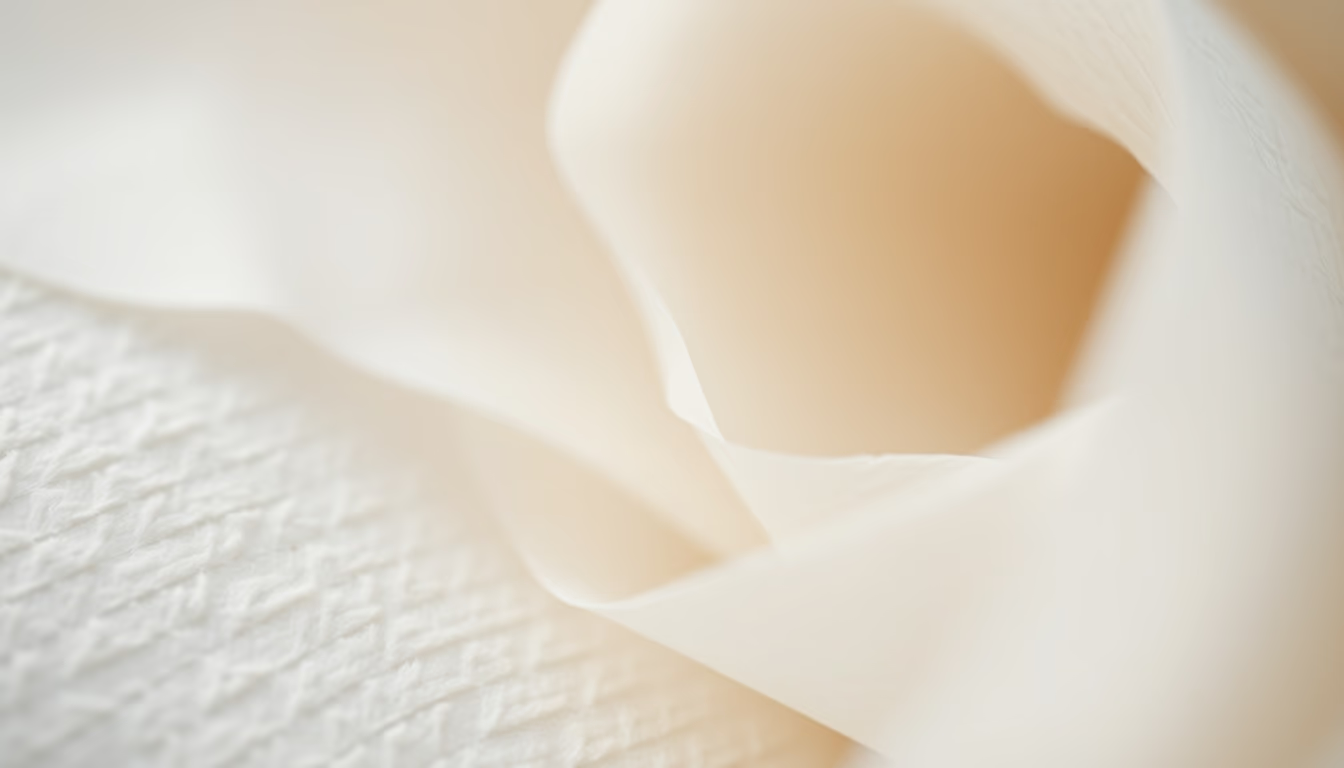
Details of the cellulose fibers that make up paper, revealing the natural structure and texture at macro scale.
About this subject
Paper is formed by an interlaced network of plant fibers, primarily cellulose extracted from wood. At macro scale, these fibers appear as long, irregular filaments with thicknesses ranging from 0.01 to 0.1 millimeters. The random arrangement of fibers gives paper its strength, porosity, and ink absorption capacity. In manufacturing, the cellulose pulp is spread over a screen, where water is drained and fibers bond through hydrogen bridges to form the sheet.
Macro photography of paper fibers reveals details such as surface roughness, fiber orientation, and the presence of natural impurities like lignin fragments. High-quality papers, such as those used for watercolor or fine art printing, feature long and uniform fibers, while recycled papers have shorter, broken fibers. Grammage, measured in g/m², is directly related to the density and thickness of the fibrous network.
Interestingly, paper texture also influences the tactile and visual perception of printed works. Papers with prominent fibers, such as kraft or handmade papers, convey a rustic and natural feel. Coated papers, like glossy or matte coated, have fibers sealed by calcium carbonate layers, resulting in a smooth surface. Microscopic fiber analysis is used in document conservation to identify paper origin and degradation state.
Frequently Asked Questions
What are paper fibers?
They are the structural units of paper, mainly composed of cellulose, hemicellulose, and lignin. They interlace to form the sheet, determining physical properties like strength, absorption, and texture.
How does paper texture affect printing?
A rougher texture with irregular fibers can result in less definition for fine details and higher ink absorption, while smooth surfaces allow better reproduction of images and vibrant colors.
What is the difference between long-fiber and short-fiber paper?
Long fibers (from conifers like pine) provide greater strength and flexibility, ideal for kraft paper. Short fibers (from eucalyptus or cotton) produce softer papers with higher opacity, used for printing and writing papers.
Direct URL
https://pub-c7d6a6ea828543ac903a74a341ccb2e1.r2.dev/imagens/paper-texture-fiber-macro-macro-closeup-p4.avifHow to credit
Include a visible link back to UtilizAí. Copy one of the snippets below:
<a href="https://xn--utiliza-eza.com/en/midia/imagens/paper-texture-fiber-macro-macro-closeup-p4">Paper texture fiber macro</a> by <a href="https://xn--utiliza-eza.com">UtilizAí</a>, licensed under <a href="https://creativecommons.org/licenses/by/4.0/">CC BY 4.0</a>.
[Paper texture fiber macro](https://xn--utiliza-eza.com/en/midia/imagens/paper-texture-fiber-macro-macro-closeup-p4) by [UtilizAí](https://xn--utiliza-eza.com), CC BY 4.0
License: CC-BY-4.0