Old map parchment
1344×768 · AVIF · CC BY 4.0
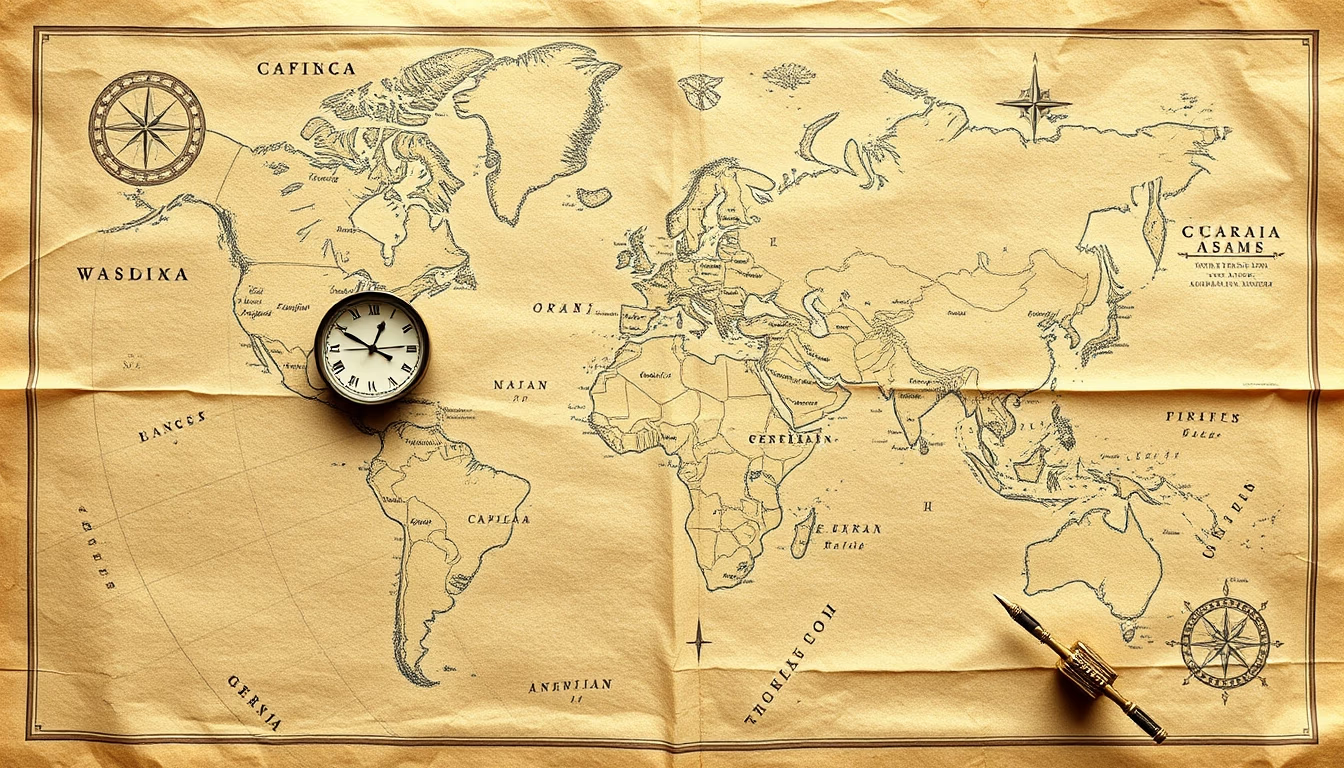
Old map parchment, used by cartographers before paper became widespread, reveals historical techniques and materials for representing the world.
About this subject
Parchment, made from animal skin (usually sheep, goat, or calf), was the primary medium for cartography in Europe during the Middle Ages and the Renaissance. Before paper became widespread, maps were hand-drawn on this prepared surface, which offered durability and resistance to handling. The manufacturing process involved washing, stretching, and scraping the skin, followed by drying under tension, resulting in a thin, uniform sheet. Parchment maps often featured illuminations, ornamental capital letters, and decorative elements, reflecting the high cost and artistic value of the material.
Ancient parchment maps were not only navigation tools but also symbols of power and knowledge. Kings, merchants, and explorers commissioned detailed atlases and nautical charts for administrative, military, and commercial purposes. A famous example is the Catalan Atlas of 1375 by Cresques Abraham, which combined geographical information with biblical and mythological narratives. Preserving these maps is challenging: parchment is sensitive to humidity, temperature changes, and light, requiring controlled conditions in archives and museums.
Today, the study of historical parchment uses techniques such as radiocarbon dating and paleographic analysis to authenticate and date documents. Institutions like the Bibliothèque nationale de France and the British Library hold significant collections. In Brazil, the National Archive and the National Library preserve colonial parchment maps, testimonies to the exploration and occupation of the territory. These artifacts are primary sources for historians, geographers, and conservators, revealing not only the evolution of geographical knowledge but also the artisanal practices of mapmaking.
Frequently Asked Questions
How was parchment prepared to receive ink for old maps?
Parchment was made from animal skin, which was washed, dehaired, stretched on a frame, and scraped with a curved knife. After drying, the surface was smoothed with pumice to make it uniform and receptive to ink.
What are the biggest challenges in preserving parchment maps?
Key challenges include humidity control (to prevent warping and mold), protection from UV light (which fades pigments), and maintaining stable temperature. Parchment is also prone to tearing and needs proper support in storage and display.
Are there famous parchment maps that have survived to this day?
Yes, notable examples include the Catalan Atlas (1375), the Hereford Mappa Mundi (c. 1300), and the Carta Pisana (c. 1275). These documents are national treasures housed in institutions like the Bibliothèque nationale de France and Hereford Cathedral.
Direct URL
https://pub-c7d6a6ea828543ac903a74a341ccb2e1.r2.dev/imagens/old-map-parchment-isometric-flat-lay-p9.avifHow to credit
Include a visible link back to UtilizAí. Copy one of the snippets below:
<a href="https://xn--utiliza-eza.com/en/midia/imagens/old-map-parchment-isometric-flat-lay-p9">Old map parchment</a> by <a href="https://xn--utiliza-eza.com">UtilizAí</a>, licensed under <a href="https://creativecommons.org/licenses/by/4.0/">CC BY 4.0</a>.
[Old map parchment](https://xn--utiliza-eza.com/en/midia/imagens/old-map-parchment-isometric-flat-lay-p9) by [UtilizAí](https://xn--utiliza-eza.com), CC BY 4.0
License: CC-BY-4.0