Magnifying glass papers
1344×768 · AVIF · CC BY 4.0
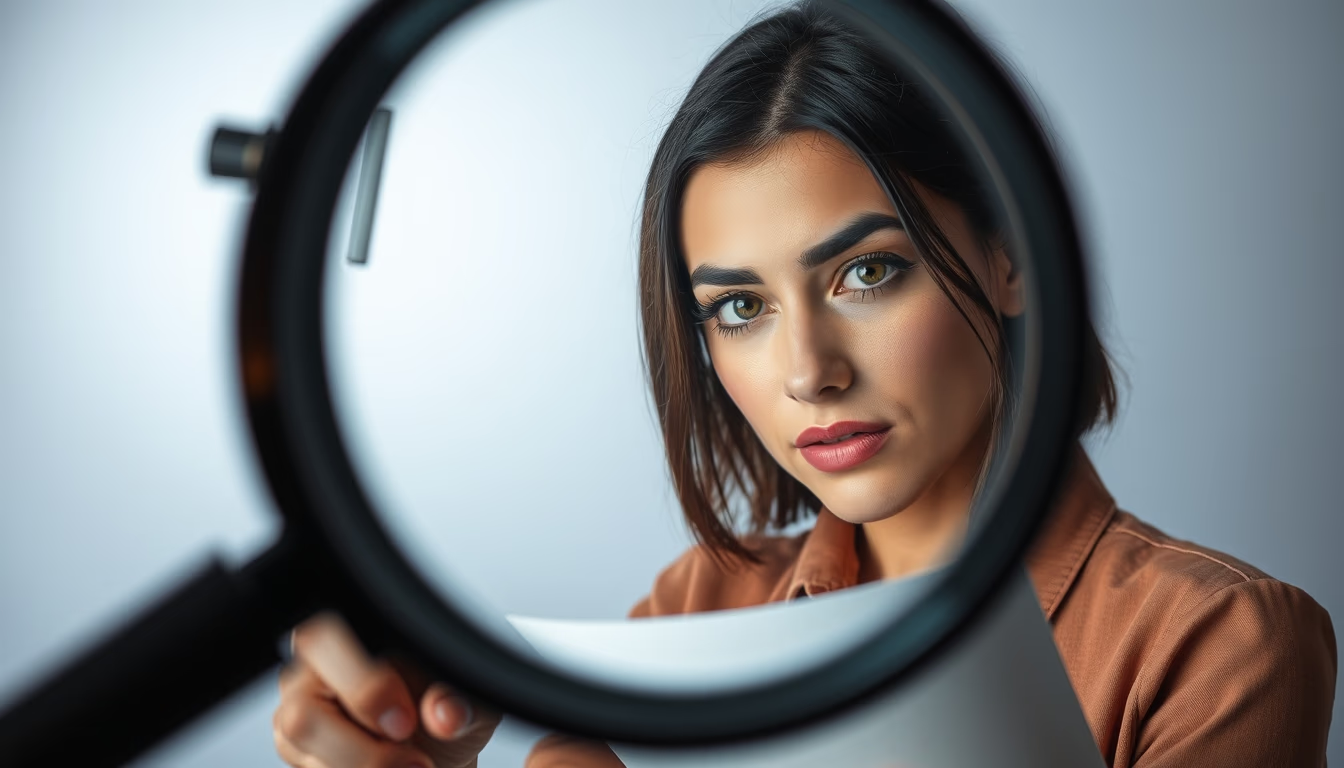
Magnifying glass over old papers: an essential tool for studying historical documents and maps, revealing details invisible to the naked eye.
About this subject
The magnifying glass, also known as a hand lens, is an optical instrument that enlarges the image of small objects or fine details. Its use in studying antiquities, especially old documents and maps, is essential for paleographers, historians, and conservators. When examining aged papers, the magnifying glass helps identify watermarks, ink types, erasures, and writing techniques dating back centuries.
The history of the magnifying glass dates back to the 13th century when Roger Bacon described the principles of magnification. However, it was only in the 17th century that hand lenses became popular among naturalists and scholars. In the Brazilian context, the analysis of colonial documents, such as those in the National Archive, often requires the use of magnifying glasses to decipher calligraphy worn by time. Many maps from the Age of Discovery also contain details visible only with magnification.
Interestingly, modern magnifying glasses may have built-in illumination and various lens diameters for specific applications. In the antiques trade, a jeweler's loupe is standard for verifying the authenticity of seals, signatures, and paper texture. Digital technology now offers portable microscopes, but the traditional magnifying glass remains preferred for its simplicity and reliability in fieldwork.
Frequently Asked Questions
Why use a magnifying glass to examine old documents?
The magnifying glass enlarges details such as watermarks, paper fibers, and ink strokes, aiding in authentication and reading of texts worn by time.
What is the difference between a magnifying glass and a microscope?
A magnifying glass offers up to 10x magnification for general observation, while a microscope achieves much higher magnifications, ideal for analyzing particles and microstructures.
Which type of magnifying glass is best for old maps?
Magnifying glasses with large lenses and good illumination are recommended, as they allow viewing extensive areas without distortion, preserving the map's integrity.
Direct URL
https://pub-c7d6a6ea828543ac903a74a341ccb2e1.r2.dev/imagens/magnifying-glass-papers-studio-editorial-portrait-p6.avifHow to credit
Include a visible link back to UtilizAí. Copy one of the snippets below:
<a href="https://xn--utiliza-eza.com/en/midia/imagens/magnifying-glass-papers-studio-editorial-portrait-p6">Magnifying glass papers</a> by <a href="https://xn--utiliza-eza.com">UtilizAí</a>, licensed under <a href="https://creativecommons.org/licenses/by/4.0/">CC BY 4.0</a>.
[Magnifying glass papers](https://xn--utiliza-eza.com/en/midia/imagens/magnifying-glass-papers-studio-editorial-portrait-p6) by [UtilizAí](https://xn--utiliza-eza.com), CC BY 4.0
License: CC-BY-4.0