Magnifying glass papers
1344×768 · AVIF · CC BY 4.0
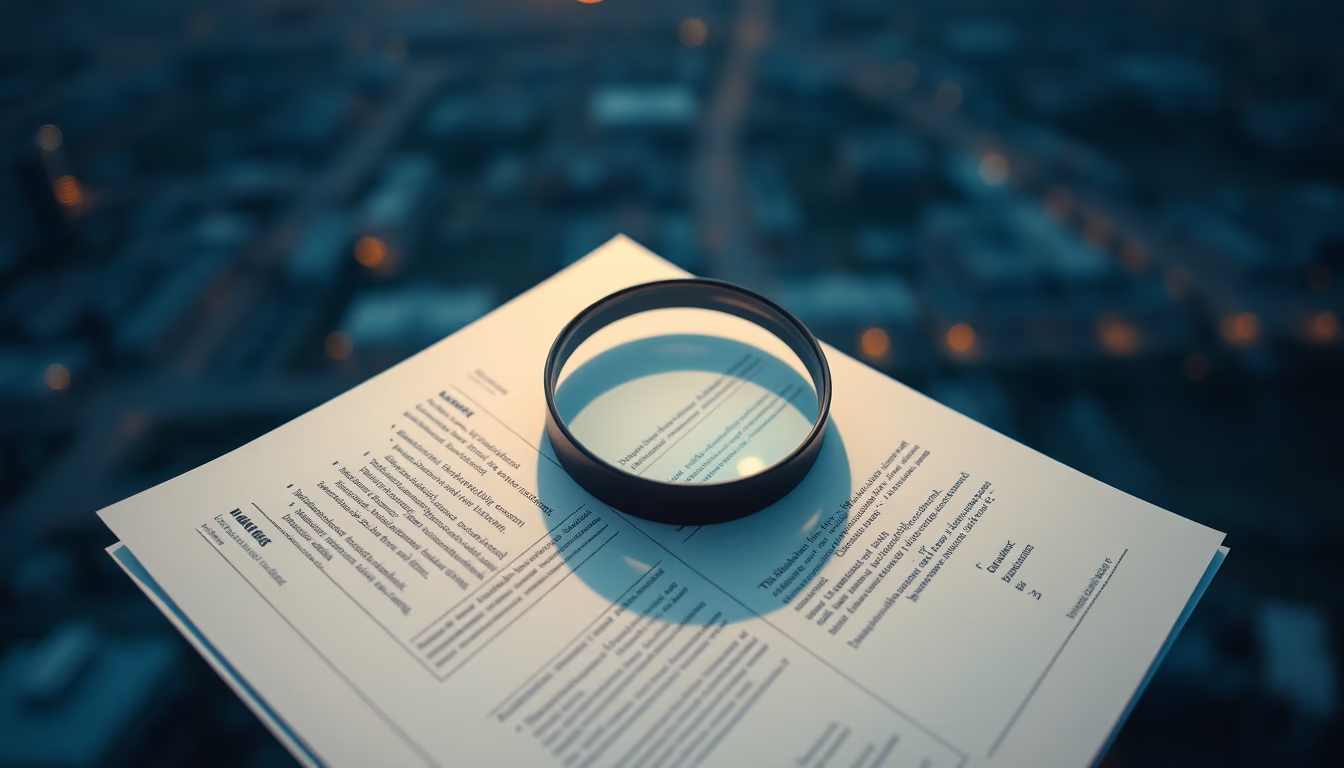
Historical documents under a magnifying glass reveal forgotten details of centuries-old correspondence and bureaucracy.
About this subject
The magnifying glass is an essential tool for paleographers and archivists studying ancient manuscripts. Papers from the 17th to 19th centuries, often stained, torn, or with faded handwriting, require magnification for accurate reading. Preventive conservation techniques, such as humidity and temperature control, are applied by public archives and universities to prevent further damage. In Brazil, the National Archive safeguards millions of colonial and imperial documents, including correspondence of Emperor Pedro II, which undergo digitization processes using high-resolution magnifying glasses.
Analysis of old papers also helps date manuscripts by observing watermarks and paper fibers. These details, invisible to the naked eye, are revealed by magnifying glasses with up to 10x magnification. Many historians use jeweler's loupes in the field, during excavations or in dusty archives, to authenticate documents. The technique is not limited to reading: the magnifying glass aids in identifying erasures, folds, and wax seals.
Museums and libraries worldwide offer paleographic reading workshops where the use of the magnifying glass is taught. The practice dates back to the Renaissance, when scholars began applying systematic methods to the analysis of classical texts. Today, modern equipment such as digital magnifying glasses with LED lighting replace traditional ones, but the principle remains the same: to amplify vision in order to understand the past.
Frequently Asked Questions
Why use a magnifying glass to read old documents?
A magnifying glass amplifies details such as handwriting strokes, watermarks, and erasures that are imperceptible to the naked eye. This helps paleographers decipher faded texts and authenticate documents.
What care should I take when handling historical papers?
Wear cotton or latex gloves to avoid oil transfer. Maintain the documents in a controlled environment with temperature 18-22°C and relative humidity 45-55%.
Where can I find old documents in Brazil?
The National Archive (Rio de Janeiro), the Brazilian Historical and Geographic Institute (São Paulo and Rio), and university libraries hold significant collections of colonial and imperial manuscripts.
Direct URL
https://pub-c7d6a6ea828543ac903a74a341ccb2e1.r2.dev/imagens/magnifying-glass-papers-aerial-drone-shot-p7.avifHow to credit
Include a visible link back to UtilizAí. Copy one of the snippets below:
<a href="https://xn--utiliza-eza.com/en/midia/imagens/magnifying-glass-papers-aerial-drone-shot-p7">Magnifying glass papers</a> by <a href="https://xn--utiliza-eza.com">UtilizAí</a>, licensed under <a href="https://creativecommons.org/licenses/by/4.0/">CC BY 4.0</a>.
[Magnifying glass papers](https://xn--utiliza-eza.com/en/midia/imagens/magnifying-glass-papers-aerial-drone-shot-p7) by [UtilizAí](https://xn--utiliza-eza.com), CC BY 4.0
License: CC-BY-4.0