Insect compound eye macro
1344×768 · AVIF · CC BY 4.0
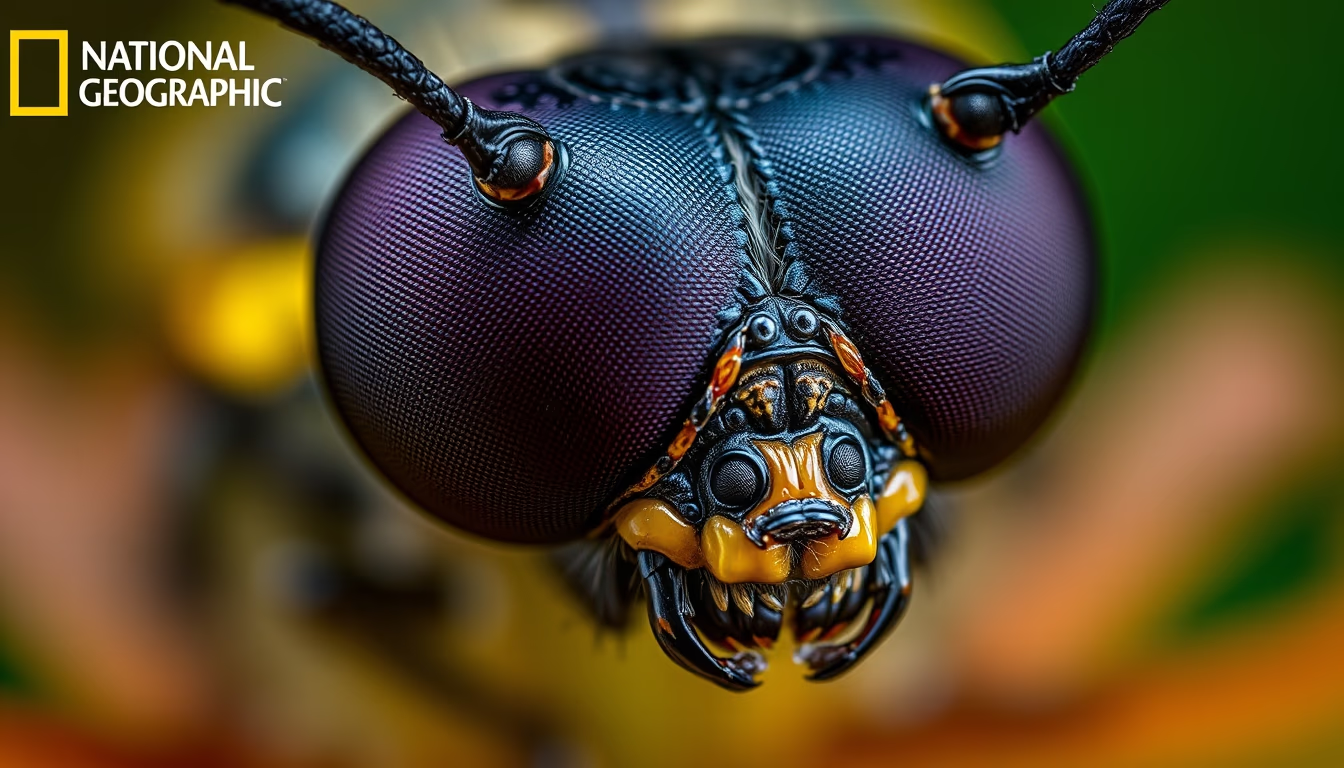
Insect compound eyes are composed of thousands of individual units called ommatidia, each functioning as a tiny eye.
About this subject
Compound eyes are one of the most fascinating adaptations of insects, providing panoramic vision and rapid motion detection. Each ommatidium is a hexagonal unit containing photoreceptor cells, a lens, and a crystalline cone. The resulting image is a mosaic of points, offering low resolution but extremely high sensitivity to movement. The number of ommatidia varies widely across species: a dragonfly has about 30,000 ommatidia per eye, giving it one of the sharpest insect visions, while a worker ant may have fewer than 100. This variation reflects the ecological niche of each species.
The structure of compound eyes allows insects to detect ultraviolet and polarized light, capabilities humans lack. This is crucial for navigation, locating flowers, and communication. For instance, bees use polarized skylight to orient themselves even on cloudy days. Moreover, insect visual processing speed is remarkably high: flies can process images about four times faster than humans, explaining their ability to avoid swats.
Evolutionarily, compound eyes appeared more than 500 million years ago during the Cambrian period, found in primitive arthropods. Although less efficient in low light, many nocturnal insects have adaptations such as larger ommatidia and a tapetum lucidum that reflects light to boost sensitivity. The diversity of compound eyes is a striking example of evolution tailoring structures to meet environmental demands.
Frequently Asked Questions
How does an insect compound eye work?
Each ommatidium captures a small portion of the visual field, creating a mosaic image. The insect's brain combines these signals to perceive motion and shapes, albeit with low resolution.
How many ommatidia does a dragonfly eye have?
A dragonfly can have about 30,000 ommatidia per eye, providing nearly 360-degree vision and ultra-fast motion detection.
Do insects see color?
Yes, many insects see colors, including ultraviolet. Bees and butterflies, for example, can distinguish colors invisible to humans, helping them locate nectar.
Direct URL
https://pub-c7d6a6ea828543ac903a74a341ccb2e1.r2.dev/imagens/insect-compound-eye-macro-national-geographic-style-p2.avifHow to credit
Include a visible link back to UtilizAí. Copy one of the snippets below:
<a href="https://xn--utiliza-eza.com/en/midia/imagens/insect-compound-eye-macro-national-geographic-style-p2">Insect compound eye macro</a> by <a href="https://xn--utiliza-eza.com">UtilizAí</a>, licensed under <a href="https://creativecommons.org/licenses/by/4.0/">CC BY 4.0</a>.
[Insect compound eye macro](https://xn--utiliza-eza.com/en/midia/imagens/insect-compound-eye-macro-national-geographic-style-p2) by [UtilizAí](https://xn--utiliza-eza.com), CC BY 4.0
License: CC-BY-4.0