Globe vintage spinning
1344×768 · AVIF · CC BY 4.0
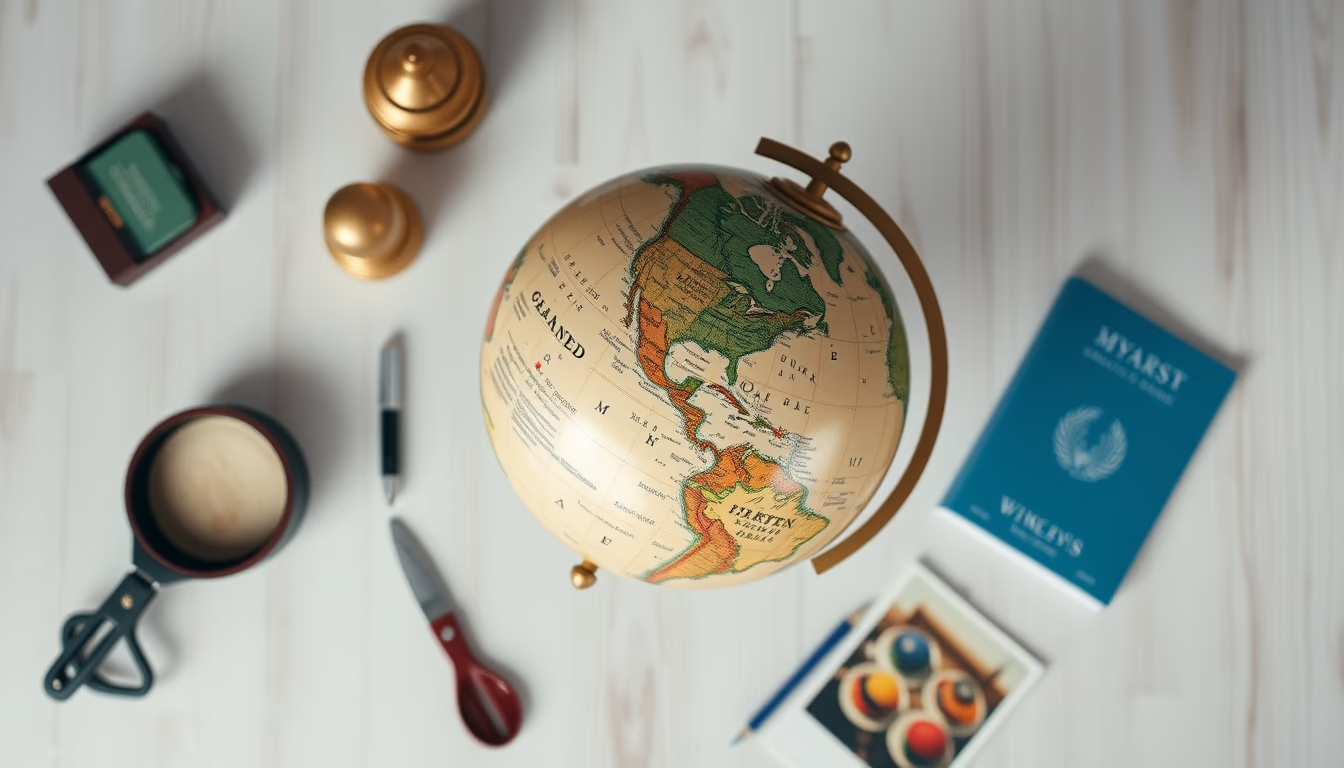
Vintage terrestrial globe, a decorative and educational piece that represents historical cartography and the geopolitical vision of its era.
About this subject
The earliest terrestrial globes appeared during the Renaissance, when major explorations and geographical discoveries demanded three-dimensional representations of the world. The oldest known, Martin Behaim's Globe (1492), did not yet include the Americas. From the 16th century onward, globes were often produced in pairs (terrestrial and celestial) by prominent cartographers such as Gerardus Mercator.
Construction of a vintage globe involved artisanal techniques: hollow spheres made of papier-mâché or plaster covered with printed paper strips, mounted on a brass meridian ring and a turned wooden base. Manufacturers like Replogle (USA) and Columbus (Germany) dominated the market between the 19th and 20th centuries, supplying globes to schools, libraries, and homes. Finishes ranged from matte varnish to glossy lacquer, with stands of cast iron or carved wood.
Beyond being educational tools, vintage globes carry historical value by recording borders, country names, and colonies that no longer exist. For instance, globes from before 1914 show the Austro-Hungarian Empire, and those from the 1950s often display the Soviet Union and African colonial divisions. This temporal dimension makes each globe a time capsule of the geopolitical knowledge of its era.
Interestingly, most domestic globes have an axis tilted at 23.5 degrees to simulate Earth's actual inclination. This feature, along with manual rotation, was part of school geography lessons. Today, these objects are collector's items and decorative pieces, prized for their retro design and the nostalgia of printed maps.
Frequently Asked Questions
What is the origin of the terrestrial globe as an object?
The first terrestrial globes were created in Europe during the Renaissance, with the oldest known example being Martin Behaim's Globe from 1492, which still did not include the Americas. Commercial production expanded from the 16th century onward with cartographers such as Mercator.
How to identify an authentic vintage globe?
Check the base material (turned wood or cast iron), the brass meridian, and the quality of map printing. Brands like Replogle, Columbus, or Cram indicate authenticity. Globes from before 1945 usually show different borders and toponyms compared to modern ones.
What is the difference between a terrestrial and a celestial globe?
A terrestrial globe represents Earth's surface with continents and oceans. A celestial globe shows the positions of stars and constellations as seen from Earth, used primarily for astronomy.
Direct URL
https://pub-c7d6a6ea828543ac903a74a341ccb2e1.r2.dev/imagens/globe-vintage-spinning-isometric-flat-lay-p10.avifHow to credit
Include a visible link back to UtilizAí. Copy one of the snippets below:
<a href="https://xn--utiliza-eza.com/en/midia/imagens/globe-vintage-spinning-isometric-flat-lay-p10">Globe vintage spinning</a> by <a href="https://xn--utiliza-eza.com">UtilizAí</a>, licensed under <a href="https://creativecommons.org/licenses/by/4.0/">CC BY 4.0</a>.
[Globe vintage spinning](https://xn--utiliza-eza.com/en/midia/imagens/globe-vintage-spinning-isometric-flat-lay-p10) by [UtilizAí](https://xn--utiliza-eza.com), CC BY 4.0
License: CC-BY-4.0