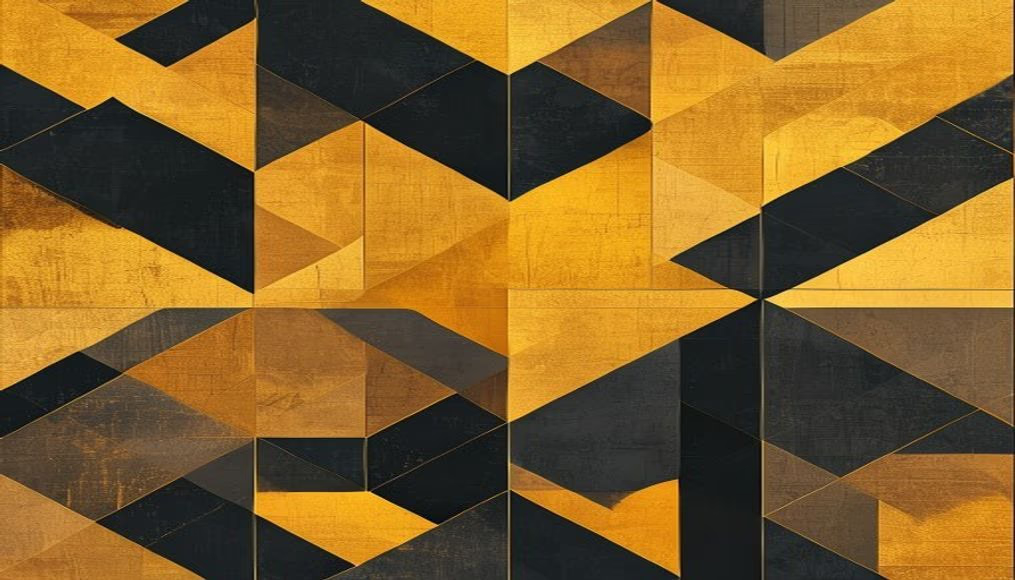
Geometric pattern minimalist
1344×768 · AVIF · CC BY 4.0
Minimalist geometric pattern merges modern art and design with pure forms and mathematical balance.
About this subject
Minimalist geometric patterns are visual elements that blend lines, angles, and simple shapes to create aesthetic balance. Their origin lies in 20th-century modernist movements like Bauhaus and De Stijl, which prioritized abstraction and artistic rationalization. Dutch designer Piet Mondrian, for example, used triangles and rectangles in monochromatic compositions to explore spatial relationships and primary colors.
These patterns transcend architecture and graphic design, being widely used in fashion, interior design, and technology. In Islamic culture, geometric forms symbolize divine order and the pursuit of harmony, while in digital art, they are essential for modern interfaces. Interestingly, mathematical proportions like the Fibonacci sequence are often present in these designs, connecting art and science.
Simplicity is not synonymous with banality: the challenge lies in balancing symmetry and asymmetry, repetition and variation. Museums such as MoMA and the Tate Modern showcase collections that explore this intersection of geometry and creative expression. Today, designers like Zaha Hadid reinvent these concepts for organic architecture, maintaining the essence of minimalism while innovating in scale and complexity.
Frequently Asked Questions
Which art movements influenced minimalist geometric patterns?
Movements like Bauhaus (1919-1933) and De Stijl (1917-1931) were pivotal. Bauhaus merged art and industry, while De Stijl focused on straight lines and primary colors to express universal order.
How are patterns used in contemporary architecture?
Architects like Zaha Hadid and Bjarke Ingels apply geometric shapes to create organic structures, combining minimalism with innovation in scale and materiality.
Why is mathematics present in geometric art?
Proportions like the Fibonacci sequence and the golden ratio (1.618) are used to create visual balance, proven by neuroscience studies on perception.
Direct URL
https://pub-c7d6a6ea828543ac903a74a341ccb2e1.r2.dev/imagens/geometric-pattern-minimalist-magazine-editorial-v8.avifHow to credit
Include a visible link back to UtilizAí. Copy one of the snippets below:
<a href="https://xn--utiliza-eza.com/en/midia/imagens/geometric-pattern-minimalist-magazine-editorial-v8">Geometric pattern minimalist</a> by <a href="https://xn--utiliza-eza.com">UtilizAí</a>, licensed under <a href="https://creativecommons.org/licenses/by/4.0/">CC BY 4.0</a>.
[Geometric pattern minimalist](https://xn--utiliza-eza.com/en/midia/imagens/geometric-pattern-minimalist-magazine-editorial-v8) by [UtilizAí](https://xn--utiliza-eza.com), CC BY 4.0
License: CC-BY-4.0