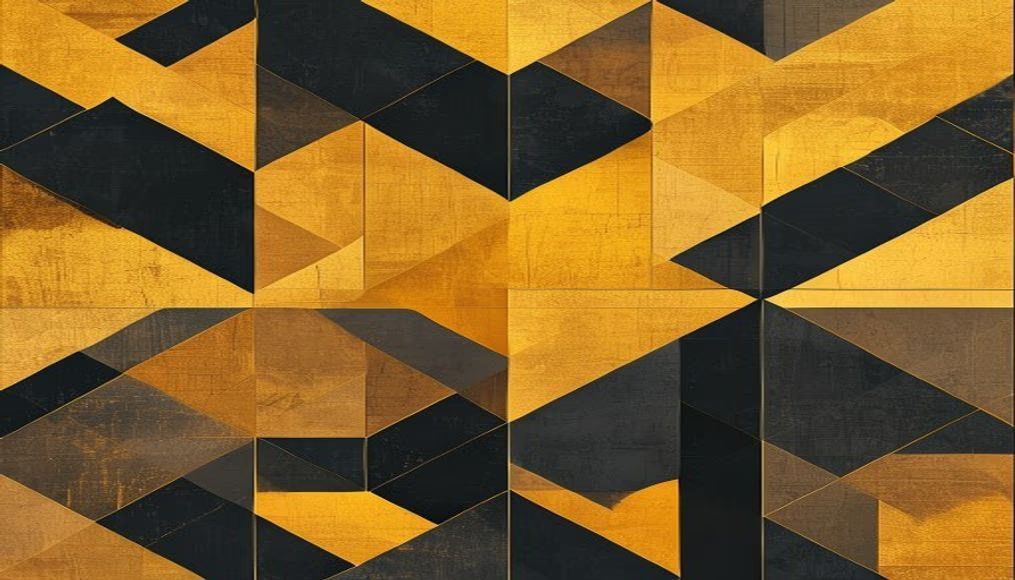
Geometric pattern minimalist
1344×768 · AVIF · CC BY 4.0

Minimalist art uses geometric patterns to create visually striking compositions, exploring simplicity and balance.
About this subject
Geometric minimalism is an artistic trend that emerged in the 20th century, influenced by movements such as De Stijl and the Bauhaus. Artists like Piet Mondrian and Kazimir Malevich explored basic shapes, such as straight lines, circles, and squares, to express a pure and universal aesthetic. In contemporary design, this style is widely used in logos, architecture, and decoration, emphasizing functionality and visual clarity.
Symmetry and repetition of forms are key characteristics, creating rhythm and harmony. Neutral colors, such as black, white, and gray, often dominate, but vibrant tones can be used to highlight specific elements. This type of composition is common in digital art, textile patterns, and even user interfaces, where simplicity facilitates navigation.
Interestingly, geometric minimalism also dialogues with mathematics, especially Euclidean geometry. Patterns like grids, concentric circles, and equilateral triangles are based on mathematical principles that ensure balanced proportions. In Brazil, artists such as Hélio Oiticica and Lygia Pape incorporated geometric elements into their works, influencing national design.
The popularity of this style grew with the modernist movement and remains relevant in the digital age, where clean aesthetics are associated with sophistication and efficiency. Whether in a painting, a logo, or a photograph, the minimalist geometric pattern invites the viewer to appreciate the beauty of pure form, without distractions.
Frequently Asked Questions
What is geometric minimalism?
It is an artistic trend that uses simple geometric shapes, such as circles, squares, and lines, in balanced and functional compositions. It emerged in the 20th century influenced by Bauhaus and De Stijl.
Which artists are known for this style?
Piet Mondrian, Kazimir Malevich, and in Brazil, Hélio Oiticica and Lygia Pape are examples of artists who explored minimalist geometric patterns.
Where is geometric minimalism applied today?
In graphic design, architecture, decoration, fashion, and digital interfaces, valuing simplicity and visual clarity.
Direct URL
https://pub-c7d6a6ea828543ac903a74a341ccb2e1.r2.dev/imagens/geometric-pattern-minimalist-cinematic-wide-shot-v2.avifHow to credit
Include a visible link back to UtilizAí. Copy one of the snippets below:
<a href="https://xn--utiliza-eza.com/en/midia/imagens/geometric-pattern-minimalist-cinematic-wide-shot-v2">Geometric pattern minimalist</a> by <a href="https://xn--utiliza-eza.com">UtilizAí</a>, licensed under <a href="https://creativecommons.org/licenses/by/4.0/">CC BY 4.0</a>.
[Geometric pattern minimalist](https://xn--utiliza-eza.com/en/midia/imagens/geometric-pattern-minimalist-cinematic-wide-shot-v2) by [UtilizAí](https://xn--utiliza-eza.com), CC BY 4.0
License: CC-BY-4.0