Crystal salt macro
1344×768 · AVIF · CC BY 4.0
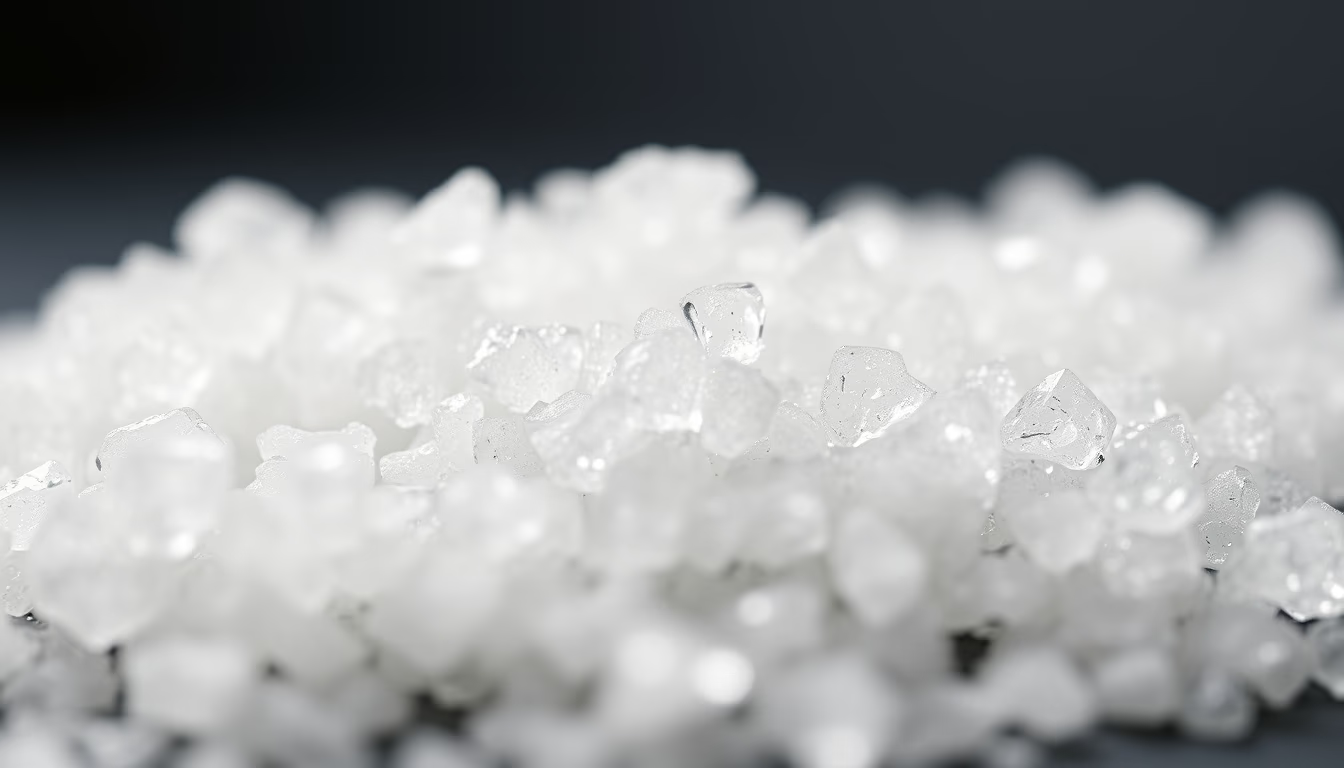
Salt crystals, microscopically cubic, reveal the natural geometry of sodium chloride, essential for life.
About this subject
Table salt, chemically sodium chloride (NaCl), naturally crystallizes in the cubic system, forming perfect tiny cubes. This crystalline structure arises from the orderly arrangement of sodium and chloride ions, which attract each other ionically in a three-dimensional lattice. When salty water evaporates slowly, the ions organize into crystals with flat faces and characteristic right angles. This process occurs in natural salt flats, such as those in Cabo Frio, Brazil, or in controlled environments for sea salt production.
Salt crystallization can be observed on macro and microscopic scales. In a salt pan, seawater is evaporated in shallow ponds, concentrating the salt until crystals precipitate. The crystal shape can vary with impurities: sea salt, rich in minerals like magnesium and calcium, tends to form less regular crystals, while refined salt undergoes processes that remove impurities and produce more uniform grains. Fleur de sel, hand-harvested from the surface of salt ponds, forms thin and fragile crystals prized in gastronomy.
Historically, salt was used as currency and preservative. Salt crystals are hygroscopic, meaning they absorb moisture from the air, making them effective for food preservation. Their importance extends beyond cooking: in the chemical industry, they are raw material for chlorine and caustic soda. In regions like the Himalayas, rock salt deposits formed millions of years ago by the evaporation of ancient seas, giving rise to the famous Himalayan pink salt, whose color comes from iron oxides. Physically, NaCl melts at 801°C and boils at 1465°C, being a stable ionic compound.
Frequently Asked Questions
Why do salt crystals form cubes?
Because of the cubic crystal structure of sodium chloride, which arranges sodium and chloride ions in a cubic lattice. This symmetry results in crystals with square faces and right angles.
What is the difference between sea salt and refined salt?
Sea salt is obtained by evaporating seawater and contains trace minerals, while refined salt is purified and often iodized with anti-caking agents. Sea salt has more irregular crystals and a more complex flavor.
How was salt used in ancient times?
Salt was used as a food preservative, trade currency, and in religious rituals. Roman soldiers received salt as payment (salarium, origin of the word 'salary'). It was also essential for mummification in Egypt.
Direct URL
https://pub-c7d6a6ea828543ac903a74a341ccb2e1.r2.dev/imagens/crystal-salt-macro-macro-closeup-p6.avifHow to credit
Include a visible link back to UtilizAí. Copy one of the snippets below:
<a href="https://xn--utiliza-eza.com/en/midia/imagens/crystal-salt-macro-macro-closeup-p6">Crystal salt macro</a> by <a href="https://xn--utiliza-eza.com">UtilizAí</a>, licensed under <a href="https://creativecommons.org/licenses/by/4.0/">CC BY 4.0</a>.
[Crystal salt macro](https://xn--utiliza-eza.com/en/midia/imagens/crystal-salt-macro-macro-closeup-p6) by [UtilizAí](https://xn--utiliza-eza.com), CC BY 4.0
License: CC-BY-4.0