Crystal salt macro
1344×768 · AVIF · CC BY 4.0
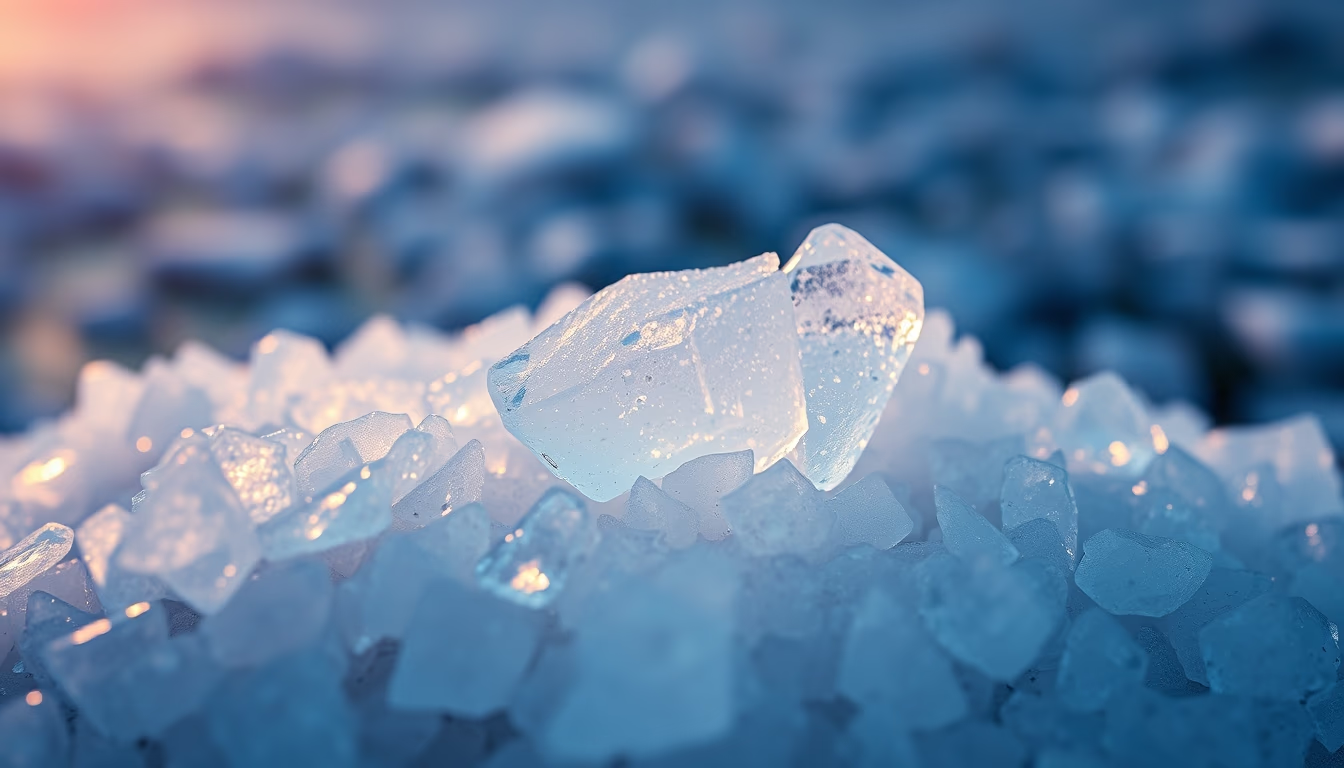
Aerial macro photography of salt crystals in natural salt flats reveals unique geometric patterns formed by evaporation of saltwater.
About this subject
Salt crystals form when saltwater evaporates, leaving behind mineral deposits that crystallize into cubic or hexagonal structures. This natural process occurs in salt flats and deserts worldwide, such as the Salar de Uyuni in Bolivia, the largest salt flat on Earth, spanning over 10,000 km². Aerial macro photography captures these crystals on a grand scale, revealing fractals and patterns that repeat from micro to macro levels, influenced by temperature, wind, and mineral concentration.
Colors range from pure white to pink and green, depending on halophilic microorganisms like algae and bacteria. In the Atacama Salt Flat in Chile, lithium extraction uses these crystals, but human activity threatens the delicate ecological balance. Tourists visit these sites to observe the mesmerizing landscapes, especially at sunrise and sunset when the crystals mirror the sky.
Interestingly, salt crystals (halite) are typically cubic, but under specific conditions, they can form dendrites or branching structures. Water depth, salinity, and the presence of other ions shape the final pattern. Aerial views show these formations spanning kilometers, creating natural mosaics reminiscent of abstract art. Geologists study these patterns to understand regional climatic and hydrological history.
Frequently Asked Questions
How do salt crystals form in salt flats?
Salt crystals form when saltwater evaporates. As water evaporates, sodium and chloride ions bond into cubic structures, creating the mineral halite. Evaporation rate and water purity influence crystal size and shape.
Why do salt flats have different colors?
Colors vary due to halophilic microorganisms, such as green algae and red or purple bacteria, which produce pigments. Salt concentration and water depth also affect color, resulting in shades from white to pink, green, and blue.
Where are the largest salt deserts in the world?
The largest salt deserts include Salar de Uyuni (Bolivia), Salar de Atacama (Chile), Bonneville Salt Flats (USA), and Chott el Djerid (Tunisia). They cover vast areas and formed from the evaporation of prehistoric salt lakes.
Direct URL
https://pub-c7d6a6ea828543ac903a74a341ccb2e1.r2.dev/imagens/crystal-salt-macro-aerial-drone-shot-p5.avifHow to credit
Include a visible link back to UtilizAí. Copy one of the snippets below:
<a href="https://xn--utiliza-eza.com/en/midia/imagens/crystal-salt-macro-aerial-drone-shot-p5">Crystal salt macro</a> by <a href="https://xn--utiliza-eza.com">UtilizAí</a>, licensed under <a href="https://creativecommons.org/licenses/by/4.0/">CC BY 4.0</a>.
[Crystal salt macro](https://xn--utiliza-eza.com/en/midia/imagens/crystal-salt-macro-aerial-drone-shot-p5) by [UtilizAí](https://xn--utiliza-eza.com), CC BY 4.0
License: CC-BY-4.0