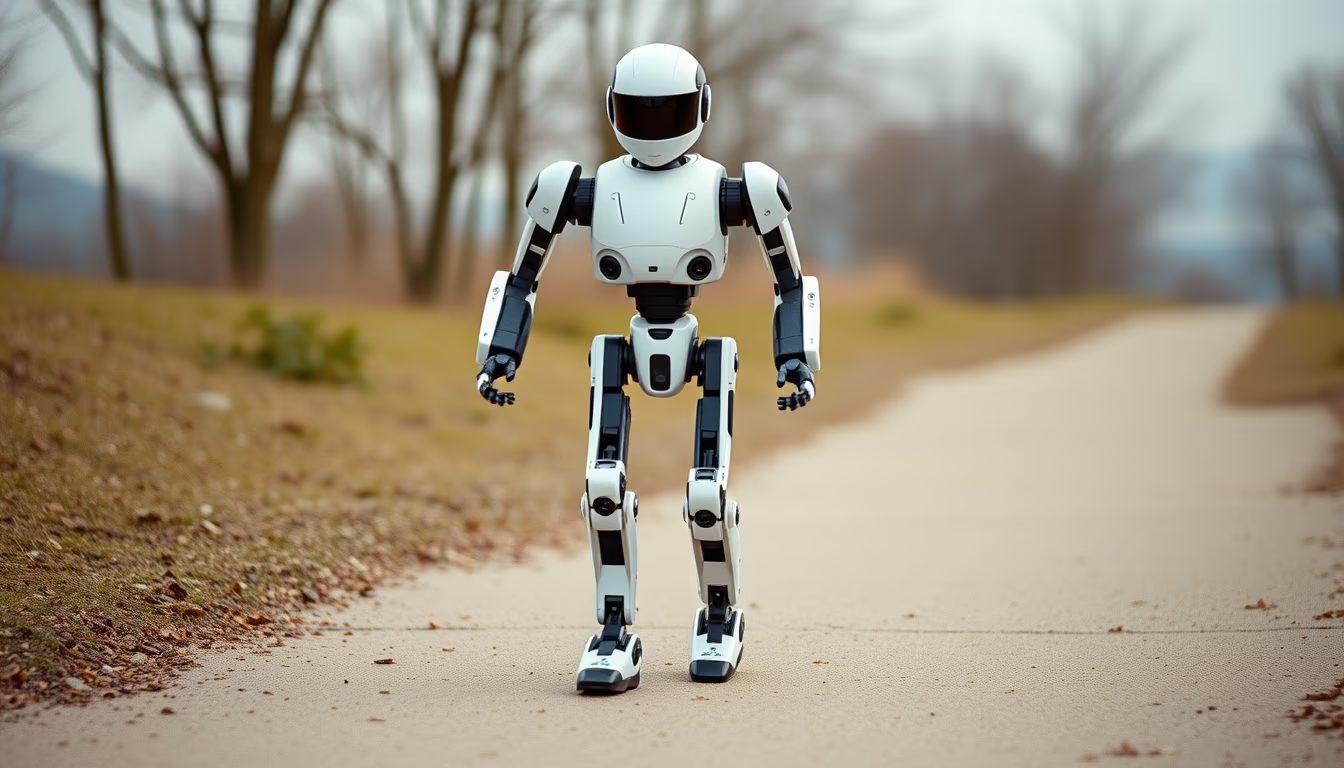
Bipedal robot walking
1344×768 · AVIF · CC BY 4.0

Bipedal walking robots combine advanced mechanics, balance control, and artificial intelligence to mimic human locomotion.
About this subject
Bipedal robots represent one of robotics' greatest challenges: replicating the complex biomechanics of human walking. Unlike wheeled or tracked robots, a biped must maintain dynamic balance with each step, compensating for gravitational forces and inertia. Companies like Boston Dynamics (with Atlas) and Honda (with ASIMO) are benchmarks in developing these machines, which use gyroscopic sensors, accelerometers, and predictive control algorithms to avoid falls.
The fundamental principle of bipedal walking is the inverted pendulum model, where the center of mass oscillates over the supporting foot while the other foot swings forward. Stability is maintained through continuous adjustments in knee, ankle, and hip angles. Research focuses on making these movements more natural and efficient, reducing energy consumption and improving battery life.
Practical applications include disaster rescue (where uneven terrain demands bipedal locomotion), exoskeletons for rehabilitation of people with motor disabilities, and even space exploration. However, high costs and mechanical complexity still limit large-scale adoption. The next milestone is integrating generative AI, enabling robots to learn to walk in never-before-seen scenarios without explicit programming.
Notably, one of the first functional bipedal robots was WABOT-1, created in Japan in 1973. Since then, evolution has been rapid: today robots like Atlas perform parkour, jumps, and spins, demonstrating extremely refined balance control. Yet natural human walking, smooth, adaptive, and energy-efficient, remains a standard not fully achieved.
Frequently Asked Questions
How does a bipedal robot maintain balance?
Bipedal robots use sensors like gyroscopes and accelerometers to measure orientation and acceleration. Control algorithms, such as PID or MPC, continuously adjust motor angles at joints to keep the center of mass over the support base, preventing falls.
What are the main challenges in building bipedal robots?
Key challenges include dynamic balance maintenance, energy efficiency (walking consumes significant power), mechanical durability (joints experience high stress), and control on uneven terrain requiring real-time adaptation.
Are there bipedal robots already in practical use?
Yes, robots like Boston Dynamics' Atlas are used in rescue and exploration research. Honda's ASIMO was used in educational demonstrations. Bipedal exoskeletons, such as ReWalk, assist people with paraplegia to walk. However, widespread commercial use is still limited.
Direct URL
https://pub-c7d6a6ea828543ac903a74a341ccb2e1.r2.dev/imagens/bipedal-robot-walking-minimalist-composition-p4.avifHow to credit
Include a visible link back to UtilizAí. Copy one of the snippets below:
<a href="https://xn--utiliza-eza.com/en/midia/imagens/bipedal-robot-walking-minimalist-composition-p4">Bipedal robot walking</a> by <a href="https://xn--utiliza-eza.com">UtilizAí</a>, licensed under <a href="https://creativecommons.org/licenses/by/4.0/">CC BY 4.0</a>.
[Bipedal robot walking](https://xn--utiliza-eza.com/en/midia/imagens/bipedal-robot-walking-minimalist-composition-p4) by [UtilizAí](https://xn--utiliza-eza.com), CC BY 4.0
License: CC-BY-4.0