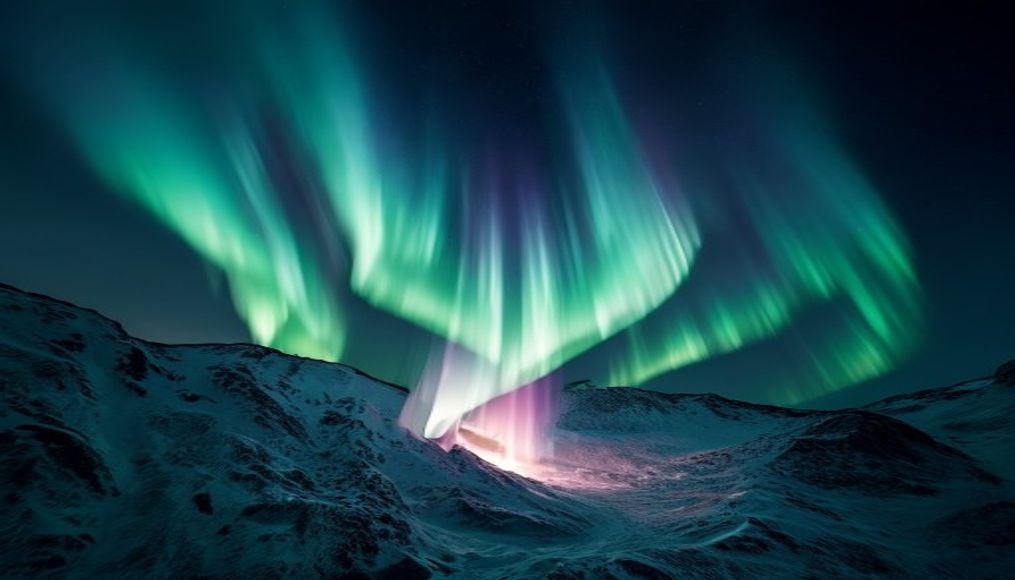
Aurora pillar dance
1344×768 · AVIF · CC BY 4.0
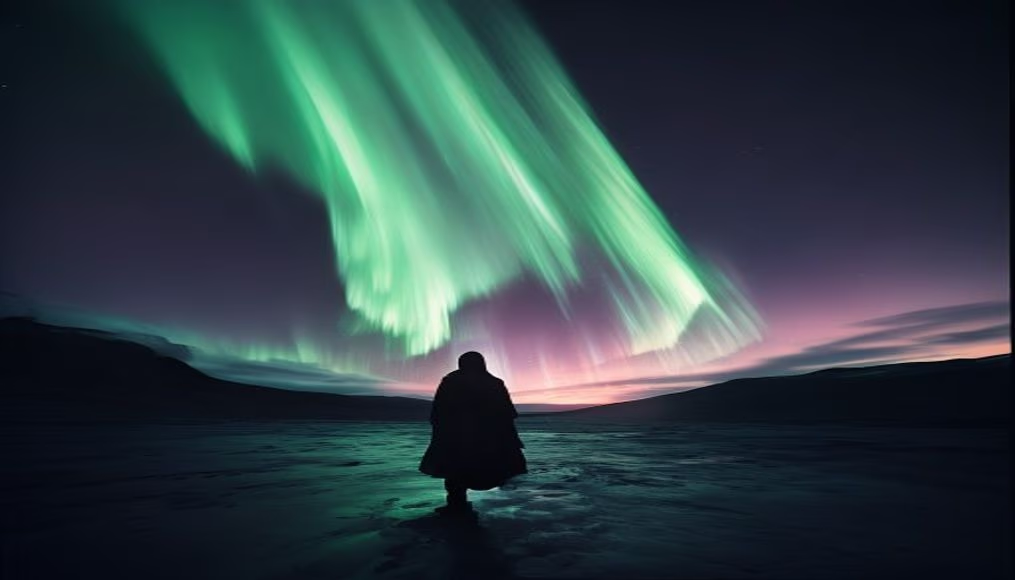
Aurora pillars, atmospheric phenomena of vertical columns of green or red light, dance across polar skies during intense solar storms.
About this subject
Aurora pillars are among the most striking features of the northern and southern lights. Unlike the typical flowing curtains, these pillars appear as vertical columns of light, usually green or reddish, that seem to dance and shift rapidly across the night sky. The phenomenon occurs when charged particles from the solar wind, guided by Earth's magnetic field, collide with oxygen and nitrogen molecules in the upper atmosphere at altitudes between 80 and 250 kilometers. The pillar shape is associated with the orientation of magnetic field lines and the presence of air layers of different densities that distort the emitted light.
Historically, indigenous Arctic peoples such as the Sami in Scandinavia and the Inuit in Canada interpreted these lights as ancestral spirits or divine messages. In Norse mythology, the aurora was seen as the reflection of Valkyries' shields. Scientifically, the study of auroras has helped understand Earth's magnetosphere and predict geomagnetic storms. Auroras are most common in regions near the polar circles, such as northern Canada, Alaska, Iceland, Norway, and Finland, but during exceptional solar events they can be seen at lower latitudes.
To observe aurora pillars, a dark, clear sky away from light pollution and strong solar activity (measured by the Kp index) are necessary. The best times run from September to March in the Northern Hemisphere and from March to September in the Southern Hemisphere. Interestingly, pillars can last from a few seconds to several minutes, and their dance is caused by variations in the intensity and direction of the solar wind. Photographing these pillars with authentic film grain, as suggested by the image curation, captures the texture and unique atmosphere of the phenomenon, evoking historical film records.
Frequently Asked Questions
What causes the formation of pillars in the aurora borealis?
Pillars form when solar particles collide with atmospheric molecules along vertical magnetic lines, creating columns of light. The presence of air layers with different densities also contributes to the elongated appearance.
What is the difference between a curtain aurora and a pillar aurora?
A curtain aurora stretches horizontally like waves, while a pillar aurora appears as narrow vertical columns. The difference lies in the orientation of magnetic field lines and the altitude of light emission.
Is it possible to see auroras in Brazil?
On very rare occasions during extreme solar storms, auroras can be seen at low latitudes, such as southern Brazil. The most famous event was in 1859, but there are no common recent records.
Direct URL
https://pub-c7d6a6ea828543ac903a74a341ccb2e1.r2.dev/imagens/aurora-pillar-dance-film-grain-authentic-p0.avifHow to credit
Include a visible link back to UtilizAí. Copy one of the snippets below:
<a href="https://xn--utiliza-eza.com/en/midia/imagens/aurora-pillar-dance-film-grain-authentic-p0">Aurora pillar dance</a> by <a href="https://xn--utiliza-eza.com">UtilizAí</a>, licensed under <a href="https://creativecommons.org/licenses/by/4.0/">CC BY 4.0</a>.
[Aurora pillar dance](https://xn--utiliza-eza.com/en/midia/imagens/aurora-pillar-dance-film-grain-authentic-p0) by [UtilizAí](https://xn--utiliza-eza.com), CC BY 4.0
License: CC-BY-4.0