Astrolabe ancient
1344×768 · AVIF · CC BY 4.0
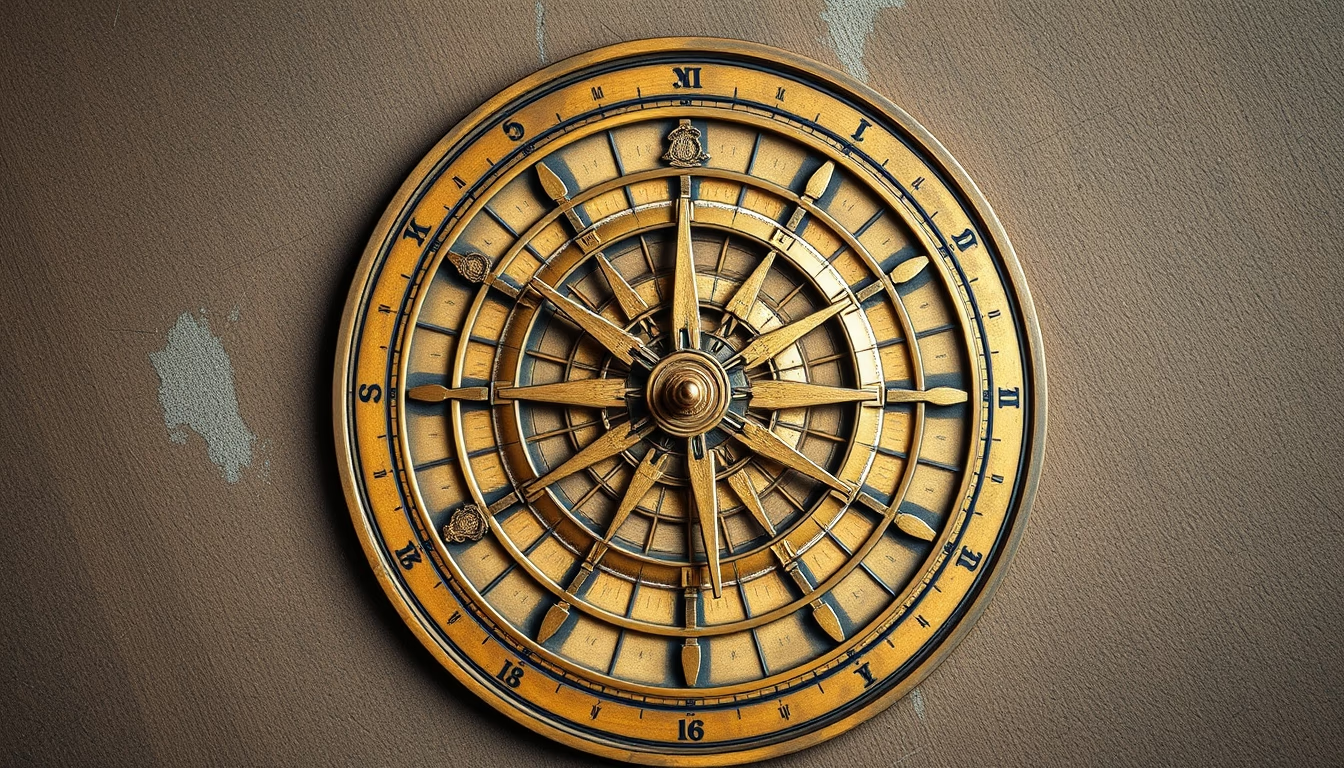
Astrolabes are ancient astronomical instruments used to measure the position of stars and planets, blending art and science.
About this subject
The astrolabe is one of the oldest scientific instruments in human history, with origins tracing back to Ancient Greece around the 2nd century BC. Refined by Islamic astronomers during the Middle Ages, it became an essential tool for navigation, timekeeping, and celestial observation. Its structure consists of a perforated disk (mater) and a rotating network (rete) representing the brightest stars, allowing the user to calculate the altitude of the Sun or stars above the horizon.
During the medieval period, the astrolabe was widely used throughout the Islamic world, where it played a crucial role in determining prayer times and the direction of Mecca. It reached Europe via Muslim Spain in the 10th century, becoming a symbol of knowledge and prestige among scholars and royalty. Instruments like the 10th-century astrolabe of al-Sufi are notable examples of the precision and craftsmanship of the era.
Astrolabes were also essential during the Age of Discovery, enabling explorers such as Vasco da Gama and Christopher Columbus to navigate unknown seas. Although gradually replaced by more modern instruments like the sextant, the astrolabe remains valued by historians and collectors as a testament to ancient scientific ingenuity.
Today, original specimens are rare and highly sought after, with 16th-century pieces selling for millions of dollars at auctions. Museums such as the Museum of the History of Science in Oxford and the National Museum of Astronomy in Brazil preserve these objects that connect humanity to its roots in observing the cosmos.
Frequently Asked Questions
What was the astrolabe used for?
The astrolabe was used to measure the altitude of celestial bodies, determine the local time, calculate latitude, and in navigation, to help find the correct route at sea.
Who invented the astrolabe?
It is not known exactly who invented the astrolabe, but it is believed to have been developed by Greek astronomers such as Hipparchus of Nicaea around the 2nd century BC.
What is the difference between an astrolabe and a sextant?
The astrolabe is older and uses flat projections to measure celestial angles, while the sextant, invented in the 18th century, is more precise and uses mirrors to measure the altitude of the Sun or stars above the horizon.
Direct URL
https://pub-c7d6a6ea828543ac903a74a341ccb2e1.r2.dev/imagens/astrolabe-ancient-isometric-flat-lay-p5.avifHow to credit
Include a visible link back to UtilizAí. Copy one of the snippets below:
<a href="https://xn--utiliza-eza.com/en/midia/imagens/astrolabe-ancient-isometric-flat-lay-p5">Astrolabe ancient</a> by <a href="https://xn--utiliza-eza.com">UtilizAí</a>, licensed under <a href="https://creativecommons.org/licenses/by/4.0/">CC BY 4.0</a>.
[Astrolabe ancient](https://xn--utiliza-eza.com/en/midia/imagens/astrolabe-ancient-isometric-flat-lay-p5) by [UtilizAí](https://xn--utiliza-eza.com), CC BY 4.0
License: CC-BY-4.0