Antique microscope brass
1344×768 · AVIF · CC BY 4.0
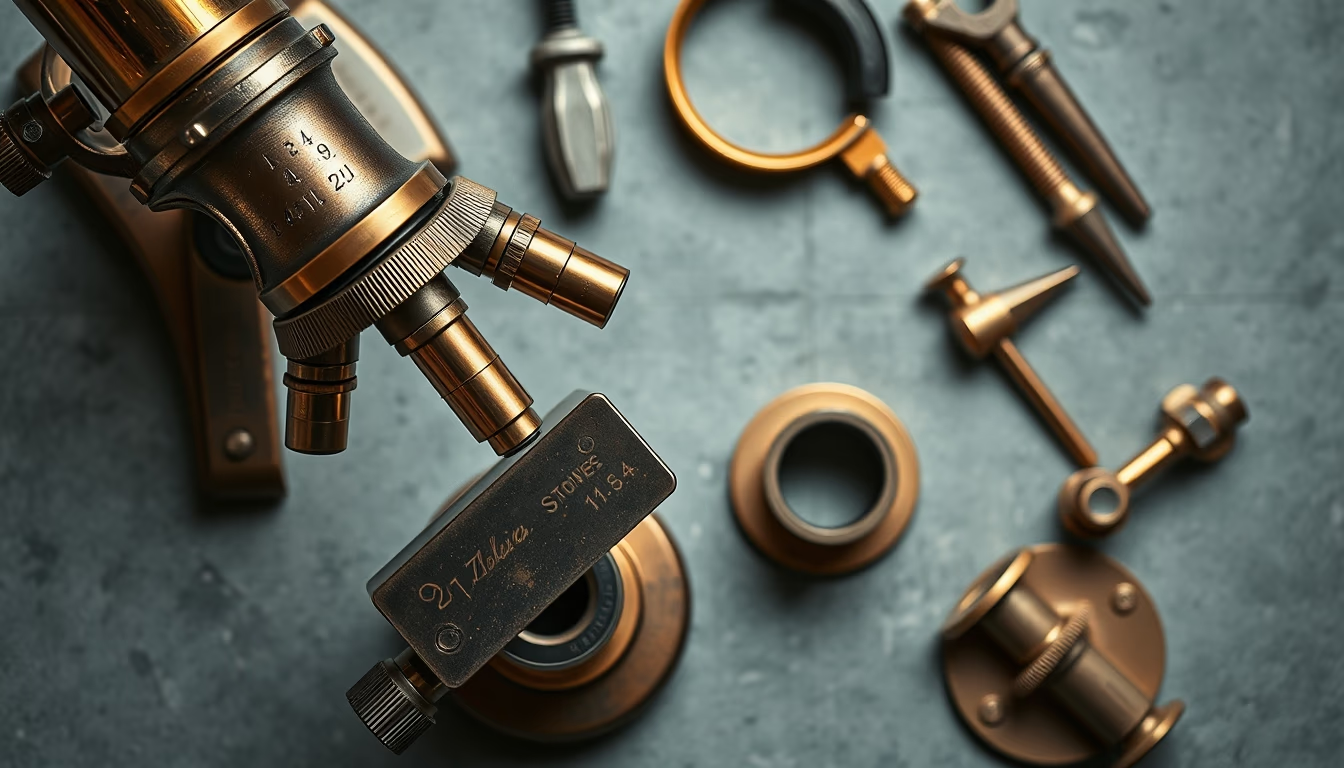
Antique brass microscope, a 19th-century scientific instrument that revolutionized biological and medical research with its handcrafted construction.
About this subject
Antique brass microscopes represent a golden age of scientific instrumentation, when optics and metallurgy combined to unveil the microscopic world. Manufactured primarily in England and Germany between 1830 and 1900, these instruments were hand-assembled by skilled artisans. Brass was the preferred material for its durability, malleability, and resistance to corrosion, allowing precise parts such as the body tube and the revolving nosepiece. Unlike modern microscopes, antique models often used natural light reflected by a concave mirror, requiring operator skill to adjust the illumination.
The isometric design and flat lay arrangement of these microscopes reveal the mechanical complexity behind their apparent simplicity. The focusing system was typically rack and pinion, enabling fine adjustments. Objectives were often achromatic, correcting chromatic aberrations, an early 19th-century innovation. Each microscope was a unique piece, with details such as mother-of-pearl inlays or decorative engravings reflecting the owner's status. Scientists like Robert Hooke and Antonie van Leeuwenhoek paved the way, but it was the Victorian brass microscopes that made microscopy accessible to universities and physicians.
In global history, brass microscopes were crucial for the development of microbiology and histology. They allowed researchers like Louis Pasteur and Robert Koch to identify pathogens, leading to breakthroughs in germ theory and vaccination. The instruments were exported worldwide, including to colonies and emerging nations, where they supported medical and agricultural research. Today, antique brass microscopes are highly sought-after collectibles, often fetching thousands of dollars at auction. Museums such as the Science Museum in London and the Deutsches Museum in Munich preserve extensive collections that document the evolution of microscopy.
The aesthetic of these instruments has also influenced steampunk design, with replicas appearing in fiction and thematic decor. The contrast between polished brass and steel screws evokes the Industrial Revolution. For collectors, preserving an antique microscope requires avoiding abrasives and maintaining a controlled humidity environment to prevent oxidation. Cleaning should be done with a soft cloth and metal-specific products, thus preserving the historical and scientific value of the instrument.
Frequently Asked Questions
How to identify an original antique brass microscope?
Look for manufacturer marks (such as R. & J. Beck, Powell & Lealand, or Carl Zeiss), hand-turned screws without Philips heads, and handmade finish. Authentic brass develops natural patina over time, and lenses may show slight chromatic aberration.
What is the difference between a brass microscope and a modern one?
Antique models use natural light reflected by a mirror, lack oil immersion systems common in modern microscopes, and have objectives with less aberration correction. Focus is manual via rack and pinion, without fine adjustment.
What is the market value of an antique brass microscope?
It depends on condition, manufacturer, and rarity. Common models cost between $200 and $1,000, while museum-quality pieces from renowned makers can exceed $10,000 at specialized auctions.
Direct URL
https://pub-c7d6a6ea828543ac903a74a341ccb2e1.r2.dev/imagens/antique-microscope-brass-isometric-flat-lay-p7.avifHow to credit
Include a visible link back to UtilizAí. Copy one of the snippets below:
<a href="https://xn--utiliza-eza.com/en/midia/imagens/antique-microscope-brass-isometric-flat-lay-p7">Antique microscope brass</a> by <a href="https://xn--utiliza-eza.com">UtilizAí</a>, licensed under <a href="https://creativecommons.org/licenses/by/4.0/">CC BY 4.0</a>.
[Antique microscope brass](https://xn--utiliza-eza.com/en/midia/imagens/antique-microscope-brass-isometric-flat-lay-p7) by [UtilizAí](https://xn--utiliza-eza.com), CC BY 4.0
License: CC-BY-4.0