Antique microscope brass
1344×768 · AVIF · CC BY 4.0
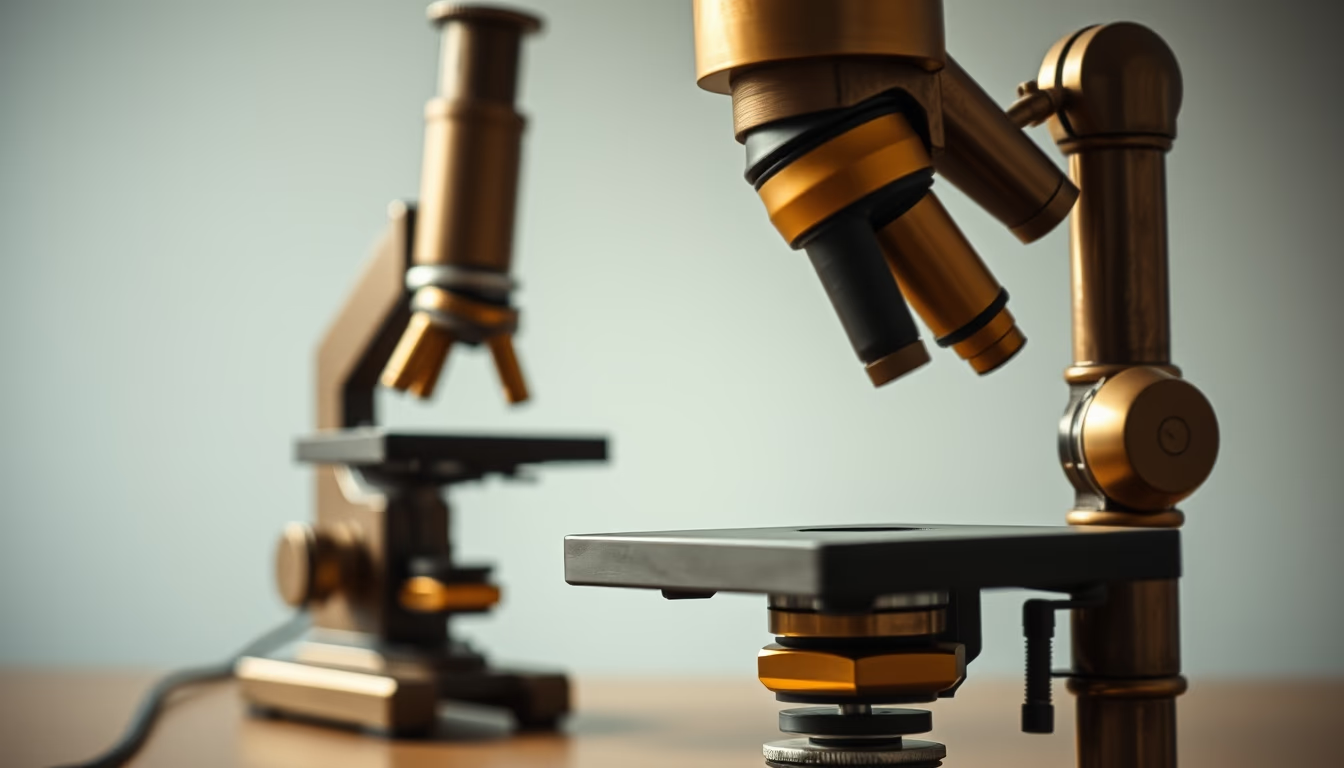
Antique brass microscope, a symbol of 19th-century science, reveals the precise engineering that enabled revolutionary discoveries in biology and medicine.
About this subject
The brass microscope represents the pinnacle of optical instrumentation in the 18th and 19th centuries, combining scientific functionality with artistic craftsmanship. These instruments were produced by specialized artisans, often in centers like London, Paris, and Vienna, and used by naturalists, physicians, and researchers to explore the microscopic world. Brass was the preferred material due to its malleability, corrosion resistance, and ability to take a fine polish, allowing the creation of precise focusing and adjustment mechanisms.
Technically, the typical brass microscope features a main tube adjustable via rack and pinion, a stage for samples with spring clips, and a concave mirror for illumination. Hand-blown glass lenses provided magnifications from 100x to 1000x, limited by the chromatic aberration of the era. More elaborate models included accessories like a camera lucida for drawing and polarizers for studying crystals. Unlike modern microscopes, these instruments required manual skill to achieve sharp focus and proper lighting.
Culturally, the brass microscope is associated with the Victorian era and the enthusiasm for amateur science. Scientists like Robert Hooke, with his "Micrographia" (1665), and Antonie van Leeuwenhoek, with simple single-lens microscopes, paved the way for these compound instruments. The book "The Microscope and Its Revelations" by William Carpenter (1856) popularized use among enthusiasts. Interestingly, many brass microscopes were sold in sets with prepared slides of insects, algae, and tissues, encouraging home exploration.
Today, these microscopes are valuable collectibles, with 19th-century pieces fetching thousands of dollars at auction. They are appreciated not only for their historical value but also as decorative objects that evoke the tradition of scientific discovery. Conservators restore mechanisms and lenses to maintain functionality, while museums such as the Smithsonian and the Natural History Museum in London display representative examples. The brass microscope remains an icon of the intersection between art, science, and history.
Frequently Asked Questions
What is the historical significance of brass microscopes?
Brass microscopes were crucial for advances in biology and medicine during the 18th and 19th centuries, enabling the observation of cells, microorganisms, and tissues, leading to discoveries like cell theory and pathogen identification.
How can you identify an original brass microscope?
Original microscopes bear maker's marks, serial numbers, and typical features such as solid brass tubes, glass lenses with aberrations, and rack-and-pinion focusing mechanisms. Natural patina and wear are indicators of authenticity.
What is the market value of an antique brass microscope?
Value varies by age, maker, condition, and rarity. Common 19th-century pieces may sell for $200 to $1,000, while models from renowned makers like Powell & Lealand or Carl Zeiss can exceed $10,000 at auction.
Direct URL
https://pub-c7d6a6ea828543ac903a74a341ccb2e1.r2.dev/imagens/antique-microscope-brass-documentary-photography-p10.avifHow to credit
Include a visible link back to UtilizAí. Copy one of the snippets below:
<a href="https://xn--utiliza-eza.com/en/midia/imagens/antique-microscope-brass-documentary-photography-p10">Antique microscope brass</a> by <a href="https://xn--utiliza-eza.com">UtilizAí</a>, licensed under <a href="https://creativecommons.org/licenses/by/4.0/">CC BY 4.0</a>.
[Antique microscope brass](https://xn--utiliza-eza.com/en/midia/imagens/antique-microscope-brass-documentary-photography-p10) by [UtilizAí](https://xn--utiliza-eza.com), CC BY 4.0
License: CC-BY-4.0