Tugboat working harbor
1344×768 · AVIF · CC BY 4.0
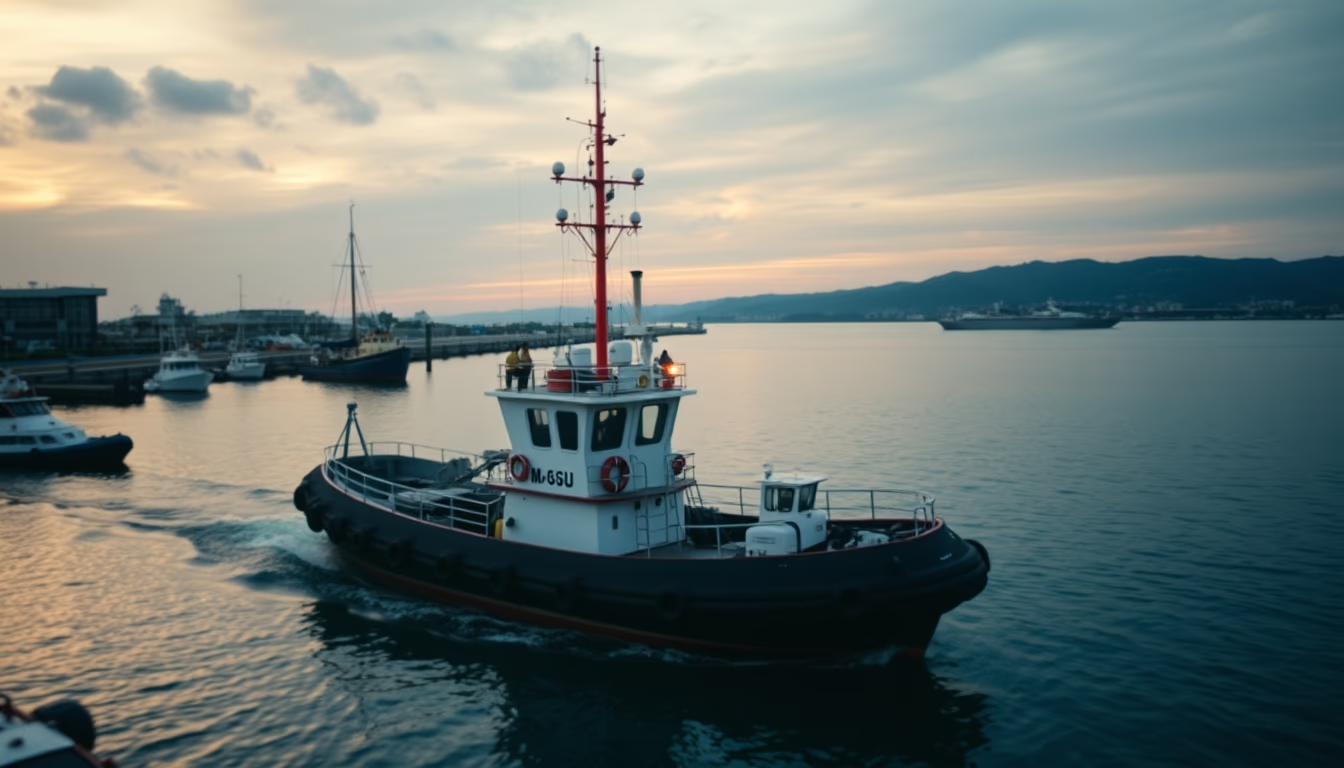
Tugboat working in a busy harbor, essential for maneuvering large vessels and ensuring safe maritime operations.
About this subject
Tugboats are robust and powerful vessels designed to assist large ships in maneuvering within harbors, narrow channels, and docking areas. Their primary function is to provide lateral thrust and directional control, enabling larger vessels to move safely in confined spaces. There are several types of tugboats, including conventional propulsion (with fixed propellers) and modern azimuth stern drive (ASD) tugs, which offer superior maneuverability and omnidirectional thrust. The pulling force of a tugboat, measured in bollard pull, can exceed 100 tons in the most powerful models.
The use of tugboats dates back to the early 19th century, when the first steam-powered tug, the 'Charlotte Dundas', operated on the Forth and Clyde Canal in Scotland in 1802. Since then, technology has evolved significantly. Modern tugs often exceed 5,000 horsepower and are essential for ports like Santos in Brazil and Rotterdam in the Netherlands, which handle massive container ships, tankers, and bulk carriers. Tugboats are also crucial for guiding vessels through locks, such as those in the Panama Canal.
Beyond harbor assistance, tugboats perform ocean towing, firefighting (some are equipped with water cannons), and salvage operations. Their crews are small but highly skilled, working in shifts under demanding conditions. The efficiency and safety of maritime trade rely heavily on these hardworking vessels, which are often underappreciated despite their critical role. Tugboats also serve in icebreaking, offshore supply, and as platforms for specialized equipment like remotely operated vehicles (ROVs) for subsea operations.
Frequently Asked Questions
What is the main function of a tugboat in a harbor?
The main function is to assist large ships in maneuvering within confined spaces like channels and berths, using their pulling and pushing power to control the vessel's direction and speed.
What is the difference between a conventional tug and an ASD tug?
Conventional tugs have fixed propellers and rudders, while ASD (Azimuth Stern Drive) tugs have rotating propellers at the stern, offering superior maneuverability and thrust in any direction without rudders.
Are tugboats used only in ports?
No, they also perform ocean towing, firefighting, salvage, offshore platform support, and even icebreaking in polar regions.
Direct URL
https://pub-c7d6a6ea828543ac903a74a341ccb2e1.r2.dev/imagens/tugboat-working-harbor-cinematic-wide-shot-p3.avifHow to credit
Include a visible link back to UtilizAí. Copy one of the snippets below:
<a href="https://xn--utiliza-eza.com/en/midia/imagens/tugboat-working-harbor-cinematic-wide-shot-p3">Tugboat working harbor</a> by <a href="https://xn--utiliza-eza.com">UtilizAí</a>, licensed under <a href="https://creativecommons.org/licenses/by/4.0/">CC BY 4.0</a>.
[Tugboat working harbor](https://xn--utiliza-eza.com/en/midia/imagens/tugboat-working-harbor-cinematic-wide-shot-p3) by [UtilizAí](https://xn--utiliza-eza.com), CC BY 4.0
License: CC-BY-4.0