Space station futuristic
1344×768 · AVIF · CC BY 4.0
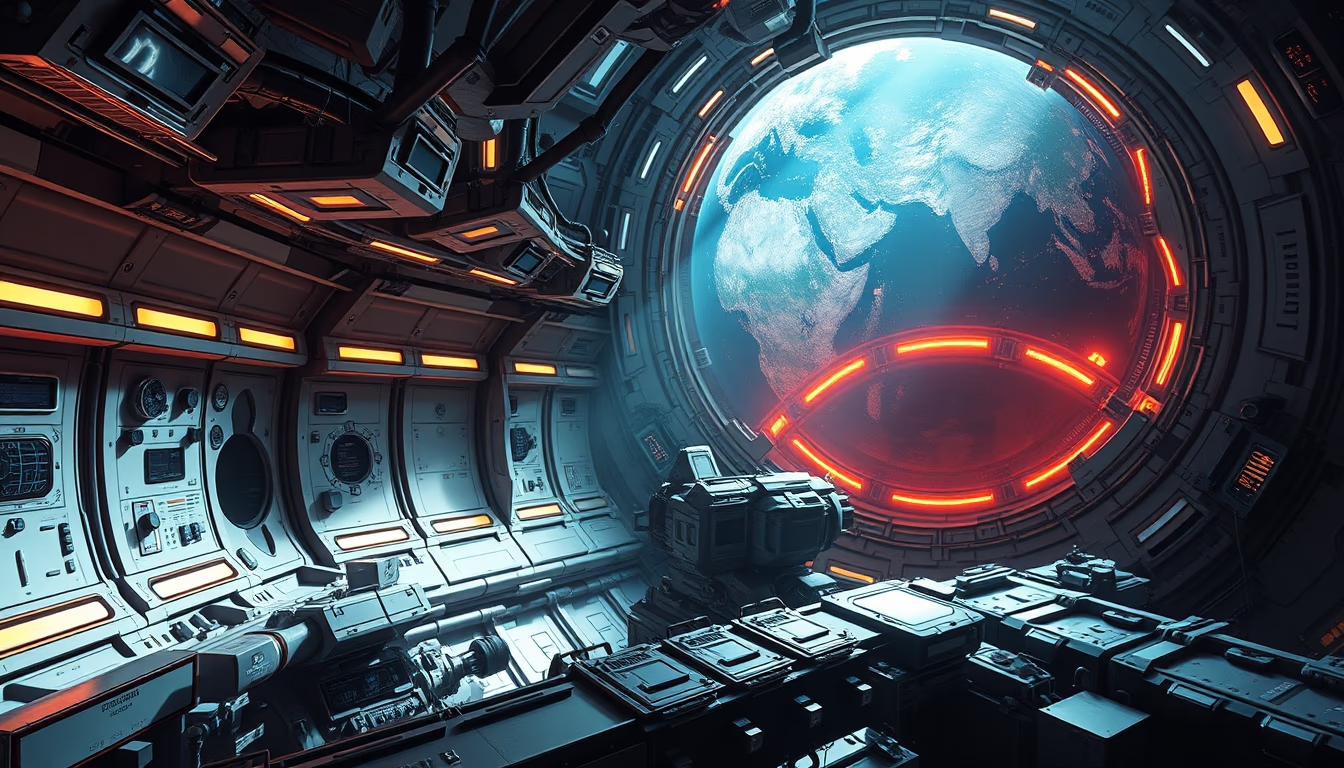
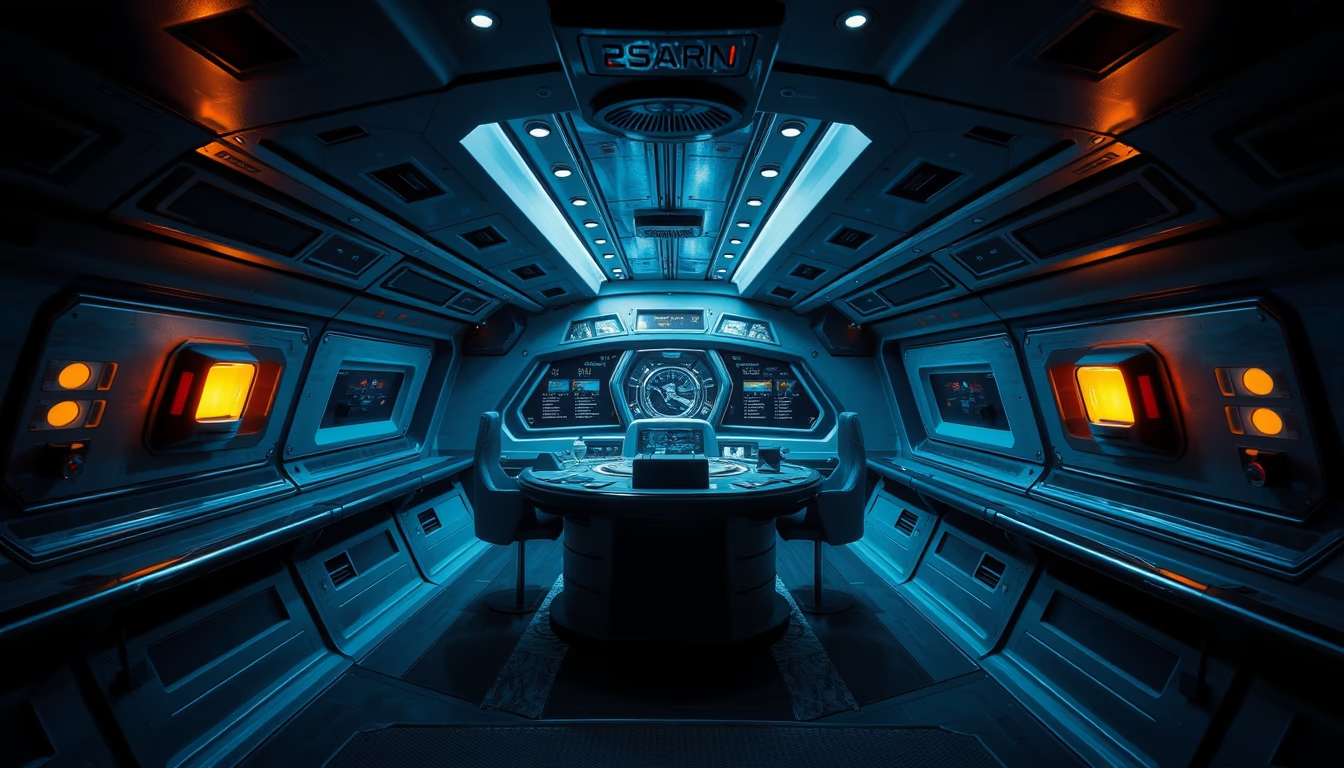
Futuristic space stations combine advanced engineering and architectural vision, designed to sustain human life in orbit for extended periods.
About this subject
Space stations represent one of the most significant milestones of human exploration beyond Earth. The International Space Station (ISS), operational since 1998, is the largest artificial object ever built in space, with a mass of about 420 tons and dimensions equivalent to a football field. Its 16 pressurized modules house microgravity laboratories where scientists study everything from protein crystals to the physiological effects of weightlessness. The project involved 15 nations, cost over 100 billion dollars, and has hosted astronauts from 19 countries.
The future of space stations points to modular and commercial structures. NASA plans the Lunar Gateway, a station in orbit around the Moon scheduled for the 2030s, which will serve as a staging point for surface missions. Companies such as Axiom Space and Bigelow Aerospace are developing inflatable modules and crewed habitats for commercial use, with plans to dock with the ISS before becoming independent stations. China, meanwhile, completed its Tiangong space station in 2022, with three main modules and capacity for three long-duration crew members.
Keeping a space station functional requires complex life support systems: water recycling, oxygen production via electrolysis, CO2 scrubbing, and protection against cosmic radiation. The ISS completes about 16 orbits per day at 28,000 km/h, experiencing 16 sunrises and sunsets in the same period. Internal lighting is adjusted to simulate 24-hour cycles, but the absence of gravity causes the human body to lose bone and muscle mass, requiring two hours of daily exercise. New technologies, such as magnetic radiation shields and rotating artificial gravity systems, are being studied for long-duration missions, such as a future trip to Mars.
Interestingly, the concept of a futuristic space station dates back to 19th-century science fiction works, such as the tales of Konstantin Tsiolkovsky. In the 1950s, Wernher von Braun popularized the rotating wheel design to create artificial gravity. Although no real station has adopted this shape, concepts like the Stanford Torus and the O'Neill Cylinder remain theoretical references for space settlements. The International Space Station, in turn, is visible to the naked eye from Earth on clear nights, passing as a bright, fast point in the sky, reminding us of humanity's constant presence in the vacuum.
Frequently Asked Questions
How do astronauts eat on a space station?
Food is dehydrated and rehydrated with hot water, or thermostabilized in pouches. There are no refrigerators; meals are powdered or pasty, and salt is liquid to prevent floating grains.
What is the difference between the ISS and the Chinese Tiangong space station?
The ISS is an international project with 16 modules, while Tiangong has 3 modules and is operated solely by China. Tiangong is smaller but features newer technologies, such as flexible solar panels and its own robotic arm.
Why don't space stations have artificial gravity?
Creating artificial gravity would require a huge, expensive, and complex rotating structure. So far, costs and risks outweigh benefits for short-duration missions. Studies for future stations with rotating rings are underway.
Direct URL
https://pub-c7d6a6ea828543ac903a74a341ccb2e1.r2.dev/imagens/space-station-futuristic-rembrandt-lighting-dramatic-shadows-fresh1.avifHow to credit
Include a visible link back to UtilizAí. Copy one of the snippets below:
<a href="https://xn--utiliza-eza.com/en/midia/imagens/space-station-futuristic-rembrandt-lighting-dramatic-shadows-fresh1">Space station futuristic</a> by <a href="https://xn--utiliza-eza.com">UtilizAí</a>, licensed under <a href="https://creativecommons.org/licenses/by/4.0/">CC BY 4.0</a>.
[Space station futuristic](https://xn--utiliza-eza.com/en/midia/imagens/space-station-futuristic-rembrandt-lighting-dramatic-shadows-fresh1) by [UtilizAí](https://xn--utiliza-eza.com), CC BY 4.0
License: CC-BY-4.0